This resolution commemorates the 100th anniversary of the Alabama Farmers Federation and recognizes its efforts to promote and advocate for the agricultural and forestry interests of Alabama.
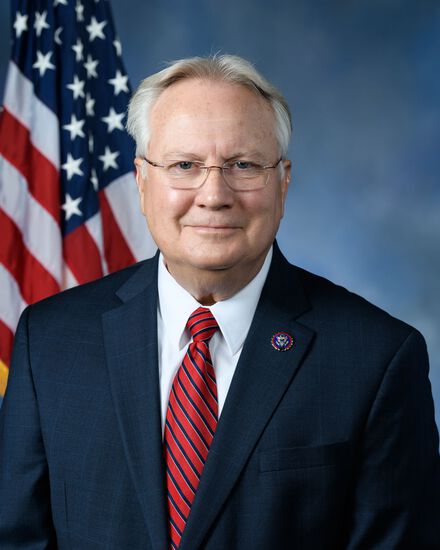
Rep. Jerry L. Carl
Sponsored bills
Community Bank Relief Act of 2021 This bill requires banking agencies to set the community bank leverage ratio between 8% and 8.5% for calendar years 2022, 2023, and 2024 for community banks seeking to satisfy simplified capital adequacy requirements. Currently, banking agencies are statutorily required to set the rate between 8% and 10% through rulemaking. Under current regulations, the rate will increase from 8.5% to 9% on January 1, 2022.
Defund de Blasio's Injection Sites Act of 2021 This bill prohibits federal funds from being made available to a state, local, tribal, or private entity that operates or controls an injection center (i.e., a medically supervised injection site) in violation of the federal statute commonly known as the Crack House Statute. The statute generally prohibits making facilities available for the purpose of unlawfully using a controlled substance.
Eliminating Global Market Distortions to Protect American Jobs Act of 2021 This bill addresses unfair trade practices by making various changes to U.S. antidumping and countervailing duty law. Antidumping provides relief to U.S industries and workers that are materially injured or threatened with injury due to imports of like products sold in the U.S. market at less than fair value, while countervailing duty provides such relief from imports of products subsidized by a foreign government or public entity. Specifically, the bill establishes a process for successive antidumping and countervailing duty investigations. Successive investigations may be concurrent (an ongoing investigation of the same product from different countries) or recently completed (not more than two years before the date of the initiation of the successive investigation). Further, the bill establishes a time line for the Department of Commerce to issue determinations in successive investigations. Among other provisions, the bill authorizes Commerce to apply countervailing duty law to subsidies provided by a foreign government or public entity to a company operating in a different country, use another method for calculating the cost of production in specific circumstances, and require importers to provide a certification that the imported merchandise is not subject to an antidumping or countervailing duty order. Additionally, the bill establishes procedures for Commerce to conduct circumvention inquiries, including by specifying the deadlines for preliminary and final determinations. The bill repeals the Softwood Lumber Act of 2008, which addresses the importation of softwood lumber and softwood lumber products.
Drug Price Transparency in Medicaid Act of 2021 This bill requires pass-through pricing models, and prohibits spread-pricing, for payment arrangements with pharmacy benefit managers under Medicaid. The bill also extends funding for retail pharmacy surveys and requires additional information with respect to price concessions, dispensing fees, and survey participation to be made publicly available.
This bill authorizes the Department of the Interior to take land into trust for all federally recognized Indian tribes. Specifically, the bill applies the Indian Reorganization Act to all federally recognized Indian tribes, regardless of when a tribe became recognized. The amendments made by this bill are retroactively effective as if included in the Indian Reorganization Act. This effectively overrules the Supreme Court's decision in Carcieri v. Salazar, which held that Interior could not take land into trust for a specified tribe because that tribe had not been under federal jurisdiction when the Indian Reorganization Act was enacted in 1934.
Veterans Health Flexibility Act This bill expands eligibility for veterans to receive care through the Veterans Community Care Program (VCCP) by removing existing qualifying criteria. Under the bill, veterans may receive care through the VCCP if they notify the Department of Veterans Affairs that they want care through the program.
Conscience Protection Act of 2021 This bill provides statutory authority for certain protections for health care providers that refuse to participate in abortions based on religious beliefs or other convictions. Health care providers include individual professionals, medical facilities, health insurance organizations, and social services providers that refer clients to health care services. The federal government and entities that receive federal funding for health-related activities, including state and local governments, may not discriminate against a health care provider that refuses to be involved in, or provide coverage for, abortions. Currently, similar requirements apply to various related activities, including certain employment or personnel decisions (the Church Amendments), abortion services training (the Coats-Snowe Amendment), qualified health plans offered through health insurance exchanges, and annual appropriations bills for the Department of Health and Human Services (HHS) and other federal agencies (the Weldon Amendment). The HHS Office for Civil Rights must investigate complaints of this kind of discrimination. Furthermore, HHS may terminate or reduce HHS funding for health-related activities if a person or entity fails to comply with nondiscrimination requirements. Additionally, the Department of Justice or any entity adversely affected by such discrimination may bring a civil action to obtain appropriate relief. A plaintiff does not need to seek or exhaust administrative remedies before bringing the action. A plaintiff may also bring an action, including one for money damages, against a governmental entity. In many cases, principles of sovereign immunity shield states and some localities from these kinds of actions.

Parents Bill of Rights Act This bill outlines various rights of parents and guardians regarding the elementary or secondary school education of their children. Among other requirements, the bill (1) directs local educational agencies to publicly post the curriculum for each elementary and secondary school grade level; and (2) requires schools to notify parents and guardians of their rights, including the right to review the school's curriculum and budget.
This resolution modifies requirements for written statements required of nongovernmental witnesses who appear before standing committees of the House of Representatives. Specifically, the resolution eliminates a requirement that a witness disclose whether they are a fiduciary of an organization or entity that has an interest in the subject matter of the hearing, in favor of a requirement that they disclose whether they are a fiduciary of an entity that has received payments from a specified foreign entity. The resolution also requires nongovernmental witnesses to disclose in their written statement certain contracts with specified foreign persons or entities. If the committee determines that a witness knowingly and willfully failed to truthfully comply with such disclosure requirements, the witness is prohibited from testifying before the committee for three years.