This resolution honors the life and legacy of the late Representative Don Young and directs the Sergeant at Arms to designate a Don Young Reserved Seat on the floor of the chamber of the House of Representatives.
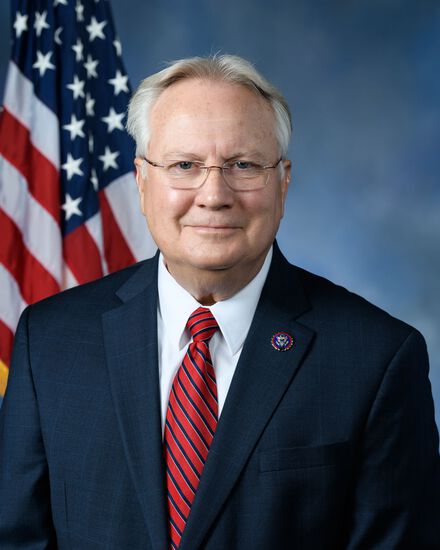
Rep. Jerry L. Carl
Sponsored bills
Equitable Community Access to Pharmacist Services Act This bill expands Medicare coverage to permanently include services provided by a pharmacist, including incidental services and supplies, related to testing, drug regimens, and vaccines for COVID-19, influenza, and certain other illnesses. Specifically, the bill provides for continued coverage of pharmacist services relating to testing and vaccines for COVID-19 and influenza, as well as coverage of testing for respiratory syncytial virus and streptococcal pharyngitis (i.e., strep throat) and the initiation of drug regimens that are used to treat COVID-19, influenza, or strep throat. It also generally provides for coverage of pharmacist services during a public health emergency or to address health equity. A pharmacist, or the facility with which the pharmacist is contracted or employed, may present a claim for reimbursement of 85% (or 100% during a declared emergency) of the applicable amount. A pharmacist may not bill an individual for such a service other than for the applicable deductible or coinsurance amounts.

Earn Your Keep Act This bill requires each executive agency to reinstate the telework policies that were in effect on December 31, 2019. Employees who do not comply with the reinstated policies must be removed from the civil service, and their positions must be eliminated. The Government Accountability Office must report on the locality pay and geographic location of employees who were teleworking during the COVID-19 pandemic.
No Pensions for Lying Bureaucrats Act This bill bars federal employees convicted of making false statements while employed by the federal government from receiving certain federal retirement benefits.
COI Elimination Act This bill limits U.S. contributions to the United Nations pertaining to the U.N. Independent International Commission of Inquiry on the Occupied Palestinian Territory, including East Jerusalem, and Israel. Current law imposes a cap on the annual U.S. contribution to the U.N. budget. The bill lowers that cap by 25% of the amount budgeted for the commission. The bill also states that it shall be U.S. policy to seek the abolition of the commission and combat systemic anti-Israel bias in international bodies.
This resolution celebrates the 200th anniversary of diplomatic relations between the United States and Colombia. The resolution recognizes the vital strategic alliance between the United States and Colombia, built on a shared commitment to democracy. The resolution also celebrates the contributions made by Colombians and Colombian Americans to the United States.
This joint resolution nullifies the rule issued by the Department of Health and Human Services on October 7, 2021, that reverts requirements for federally funded providers of family planning services to those in effect before May 3, 2019, and makes other changes to family planning programs. Specific changes in the rule include (1) removing restrictions on pregnancy options counseling and referrals for abortion services, (2) eliminating requirements for physical and financial separation between abortion-related activities and specified family planning activities, and (3) providing a particular focus on health equity.
This resolution rejects and opposes engaging Russia as a main intermediary for reviving any nuclear agreement with Iran. The resolution rejects and opposes giving Russia any sanctions exemption or waiver as a condition to any nuclear agreement with Iran. The resolution rejects and opposes any agreement that lifts sanctions on Iran and legitimizes the regime's illicit nuclear program amidst an International Atomic Energy Agency investigation into undeclared sites, facilities, and material in Iran. The resolution also reaffirms that any nuclear deal with Iran reached by the Biden administration without congressional approval or Senate ratification as a treaty is illegitimate; to take every legislative opportunity to overturn such an agreement; to restore every single sanction, restrictive measure, designation, waiver, or general license the Biden administration removes; and to limit the Biden administration's or any future administration's ability to issue waivers and licenses for Iran sanctions, designations, or restrictive measures.
This resolution condemns the terrorist attack on Congregation Beth Israel in Colleyville, Texas, on January 15, 2022. It also expresses support for the affected community, commends the actions of law enforcement and emergency responders, and reaffirms a commitment to combat hate, bigotry, anti-Semitism, and violence against Jewish Americans.
American Energy Independence from Russia Act This bill addresses U.S. energy security, the production of oil and gas, and the importation and exportation of oil and gas. Specifically, the President must submit an energy security plan that (1) evaluates U.S. crude oil, petroleum products, and natural gas imports and exports; (2) assesses the energy security risks of such imports; and (3) includes strategies to encourage increased domestic production of crude oil, petroleum products, and natural gas to offset Russian imports. The bill also approves the TransCanada Keystone Pipeline in Phillips County, Montana for the import of oil from Canada to the United States. In addition, the bill grants the Federal Energy Regulatory Commission the authority to approve or deny applications for facilities to export natural gas from the United States to foreign countries or import natural gas from foreign countries. The President and federal agencies must obtain congressional approval before (1) prohibiting or substantially delaying certain new energy mineral leases or permits on federal lands, or (2) withdrawing certain federal lands from mineral and geothermal leasing activities. The Department of the Interior must resume issuing oil and gas leases on federal lands and offshore submerged lands in the Outer Continental Shelf as specified under the bill. Finally, the bill limits the drawdown of petroleum in the Strategic Petroleum Reserve until the Department of Energy develops a plan to increase the percentage of federal lands leased for oil and gas production.