

Maddy summaryHR 4351, the Broadband Internet for Small Ports Act, prioritizes broadband deployment in rural ports by amending the Rural Electrification Act. It gives equal priority to applications that expand broadband access at rural ports - including harbors, marine terminals, and shore facilities - as defined in the bill. The law requires verifying unserved communities using FCC data and site testing, and allows up to 75% grant funding for qualifying projects serving rural areas. Recipients must also provide geolocation data for new broadband infrastructure within 30 days of project completion.
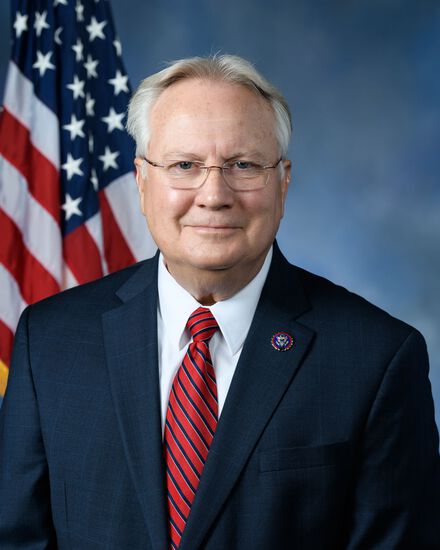
Rep. Jerry L. Carl
Sponsored bills
Maddy summaryHR 5130, the "Finish It Act," requires the Department of Defense to use stored border wall construction materials (valued at approximately $300 million) for building permanent barriers along the U.S.-Mexico border within 30 days of the bill's enactment. It mandates that states receiving materials certify they will use them exclusively for border barriers, with penalties for unused materials (requiring repayment of the original cost) and imposes a 1% budget cut for every two days of delay in implementation. The bill also demands a detailed report from the Department of Defense within 90 days, including internal communications about storage costs and contracts with private landowners. This legislation directly affects the Department of Defense and border states, focusing on redirecting existing resources rather than creating new funding or construction.
Maddy summaryThe AQUAA Act establishes a regulatory framework for sustainable offshore aquaculture in U.S. waters, creating "aquaculture opportunity areas" in the exclusive economic zone. It requires aquaculture management plans for these areas and sets up a permitting process for offshore facilities, including environmental monitoring and contingency planning requirements. The bill includes provisions for research and development grants to support sustainable aquaculture technology, economic development programs for coastal communities, and protections for marine ecosystems and wild fish stocks. It directly affects offshore aquaculture operators, coastal communities, and federal agencies responsible for regulation, including the Department of Commerce and National Oceanic and Atmospheric Administration. The act aims to expand domestic seafood production through sustainable offshore aquaculture while supporting job creation in the seafood industry.
Maddy summaryThe Forest Data Modernization Act of 2023 updates the U.S. Forest Service's national forest inventory program to improve data collection on forest resources, with specific focus on forest carbon. It mandates new surveys of timber products and woodland owners, standardizes definitions for forest data reporting, and requires the Forest Service to develop a strategic plan every five years integrating remote sensing technology and carbon data (including soil carbon). The bill ensures collected data is publicly accessible while protecting the confidentiality of individual landowners' non-aggregated information. These changes aim to enhance the accuracy of forest resource tracking for management and policy decisions across public and private lands.
Maddy summaryHR 4922, the Lacey Act Amendments of 2023, establishes a new rule that generally prohibits importing non-native wildlife species (including mammals, birds, fish, amphibians, and reptiles) into the U.S. unless they were imported in "more than minimal quantities" during the year before the law passed or the Secretary of the Interior determines they pose no significant invasion risk. This directly affects importers and businesses handling non-native wildlife, requiring them to meet specific criteria to legally import such species. The bill also grants the Secretary emergency authority to immediately ban imports of a species deemed an imminent threat to humans, agriculture, or wildlife, with a 3-year limit on such bans. The new rules take effect one year after enactment, with the Secretary required to define "minimal quantities" within that timeframe.
Maddy summaryThis bill expands employee ownership in S corporations by extending tax deferral for selling company stock to employee ownership plans (ESOPs), creating a Treasury Department office to provide education and technical assistance for ESOPs, and amending small business rules to maintain eligibility for government programs after ESOP ownership exceeds 49%. It establishes a new Labor Department "Advocate for Employee Ownership" to coordinate federal efforts, educate stakeholders, and recommend policy improvements. The bill directly affects S corporations using ESOPs, their employees who become owners, and small businesses that might lose government program access due to ESOP acquisitions. Key provisions include tax incentive extensions, new support offices, and updated small business classification rules.
Maddy summaryHR 4470 extends the authorization of the Chemical Facility Anti-Terrorism Standards Program (CFATS) under the Department of Homeland Security until September 30, 2025, instead of the previous expiration date of July 27, 2023. This bill directly affects DHS, which administers the program, and chemical facilities subject to its security standards. The key mechanism is a simple date extension for the existing program, maintaining current security requirements for facilities handling hazardous chemicals without introducing new rules or funding changes.
Maddy summaryThis bill directs the U.S. Treasury to mint commemorative coins marking the Marine Corps' 250th anniversary in 2025. It authorizes three coin types: $5 gold coins (max 50,000), $1 silver coins (max 400,000), and half-dollar coins (max 750,000), with surcharges of $35, $10, and $5 respectively. The surcharge proceeds will fund the Marine Corps Heritage Center's educational programs, with no net cost to taxpayers as the Treasury must recover all minting costs through the surcharges. The coins can only be issued during 2025, and the Treasury must ensure all costs are covered before distributing funds to the Heritage Foundation.
Maddy summaryThis bill amends the Wilderness Act to explicitly permit U.S. Customs and Border Protection (CBP) to access wilderness areas for border security purposes. It allows CBP to conduct specific activities including building roads and barriers, using motor vehicles and aircraft, conducting patrols, and deploying technology within designated wilderness areas. The bill requires CBP to carry out these activities "to the extent possible" in a way that protects the wilderness character of the land. The direct effect is on wilderness areas (such as national parks and protected lands) and CBP's operational authority within them.
Maddy summaryHR 4721, the Main Street Tax Certainty Act, makes a permanent the 20% tax deduction for eligible small business owners under Section 199A of the tax code. This provision directly affects pass-through business owners (like S-corps, partnerships, and sole proprietorships) who qualify for the deduction. The bill achieves this by removing the temporary expiration language (subsection (i)) from the existing tax code provision. The key change is ending the need for annual congressional extensions of this deduction, providing long-term tax certainty for small businesses.