Maddy summaryHR 6449, the "DO NOT Call Act," amends the Telephone Consumer Protection Act of 1993 to strengthen penalties for illegal robocalls. It increases criminal penalties for willful violations to up to one year in prison (or three years for aggravated offenses like repeated high-volume calls or calls intended to support felonies), and raises fines for inaccurate caller identification from $10,000 to $20,000 per violation. The bill directly affects businesses and entities making unsolicited calls without consent, including those using auto-dialers or prerecorded messages. Key provisions define "calls" broadly to include unsolicited texts sent via auto-dialers without prior permission.
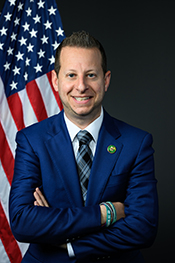
Rep. Jared Moskowitz
Sponsored bills
Maddy summaryThis bill (HR 6469) requires the U.S. State Department, in coordination with the FCC and Treasury, to submit a report within 120 days of enactment assessing internet access options in Iran. The report must evaluate the feasibility of using direct-to-cell wireless technology to expand internet access there, including technical, security, and regulatory considerations. It also analyzes how drone-based systems and signal jamming could affect such technology, surveys Iranian telecom providers (including state ownership and foreign investment), and examines broader implications for communications freedom. The bill does not enact new policy but mandates a government review of potential technological solutions.
Maddy summaryThis bill would amend the Anti-Terrorism Act of 1987 to designate the Muslim Brotherhood as a terrorist organization and prohibit its operations within the United States. It would require the President to designate the Muslim Brotherhood as a foreign terrorist organization under immigration law and impose new visa restrictions, including immediate revocation of current visas, for individuals identified as members. The bill mandates annual reports from the Secretary of State identifying Muslim Brotherhood branches worldwide and determining which should be designated as terrorist organizations under existing laws. These provisions would directly affect Muslim Brotherhood members, branches, and affiliated organizations seeking entry to or operating within the United States.
Maddy summaryThis bill requires U.S. agencies maintaining federal sanctions lists to notify each other within 30 days when an individual or entity is added to one list, then review whether they should be added to other lists within 90 days. It applies to six specific sanctions lists, including Treasury’s blocked persons list, Commerce’s Entity List, and Defense’s military end-user list. Agencies must report to Congress within one year on how they implemented the coordination process and whether it led to additional sanctions. The goal is to prevent gaps where sanctioned parties could evade restrictions by operating outside a single list’s scope.
Maddy summaryHR 1848, the Houthi Human Rights Accountability Act, requires the U.S. State Department and USAID to submit three reports within 180 days of enactment: one on Houthi indoctrination efforts in Yemen, one on obstacles to humanitarian aid in Houthi-controlled areas, and one on human rights abuses committed by the Houthis (including child soldier recruitment and enforced disappearances). The bill mandates annual sanctions determinations under existing laws against Houthi members who restrict aid or commit human rights violations. It directly targets the Houthi group (Ansarallah) in Yemen, focusing on accountability for their actions. The legislation expires five years after enactment.
Give Kids a Chance Act of 2025 This bill expands the Food and Drug Administration’s (FDA’s) authority with respect to research on rare pediatric diseases, including by permitting the FDA to take enforcement action against drug sponsors that fail to satisfy pediatric study requirements and by reauthorizing programs that support pediatric research. Specifically, the bill modifies requirements relating to molecularly targeted pediatric cancer investigations to permit research on new drugs in combination with active ingredients that have already been approved, provided certain conditions are met; permits the FDA to take enforcement action against drug sponsors that fail to comply with pediatric study requirements, if such sponsors demonstrated a lack of due diligence in satisfying the requirement; renews the FDA’s authority to award priority review vouchers to sponsors of new products intended to treat rare pediatric diseases through September 30, 2029; and reauthorizes through FY2027 certain funding for the National Institutes of Health to support priority pediatric research. The bill also provides statutory authority for the FDA’s interpretation of the orphan drug exclusivity period. The bill specifies, consistent with FDA regulations, that the seven-year market exclusivity period for drugs for rare diseases or conditions (i.e., orphan drugs) prohibits the approval of the same drug for the same approved use or indication with respect to the disease or condition. (In Catalyst Pharmaceuticals, Inc. v. Becerra , a court rejected the FDA’s interpretation and held that orphan drug exclusivity extends to all uses or indications for the disease or condition.)

Maddy summaryThis bill ensures FEMA can continue disaster relief payments during government funding gaps. It requires the agency to keep using existing Disaster Relief Fund money for active disaster assistance, emergency aid, and recovery programs - even if Congress hasn’t passed new funding. Essential staff handling these disbursements are protected from furloughs during such gaps, treated as "excepted" under federal law. The bill directly affects disaster victims receiving aid and FEMA employees managing relief operations during budget lapses.
Maddy summaryHR 5652, the Wildfire Recovery Act, increases federal reimbursement for wildfire response by setting a minimum 75% federal cost share under Section 420 of the Stafford Act, directly benefiting states, local governments, and Tribal governments that deploy firefighting resources. It requires FEMA to develop rules within three years to determine when the federal share could exceed 75% based on a state's financial impact from wildfires. The bill also updates FEMA policy to allow reimbursement for predeployment of fire assets (like crews or equipment) before a fire occurs. These changes aim to provide more predictable and timely federal support for wildfire recovery efforts.
Maddy summaryHR 6249, the "Addressing Addiction After Disasters Act," updates federal disaster relief guidelines to explicitly include substance use and alcohol use disorders in crisis counseling services. It amends the Robert T. Stafford Disaster Relief Act to allow FEMA-funded programs to address these issues alongside mental health needs for disaster survivors. The bill requires FEMA to revise application forms and guidance within 180 days to reflect these changes and mandates a GAO report on program duration and compliance with using funds only for disaster-related substance/alcohol issues. This directly affects disaster survivors facing substance use or alcohol challenges by expanding access to covered support services.
Maddy summaryHRES 905 is a non-binding House resolution supporting the designation of November 2025 as "National Homeless Children and Youth Awareness Month." It does not create new programs or funding but formally encourages businesses, governments, schools, and organizations to raise awareness about homelessness affecting children and youth during that month. The resolution cites statistics on homelessness rates among students and youth (e.g., 1.4 million enrolled homeless children in 2022-2023) to underscore the need for greater public attention. It urges these groups to highlight causes, solutions, and prevention efforts during the designated month.