

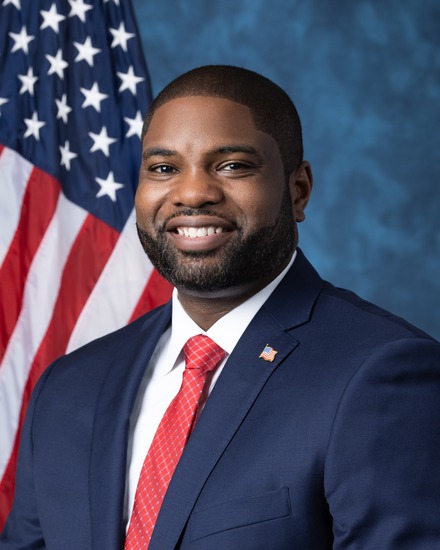
Photo of Byron Donalds
R United States House · District 19 · Florida

Rep. Byron Donalds

Compare
Total votes
2,818
all sessions
Attendance
94%
174 missed
Lower than 87% of chamber peers
With party
90%
of cast votes
Lower than 91% of chamber peers
Bipartisan score
5%
crosses aisle rarely
Higher than 90% of chamber peers
Sponsored
1,457
bills & resolutions
Near the chamber average
Committees
6
assignments
1,457 bills and resolutions

Sponsored bills

Total
1,457
Primary
142
Co-sponsor
1,315
This page
1,457
matching current filters
Co-sponsor HR 7678
In committee · Texas House · Co-sponsor
Gun Owner Registration Information Protection Act

Maddy summaryHR 7678, the Gun Owner Registration Information Protection Act, prohibits federal funding for state or local databases that track lawfully owned firearms or their owners. The bill allows federal funding for databases recording lost or stolen firearms but bans it for databases listing legal gun ownership. This means states cannot use federal money to create or maintain systems that compile information about legally owned guns. The bill directly affects state and local governments that rely on federal funds for firearm ownership databases.

In committee Feb 25, 2026 1 co-sponsor
Co-sponsor HR 1319
In committee · Texas House · Co-sponsor
Modern Worker Empowerment Act

This bill specifies a legal standard for determining whether an individual is considered an independent contractor rather than an employee for the purposes of federal labor laws that address issues such as the federal minimum wage, overtime compensation, and collective bargaining. The rights and protections provided by these laws exclusively apply to employees. Under the bill, an individual is considered an independent contractor if (1) another individual or entity does not exercise significant control over the details of how the individual's work is performed, without regard to any control the other individual or entity may exercise over the final result of the work performed; and (2) while performing such work, the individual has opportunities and risks inherent with entrepreneurship (for example, the discretion to exercise professional judgment). The bill also sets forth factors that may not be used to determine whether an individual is an employee. Specifically, factors such as whether another individual or entity requires the individual to meet certain legal, health and safety, insurance, or performance requirements may not be used to make such a determination.

In committee Feb 20, 2026 1 co-sponsor
Co-sponsor HR 1028
In committee · Texas House · Co-sponsor
Protection of Women in Olympic and Amateur Sports Act of 2026

Protection of Women in Olympic and Amateur Sports Act This bill requires certified national governing bodies (NGBs) of amateur sports (e.g., USA Gymnastics) to prohibit a person whose sex is male from participating in an amateur athletic competition that is designated for females, women, or girls. Under the bill, male  means an individual who has, had, will have—or would have, but for a developmental or genetic anomaly or historical accident—the reproductive system that at some point produces, transports, and utilizes sperm for fertilization.

In committee Feb 17, 2026 1 co-sponsor
Co-sponsor HR 7534
In committee · Texas House · Co-sponsor
Contract Our Veterans Act of 2026

Maddy summaryThe Contract Our Veterans Act of 2026 establishes new federal contracting preferences for small businesses owned and controlled by veterans. It allows agencies to award contracts above the simplified acquisition threshold without competition to qualified veteran-owned businesses if they meet performance, pricing, and value criteria, and creates restricted competitions exclusively for these businesses. The bill sets a mandatory governmentwide goal of at least 5% of all federal prime and subcontract awards going to veteran-owned small businesses each fiscal year. It also amends reporting requirements to track these contracts separately across agencies, including through sole-source awards and restricted competitions. This directly affects veteran-owned small businesses seeking federal contracts and federal agencies responsible for procurement.

In committee Feb 12, 2026 1 co-sponsor
Co-sponsor HR 7548
In committee · Texas House · Co-sponsor
SCAM Act

Maddy summaryThe SCAM Act requires online platforms that display paid advertisements (like social media sites) to verify advertiser identities, implement scam detection systems, and remove fraudulent ads within 24 hours of confirmation. It directly affects platforms that accept payment for ads, targeting scams such as fake giveaways, romance scams, and AI impersonations that cost consumers $195 billion in 2024 (per FTC data). Key mechanisms include mandatory identity checks for advertisers, active monitoring systems, and a 72-hour investigation window for reported scams. The law aims to reduce fraud by shifting responsibility to platforms, with enforcement by the FTC and state attorneys general.

In committee Feb 12, 2026 1 co-sponsor
Co-sponsor HR 34
In committee · Texas House · Co-sponsor
LASSO Act

Maddy summaryThe LASSO Act requires 10% of annual revenue generated from public lands managed by the Interior Department and Agriculture Department (including national forests and Outer Continental Shelf areas) to be deposited into the Social Security Trust Fund. This directly affects the Social Security Trust Fund by increasing its funding, while ensuring no fee hikes for public land activities or reductions in funds for states, tribes, or local governments. The bill mandates this transfer annually without altering existing revenue-sharing agreements or pricing structures. It aims to bolster Social Security finances through a specific, measurable mechanism tied to federal land management.

In committee Feb 10, 2026 1 co-sponsor
Co-sponsor HR 5438
In committee · Texas House · Co-sponsor
Incentivize Savings Act

Maddy summaryThis bill modifies federal budget rules for unspent agency funds. It requires federal agencies to allocate 49% of unused funds to the next fiscal year, 49% toward paying the national debt, and 2% for retention bonuses (capped at 10% of an employee's base pay). Agencies must also limit future budget requests to the previous year's amount adjusted for inflation. The bill directly affects all executive branch agencies (excluding the Red Cross), altering how they manage leftover budget authority. It does not create new savings programs for individuals but changes government fiscal management procedures.

In committee Feb 4, 2026 1 co-sponsor
Co-sponsor HR 3699
In committee · Texas House · Co-sponsor
Energy Choice Act

Maddy summaryThis bill prevents state or local governments from banning or restricting energy connections (like installation, modification, or access) based on the type or source of energy, such as electricity, natural gas, or renewable fuels. It directly affects consumers choosing energy providers and energy companies seeking to offer services. The key provision prohibits local laws, regulations, or policies that limit energy services sold in interstate commerce, covering all energy types listed in the bill’s definitions. It does not create new programs but limits regulatory authority at the state or local level. The law aims to ensure open access to diverse energy sources without source-based restrictions.

In committee Feb 4, 2026 1 co-sponsor
Co-sponsor HR 7300
In committee · Texas House · Co-sponsor
Make Elections Great Again Act

Maddy summaryThe Make Elections Great Again Act (HR 7300) would require voters to present photo identification to cast ballots in person or by mail for federal elections, with limited exceptions for religious objections or military voters. It would establish new requirements for proving U.S. citizenship during voter registration, including documentary proof of citizenship and proof of state residency. The bill would change mail-in ballot procedures by requiring voters to request mail-in ballots (rather than universal mail-in voting), implementing barcode tracking for mail-in ballots, and setting strict deadlines for ballot receipt. These provisions would apply to all states for federal elections held in 2027 or later, affecting how voters register, vote in person, and submit mail-in ballots for federal office elections.

In committee Feb 2, 2026 1 co-sponsor
Showing 61 to 70 of 1,457 bills
Previous 1 6 7 8 146 Next