

Maddy summaryThis bill amends the Social Security Act to provide work incentives for Purple Heart recipients receiving disability benefits. It removes the standard earnings penalty that would reduce benefits when veterans earn above the "substantial gainful activity" (SGA) threshold, instead allowing benefits to continue with a reduced rate ($1 reduction for every $4 earned above the threshold, but not below $0). It also specifically applies a higher SGA earnings limit to Purple Heart recipients under Social Security disability rules. The changes affect veterans who received a Purple Heart for a service-connected injury and are currently receiving Social Security disability benefits. The bill takes effect six months after enactment.
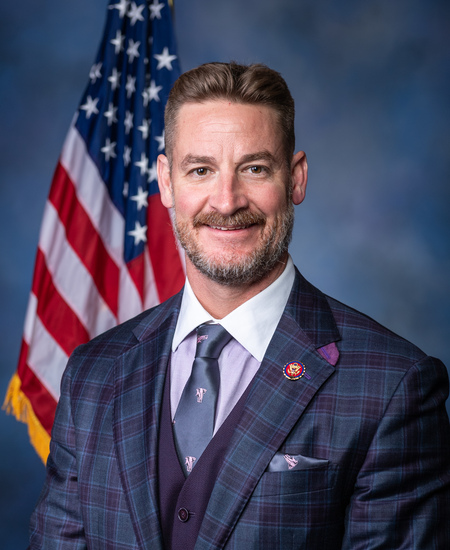
Rep. W. Gregory Steube
Sponsored bills
Maddy summaryHR 7122, the Ensuring Consistency in Nutrition Labels Act, requires food manufacturers to ensure their product labels accurately reflect nutrient content within a 5% tolerance. If actual nutrient levels exceed the declared amount by more than 5% for specific nutrients (like calories or fat), the food would be considered "misbranded" under federal law. The bill mandates the FDA to update its labeling regulations within 60 days of enactment to implement this 5% deviation rule. This directly affects food producers who must comply with stricter labeling accuracy standards for nutrient declarations on packaging.
Maddy summaryHR 7097, the "No American Benefits Abroad Act," bans individuals receiving means-tested welfare benefits from sending money abroad via international wire transfers. The bill requires wire transfer providers to verify in writing whether a customer receives public assistance (like SNAP or TANF) before processing any international transfer. It directly affects people enrolled in income-based welfare programs who might otherwise send funds overseas. The law focuses on preventing public assistance funds from being used for international transfers, without altering eligibility for benefits.
Maddy summaryHR 2617, the "Say No to Indoctrination Act," amends the Elementary and Secondary Education Act to prohibit public K-12 schools receiving federal funds from teaching "concepts related to gender ideology" as defined in Executive Order 14168. The bill adds this specific restriction to Section 8526 of the ESEA, directly affecting curriculum content in federally funded schools. This policy change would require schools to avoid instructional materials or lessons addressing gender identity concepts as defined by the referenced executive order.
Maddy summaryHR 2516, the Accreditation for College Excellence Act of 2025, prohibits accreditation agencies from requiring colleges to support specific political views, ideologies, or partisan positions. It explicitly prevents agencies from assessing institutions based on their commitment to any ideology or requiring adherence to statements of faith for religious institutions. The bill also limits federal criteria for accreditation to only what is necessary, ensuring colleges comply with their accreditor’s standards - not additional unrelated requirements. This directly affects all colleges seeking federal funding through accredited programs by clarifying permissible accreditation standards.
Maddy summaryHR 909, the Crime Victims Fund Stabilization Act of 2025, modifies how funds from the False Claims Act are deposited into the Crime Victims Fund. It specifies that from 2025 through 2029, certain False Claims Act proceeds (specifically those for qui tam plaintiff payments and government damage reimbursements) cannot be deposited into the fund. This change directly affects the composition of the Crime Victims Fund by excluding these specific revenue streams during the specified period. The bill does not create new benefits or alter victim services; it only adjusts fund allocation rules for existing False Claims Act revenues.
Maddy summaryHRES 987 is a symbolic House resolution denouncing Venezuela's Nicolás Maduro as an "authoritarian, despotic, and murderous regime" and commending former President Trump for ordering a January 3, 2026, operation to arrest Maduro. It references prior congressional efforts to address Maduro's alleged human rights abuses and election interference. The resolution expresses support for the operation described as targeting Maduro's "brutal narcoterrorism and crimes against humanity." As a non-binding resolution, it does not create new policy but serves as a formal statement of congressional position.
Maddy summaryHRES 984 is a symbolic resolution designating January 9, 2026, as "National Law Enforcement Appreciation Day." It directly honors all federal, state, local, and tribal law enforcement officers across the United States for their service and sacrifices. The resolution expresses the House's support and gratitude, encourages public observance through ceremonies, and recognizes officers who have made the ultimate sacrifice. As a non-binding resolution, it does not create new laws or policies but serves as a formal expression of appreciation.
Maddy summaryHR 3492, the Protect Children’s Innocence Act, makes it a federal crime to perform genital or bodily mutilation or chemical castration on minors under 18, except for specific medical reasons. The bill broadly defines prohibited procedures to include gender transition-related surgeries (like hysterectomies or mastectomies) and medical treatments such as puberty blockers or cross-sex hormones administered to minors. It criminalizes these acts when they occur across state lines, involve payments, or use interstate commerce, while explicitly banning religious tradition as a defense. Exceptions include medically necessary procedures for health emergencies, childbirth, or conditions certified by a physician.
Maddy summaryHR 498, the "Do No Harm in Medicaid Act," prohibits federal Medicaid funding for gender transition procedures for individuals under 18 years old. The bill amends the Social Security Act to define "specified gender transition procedures" broadly, including surgeries, hormone treatments, and certain medications, and bans federal Medicaid coverage for these services for minors. Exceptions are made only for medically necessary treatments related to precocious puberty, genetic disorders of sex development, or urgent medical conditions requiring bodily correction (like infections or injuries from prior procedures). This directly affects minors enrolled in Medicaid state plans, as states would no longer receive federal funds for these specific covered services.