

Maddy summaryHRES 431 is a symbolic resolution recognizing the Arctic Council’s role as a key forum for international cooperation on Arctic issues. It reaffirms the U.S. commitment to active participation in the Council, highlights the importance of Indigenous involvement, and urges sustained diplomatic engagement - including support for the U.S. Arctic Ambassador role - amid geopolitical shifts like Russia’s suspension from Council activities. The resolution does not create new laws or funding but expresses support for existing U.S. leadership in Arctic diplomacy.
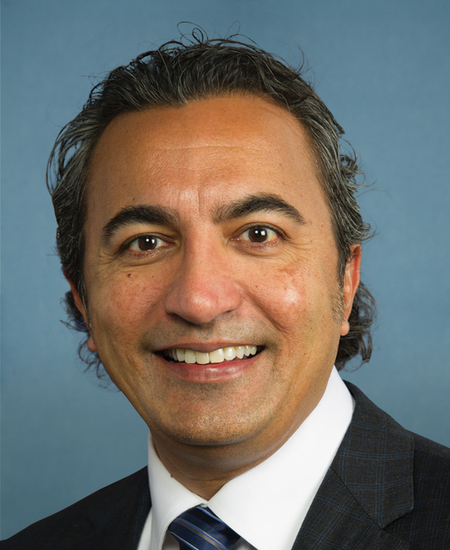
Rep. Ami Bera
Sponsored bills
Maddy summaryThe Strengthening the Quad Act directs the U.S. State Department to create a strategy within 180 days for deepening cooperation with the Quad (U.S., Australia, India, and Japan), covering democratic leadership, current initiatives (like infrastructure, climate, and supply chains), and barriers to collaboration. It also establishes a formal Quad Inter-Parliamentary Working Group, requiring the U.S. to form a congressional delegation of up to 24 members (split evenly between House and Senate, with committee representation) to meet annually with Quad counterparts. The strategy must include specific recommendations for Congress to address obstacles and secure new resources for Quad initiatives. This bill directly affects U.S. foreign policy coordination with Quad nations and congressional committees overseeing foreign affairs.
Maddy summaryHR 3452, the "Six Assurances to Taiwan Act," formally codifies six longstanding U.S. policy commitments regarding Taiwan that were established in 1982. It reaffirms that the U.S. has never agreed to set a date for ending arms sales to Taiwan, consult with China on such sales, mediate between Taiwan and China, revise the Taiwan Relations Act, take a position on Taiwan's sovereignty, or pressure Taiwan to negotiate with China. The bill’s key mechanism requires the President to notify Congress before taking any action that could alter these assurances, giving Congress 30 days (or 60 days during a specific period) to review proposals through a joint resolution process. This applies to actions like pausing arms sales, negotiating with China on arms, or changing U.S. policy on Taiwan’s status. The bill directly affects U.S. executive branch decisions on Taiwan policy and Congressional oversight authority.
Maddy summaryHR 3413, the Physician and Patient Safety Act, requires the Health and Human Services Secretary to create regulations ensuring physicians with hospital privileges receive a fair hearing and appeal process before any termination, restriction, or reduction of their professional activity or privileges at a hospital. The regulations must prevent hospitals from denying these hearings through third-party contracts, prohibit requiring physicians to waive their hearing rights as an employment condition, and keep hearings confidential unless there is an ongoing patient safety threat or data bank reporting is legally required. This directly affects physicians who hold hospital medical staff privileges and hospitals that grant or manage those privileges. The regulations must be finalized within 18 months of the bill's enactment. The bill focuses on procedural due process for physicians, not on altering clinical standards or patient care outcomes.
Maddy summaryHR 3328 establishes a new U.S. Ambassador-at-Large for Arctic Affairs within the State Department, appointed by the President with Senate approval. The position coordinates U.S. foreign policy across federal agencies on Arctic issues including environmental protection, indigenous engagement, resource management, security, and scientific research. The ambassador reports directly to the Secretary of State and oversees efforts related to the eight Arctic Council nations and the defined Arctic region (including northern U.S. territories and Arctic waters). This bill creates a dedicated diplomatic role to streamline U.S. coordination on Arctic matters rather than changing existing laws or affecting specific constituencies directly.
Maddy summaryHR 3332, the Pacific Partnership Act, requires the U.S. President to develop a formal strategy for engagement with Pacific Island nations by 2026 and again by 2030. The strategy must outline U.S. diplomatic, defense, and economic goals; assess regional threats like natural disasters and foreign military activity; and detail resource plans for addressing these challenges. It mandates consultation with Pacific Island governments, regional organizations like the Pacific Islands Forum, and U.S. allies such as Australia and Japan. The bill does not create new programs but establishes a structured framework for U.S. policy coordination in the region, directly affecting U.S. government agencies and indirectly shaping U.S. relations with Pacific Island nations.
Maddy summaryHRES 400 is a ceremonial resolution recognizing May as Asian American, Native Hawaiian, and Pacific Islander Heritage Month. It formally celebrates the historical contributions of these communities to U.S. history and society, as documented in the resolution’s preamble. The resolution does not create new laws, allocate funding, or change policies - it serves solely as a symbolic acknowledgment by the House of Representatives. It highlights the diversity of these communities and their ongoing impact, referencing their growth, cultural milestones, and historical challenges. This recognition aligns with the existing statutory designation of May for Heritage Month under U.S. Code.
Maddy summaryHR 3277, the Ensuring Lasting Smiles Act, requires group health plans and health insurance issuers to cover medically necessary outpatient and inpatient treatments for congenital anomalies or birth defects primarily affecting the eyes, ears, teeth, mouth, or jaw. This includes reconstructive procedures, dental/orthodontic support during treatment, and follow-up care, but excludes purely cosmetic surgery not tied to a medical diagnosis. Cost-sharing (like copays) for these services must not be stricter than for other medical benefits. The law takes effect for plan years beginning January 1, 2026, and mandates insurers to provide notice about this coverage to beneficiaries.
Maddy summaryHR 3243, the Therapeutic Fraud Prevention Act of 2025, bans the provision of paid conversion therapy aimed at changing a person's sexual orientation or gender identity, and prohibits advertising such therapy as effective, safe, or without risk. It directly affects LGBTQ+ individuals and their families who might be targeted by these practices, as professionals have determined conversion therapy is ineffective and harmful. The law treats violations as deceptive acts under consumer protection laws, empowering the Federal Trade Commission and state attorneys general to enforce it through civil actions. It explicitly excludes legitimate gender transition support and non-discriminatory counseling from the ban.
Maddy summaryThis bill amends the TAIPEI Act to clarify that UN Resolution 2758 does not address Taiwan's representation in international organizations or Taiwan's sovereignty. It directs U.S. officials in international bodies to actively resist China's efforts to distort policies affecting Taiwan's participation and to advocate for Taiwan's meaningful engagement. The bill also requires the U.S. government to report on China's attempts to undermine Taiwan's international partnerships and observer status. These provisions aim to strengthen Taiwan's ability to participate in global organizations without altering its political status.