

Maddy summaryThis bill expands eligibility for federal TIFIA loans to include most airport infrastructure projects, such as new terminals, security systems, or surface transportation links, regardless of revenue generation or public access. It raises the maximum loan amount from $75 million to $100 million and removes certain eligibility barriers for airport projects seeking loan waivers. The changes directly affect airport authorities and developers seeking federal financing for aviation facility construction or upgrades. Key provisions clarify that projects enhancing air transportation safety, passenger movement, or airport operations qualify under TIFIA. The bill modifies existing transportation law to simplify access to federal credit for airport infrastructure.
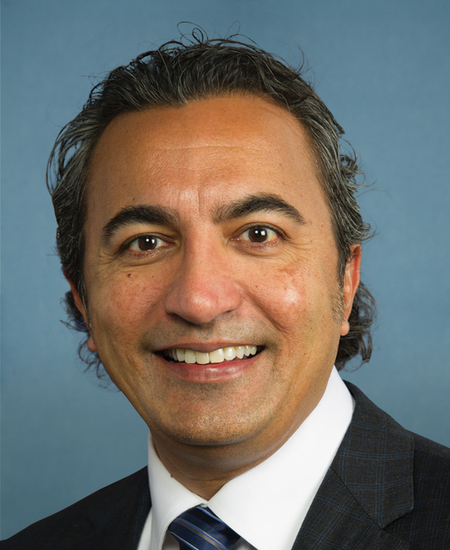
Rep. Ami Bera
Sponsored bills
Maddy summaryHR 6181, the John Lewis Every Child Deserves a Family Act, prohibits child welfare agencies receiving federal funds from discriminating against children, youth, or prospective foster/adoptive parents based on religion, sex (including sexual orientation and gender identity), or marital status. It directly affects LGBTQ youth in foster care - overrepresented at 30% of the system - who face higher risks of trauma, group home placements, and suicide attempts compared to non-LGBTQ peers. Key provisions require agencies to collect data on sexual orientation and gender identity, establish a National Resource Center for LGBTQ youth support, provide cultural competency training, and eliminate discriminatory practices. The law aims to improve safety, permanency, and placement stability by expanding access to family-based care and ensuring equitable services for all children in the system.
Maddy summaryThis bill would require Medicare to cover early detection screening tests for Alzheimer's disease and related dementias starting January 1, 2028. It defines eligible tests as FDA-cleared genomic blood tests, blood product analyses, or equivalent medical imaging methods (like protein expression or whole genome sequencing) that detect pre-symptomatic or early-stage conditions. Medicare beneficiaries would receive this coverage without cost-sharing for these specific screenings. The bill amends Medicare coverage rules to explicitly include these tests under Section 1861(nnn) of the Social Security Act.
Maddy summaryHR 6126 authorizes the minting of commemorative coins to mark the 100th anniversary of the U.S. Foreign Service (established in 1924). It specifies three coin types: up to 50,000 $5 gold coins (90% gold), 400,000 $1 silver coins (90% silver), and 750,000 half-dollar coins, all to be sold during 2029. A surcharge of $35 per gold coin, $10 per silver coin, and $5 per half-dollar is added to the sale price, with all surcharge funds directed to the Association for Diplomatic Studies and Training to support its diplomatic history preservation work. The coins must include standard inscriptions (e.g., "Liberty," "United States of America") and will be legal tender, but the bill does not create new policy or affect government operations.
Maddy summaryThis bill changes how Medicare pays doctors and healthcare providers after 2025. It replaces the current two-part payment system with a single annual update based on the Medicare Economic Index (MEI), which tracks costs providers face. Starting in 2026, the payment rate for physician services will automatically adjust each year using the MEI, rather than separate calculations. This directly affects doctors, clinics, and other Medicare providers who receive payments under the physician fee schedule.
This bill designates the facility of the United States Postal Service located at 28201 Franklin Parkway in Santa Clarita, California, as the "Deputy Ryan Clinkunbroomer Post Office Building".
Maddy summaryHR 6132, the Housing Affordability Act, updates inflation-adjusted dollar limits for multifamily housing loans under the National Housing Act. It increases specific loan caps (e.g., raising the maximum for certain units from $38,025 to $167,310) using the Bureau of the Census' Price Deflator Index for multifamily construction, with adjustments calculated annually based on March-to-March data. These changes directly affect lenders and borrowers participating in federally backed multifamily housing programs by setting new maximum loan amounts. The bill makes technical adjustments to existing limits without creating new programs or altering eligibility rules.
Maddy summaryThe Global Respect Act (HR 6151) requires the U.S. President to publicly list foreign officials responsible for severe human rights violations against LGBTQI individuals, including torture, prolonged detention, or violence based on sexual orientation or gender identity. It mandates denying visas and entry to listed individuals and requires annual reports on the list's updates and impacts. The bill also directs the State Department to track global violence against LGBTQI people and update annual human rights reports to include discrimination based on sexual orientation or gender identity. These provisions directly affect foreign government officials and entities implicated in such abuses, aiming to increase accountability through U.S. visa restrictions.
Maddy summaryHRES 880 is a symbolic House resolution recognizing the strategic U.S.-India partnership, not a bill with new policy or funding. It reaffirms longstanding cooperation on defense, counterterrorism, technology, and people-to-people ties, citing historical milestones like the 2008 nuclear agreement and recent Quad collaboration. The resolution has no binding effect but formally supports continued partnership through existing mechanisms like the U.S.-India Transforming Relationship Utilizing Strategic Technology initiative. It highlights shared priorities including Indo-Pacific stability and counterterrorism efforts, with no new legislative requirements or changes to law.
Maddy summaryThis bill requires all new passenger vehicles manufactured for sale in the U.S. to include AM radio as standard equipment (not an optional add-on) by 2027-2028, depending on manufacturer size. It mandates that AM radio receivers must be easily accessible to drivers and allows compliance through digital AM broadcast technology. During a transition period, manufacturers must clearly label vehicles without AM radio but cannot charge extra for this feature. The bill also mandates a GAO study on AM radio's role in emergency alerts and includes a 10-year sunset provision for the rule. It preempts state laws regarding AM radio access in vehicles.