COVID-19 Medical Production Act This bill provides additional funding for FY2021 to acquire medical supplies, vaccines, and other equipment to combat COVID-19 (i.e., coronavirus disease 2019) using authorities under the Defense Production Act of 1950. That act confers on the President a broad set of authorities to influence domestic industry to provide essential materials and goods for the national defense. This funding is available through FY2025. Beginning in FY2023, it may be used to meet public health needs to address any pathogen determined by the President to have the potential to create a public health emergency.
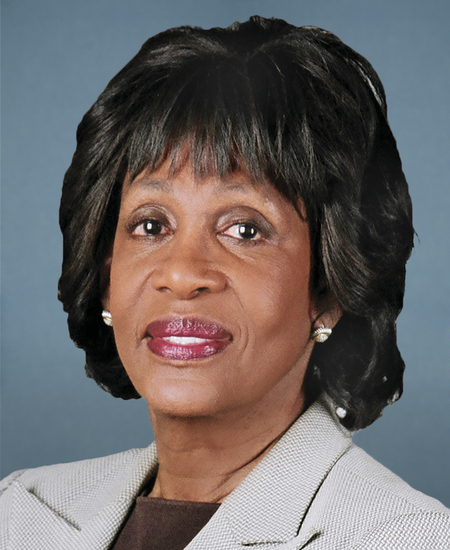
Rep. Maxine Waters
Sponsored bills
Stabilizing Rural Homeowners During COVID Act of 2021 This bill provides additional FY2021 funding to the Department of Agriculture's Direct Home Loan and Housing Repair Loan programs for rural housing assistance.
George Floyd Justice in Policing Act of 2021 This bill addresses a wide range of policies and issues regarding policing practices and law enforcement accountability. It increases accountability for law enforcement misconduct, restricts the use of certain policing practices, enhances transparency and data collection, and establishes best practices and training requirements. The bill enhances existing enforcement mechanisms to remedy violations by law enforcement. Among other things, it does the following: lowers the criminal intent standard—from willful to knowing or reckless—to convict a law enforcement officer for misconduct in a federal prosecution, limits qualified immunity as a defense to liability in a private civil action against a law enforcement officer, and grants administrative subpoena power to the Department of Justice (DOJ) in pattern-or-practice investigations. It establishes a framework to prevent and remedy racial profiling by law enforcement at the federal, state, and local levels. It also limits the unnecessary use of force and restricts the use of no-knock warrants, chokeholds, and carotid holds. The bill creates a national registry—the National Police Misconduct Registry—to compile data on complaints and records of police misconduct. It also establishes new reporting requirements, including on the use of force, officer misconduct, and routine policing practices (e.g., stops and searches). Finally, it directs DOJ to create uniform accreditation standards for law enforcement agencies and requires law enforcement officers to complete training on racial profiling, implicit bias, and the duty to intervene when another officer uses excessive force.
This joint resolution proposes a constitutional amendment authorizing Congress and the states to set reasonable limits on the raising and spending of money by candidates and others to influence elections. The amendment grants Congress and the states the power to implement and enforce this amendment by legislation. They are allowed to distinguish between natural persons and corporations or other artificial entities created by law, including by prohibiting such entities from spending money to influence elections.
This resolution impeaches President Donald John Trump for high crimes and misdemeanors. Specifically, the resolution sets forth two articles of impeachment stating that President Trump has abused the powers of the presidency. The first article states that, using the powers of his office, President Trump sought to threaten, intimidate, and solicit the Secretary of State of Georgia to acquiesce to his demand to find enough votes to make him the winner of Georgia's presidential election, even though the votes in Georgia had already been counted three times in favor of his opponent. The article further states that, by doing so, President Trump actively undermined public faith and confidence in the integrity of American elections, subverted the rule of law, and placed his personal interests above the national interest. The second article states that President Trump has endeavored to undermine foundations of U.S. democracy, indicating an intention to make himself an authoritarian ruler who is unaccountable to the U.S. people. The article specifies the following actions by President Trump: refusing to acknowledge, and opposing efforts to protect against, Russian interference in U.S. affairs; expressing willingness to accept foreign assistance to win reelection; refusing to accept the results of the election; undermining the ability of American citizens to exercise their rights as voters; falsely alleging widespread voting fraud while producing no evidence; inciting his supporters to believe falsely that the election had been stolen from him; and failing to take action to protect federal officers, personnel, property, and institutions on January 6, 2021, when the Capitol was besieged by his supporters. Both articles state that, by such conduct, President Trump warrants impeachment and trial, removal from office, and disqualification to hold U.S. office.

This resolution impeaches President Donald John Trump for high crimes and misdemeanors. Specifically, the resolution sets forth two articles of impeachment. The first article states that President Trump abused the powers of the presidency by attempting to unlawfully overturn the results of Georgia's presidential election. The article specifies that President Trump, on a recorded call, repeatedly asked the Secretary of State of Georgia to overturn the verified results of the election and threatened consequences for a failure to do so. The second article states that President Trump abused the powers of the presidency by inciting violence and orchestrating an attempted coup. The article specifies that, on January 6, 2021, President Trump incited a crowd of supporters to attack the Capitol while Congress was in session to certify the results of the election. The article further specifies that, after those supporters had violently breached the Capitol, President Trump made a statement repeating his false claims of election fraud and expressing affection for the supporters. Both articles state that, by such conduct, President Trump warrants impeachment and trial, removal from office, and disqualification from holding U.S. office.
This resolution impeaches President Donald John Trump for high crimes and misdemeanors. Specifically, the resolution sets forth four articles of impeachment. The first article states that President Trump abused the powers of the presidency by inciting an insurrection against the U.S. government. The article specifies a pattern of conduct by President Trump, including the following: spreading disinformation and unsupported allegations of voter fraud; appealing to and defending white supremacists; and encouraging his supporters to descend on the Capitol on January 6, 2021, while Congress certified the results of the presidential election, leading to destruction and death. The second article states that President Trump abused the powers of the presidency by corrupting the electoral process. The article specifies the following conduct by President Trump: soliciting a foreign government (Ukraine) to intervene in the 2020 presidential election; soliciting the Secretary of State of Georgia to overturn election results in Georgia; and during the 2016 presidential election, making unlawful payments to silence persons with unfavorable information about him. The third article states that President Trump has accepted emoluments, including from foreign states, and, in doing so, has violated anti-corruption provisions of the Constitution and used the power of the presidency for improper personal gain. The fourth article states that President Trump has obstructed justice by, for example, directing the firing of the Special Counsel who was investigating him in 2017 and later ordering federal officials to lie about this directive. Each article states that, by such conduct, President Trump warrants impeachment and trial, removal from office, and disqualification from holding U.S. office.
This resolution censures and condemns President Donald J. Trump for asking the Georgia Secretary of State on January 2, 2021, to overturn the Georgia results of the November 2020 presidential election. It further calls on President Trump to (1) retract and disavow this behavior, and (2) acknowledge President-elect Joseph R. Biden as the victor of the November 2020 presidential election.
Restricting the Use of Solitary Confinement Act This bill imposes restrictions on the use of solitary confinement for inmates in federal custody. Among the restrictions, the bill prohibits placement in solitary confinement for nondisciplinary reasons; it limits the duration of such placement; and it provides an administrative review process for inmates to contest such placement.
Preventing Future Pandemics Act of 2021 This bill establishes measures to address global public health risks posed by wildlife markets, which are commercial markets that sell or slaughter wildlife for human consumption as food or medicine in communities where alternative nutritional or protein sources are available. Specifically, the bill prohibits importing, exporting, purchasing, or selling live wild animals in the United States for human consumption as food or medicine. The Department of the Interior must hire, train, and deploy at least 50 new U.S. Fish and Wildlife Service law enforcement attachés around the world, and the U.S. Agency for International Development must increase specified activities to address the threats and causes of zoonotic (animal-to-human transmission) disease outbreaks. Additionally, the United States must work with other United Nations member states to urge a global ban on commercial wildlife markets and enforcement of laws to end wildlife trafficking. Further, the President may impose sanctions against a foreign country or foreign nationals that the Department of State has determined are taking certain actions that enable or facilitate commercial wildlife markets. Among other reports required by the bill, the National Academies of Sciences, Engineering, and Medicine must conduct a study and submit a report that includes an evaluation of (1) the impact that consumption of terrestrial wildlife as food or medicine has on the transmission of novel viral and other pathogens, (2) the role of consuming terrestrial wildlife as food or medicine in the transmission of microbes from animals to humans, and (3) the conditions at live wildlife markets that lead to this transmission.