

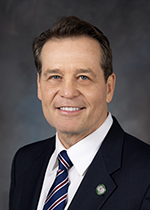
Photo of Brent Hagenbuch
R Texas Senate · District 30

Sen. Brent Hagenbuch

Compare
Total votes
1,316
all sessions
Attendance
100%
of floor votes
Near the chamber average
With party
87%
of cast votes
Near the chamber average
Bipartisan score
6%
crosses aisle rarely
Lower than 77% of chamber peers
Sponsored
397
bills & resolutions
Higher than 93% of chamber peers
Committees
8
assignments
397 bills and resolutions

Sponsored bills

Total
397
Primary
214
Co-sponsor
183
This page
397
matching current filters
Primary SB 9
Passed · Texas Senate · Lead sponsor
Relating to the calculation of the voter-approval tax rate for certain taxing units.

Maddy summarySB 9 amends Texas Tax Code sections to update how local taxing units (like cities, counties, and school districts) calculate voter-approval tax rates when implementing or adjusting sales taxes. It introduces specific formulas that account for new sales tax revenue by adding a "sales tax gain rate" to the calculation, ensuring the voter-approval rate reflects the impact of the new revenue source. The bill differentiates rules based on the taxing unit type, applying multipliers of 1.08 for special districts, 1.035 for small municipalities/counties (<30,000 population), and 1.025 for others. These changes directly affect how local governments determine tax rates that require voter approval when they add or modify sales taxes.

Passed Aug 6, 2025 0 co-sponsors
Co-sponsor SB 5
Passed · Texas Senate · Co-sponsor
Relating to the regulation of certain products derived from hemp, including consumable hemp products and the hemp-derived cannabinoids contained in those products; requiring occupational licenses and registrations; imposing fees; creating criminal offenses; authorizing an administrative penalty.

Maddy summarySB 5 regulates hemp-derived consumable products (like edibles, oils, and topicals containing cannabinoids such as CBD) sold in Texas. It requires businesses to obtain occupational licenses, imposes fees, and prohibits sales to anyone under 21. The bill creates criminal penalties for violations and administrative fines, while exempting certain products (like hemp seed oil in food), research activities, low-THC cannabis, and medical prescriptions. These changes directly affect hemp product manufacturers, retailers, and distributors operating in Texas.

Passed Aug 4, 2025 1 co-sponsor
Co-sponsor SB 11
Passed · Texas Senate · Co-sponsor
Relating to the duty of the attorney general to prosecute criminal offenses prescribed by the election laws of this state.

Maddy summarySB 11 requires Texas law enforcement agencies to report election-related crimes to the attorney general and gives the attorney general exclusive authority to prosecute these offenses. Local prosecutors and law enforcement must share relevant information with the attorney general to assist in these cases, and the attorney general can direct local offices to handle or support prosecutions. The law applies only to election crimes committed after its effective date (91 days after the legislative session). This shifts prosecution responsibility for election law violations from local to state-level authorities.

Passed Aug 4, 2025 1 co-sponsor
Primary SB 66
Introduced · Texas Senate · Lead sponsor
Relating to powers of regional transportation authorities.

Maddy summarySB 66 allows local areas within Texas regional transportation authorities to allocate up to 25% of their annual sales tax revenue toward local transportation projects. This includes building/maintaining sidewalks, trails, roads, streetlights, traffic signals, and drainage improvements related to transportation infrastructure. Funds are distributed with 50% available at the start of the fiscal year and 50% on a reimbursement basis by year-end. Unused funds must be used to pay down debt secured by a 1% sales tax rate. The bill directly affects local governments participating in regional transportation authorities that manage these tax revenues.

Introduced Aug 4, 2025 0 co-sponsors
Co-sponsor SB 12
Passed · Texas Senate · Co-sponsor
Relating to the use by a political subdivision of public funds for lobbying activities.

Maddy summarySB 12 prohibits Texas cities, counties, and other local governments (political subdivisions) from using public funds to hire registered lobbyists or pay organizations that primarily represent local governments and employ lobbyists. The bill specifically bans spending on activities like lobbying state legislators, but allows local government employees to provide information to lawmakers or testify without triggering the restriction. Exceptions include associations representing sheriffs or law enforcement officers, and direct advocacy by employees that doesn’t require lobbyist registration. Taxpayers can seek court orders to stop prohibited spending and recover related costs.

Passed Aug 4, 2025 1 co-sponsor
Co-sponsor SB 3
Vetoed · Texas Senate · Co-sponsor
Relating to the regulation of products derived from hemp, including consumable hemp products and the hemp-derived cannabinoids contained in those products; requiring occupational licenses and permits; imposing fees; creating criminal offenses; authorizing an administrative penalty.

Maddy summarySB 3 regulates consumable hemp products (like edibles, topicals, or beverages containing hemp-derived cannabinoids) in Texas. It requires businesses to obtain licenses with $10,000 fees per location, bans manufacturing products with cannabinoids other than CBD or cannabigerol, and mandates product testing before sale. The bill also creates criminal penalties for violations and allows administrative fines. This primarily affects hemp product manufacturers, retailers, and distributors in Texas. The bill was vetoed by the governor on June 22, 2025, so it did not become law.

Vetoed Jun 22, 2025 1 co-sponsor
Co-sponsor SB 1758
Signed into law · Texas Senate · Co-sponsor
Relating to the operation of a cement kiln and the production of aggregates near a semiconductor wafer manufacturing facility.

Maddy summarySB 1758 creates a legal exemption for cement kilns and aggregate production facilities that began operations before nearby semiconductor wafer manufacturing plants. Specifically, it states that owners/operators of such pre-existing cement/aggregate facilities cannot be held liable for vibration damage to semiconductor facilities caused by their operations, provided the cement/aggregate facility started before the semiconductor plant. The bill also establishes a two-year pilot program in Grayson County (ending in 2027) to study vibration impacts, managed by the University of Texas Bureau of Economic Geology. This directly affects semiconductor manufacturers and cement/aggregate operators in areas where these facilities operate near each other. The law applies statewide but includes a limited pilot program for Grayson County.

Signed into law Jun 22, 2025 1 co-sponsor
Co-sponsor SB 25
Signed into law · Texas Senate · Co-sponsor
Relating to health and nutrition standards to promote healthy living, including requirements for food labeling, primary and secondary education, higher education, and continuing education for certain health care professionals; authorizing a civil penalty.

Maddy summarySB 25 requires Texas public school districts and open-enrollment charter schools to provide daily moderate or vigorous physical activity for students in prekindergarten through grade 8. Specifically, it mandates at least 30 minutes daily for grades K-5 and 30 minutes daily for at least four semesters in grades 6-8, with alternatives for scheduling challenges (e.g., 135 minutes weekly). The bill prohibits schools from restricting student participation in physical activity as punishment for academic or behavioral issues. It directly affects K-8 students and school employees responsible for implementing physical education curricula, effective September 1, 2025.

Signed into law Jun 22, 2025 1 co-sponsor
Co-sponsor SB 22
Signed into law · Texas Senate · Co-sponsor
Relating to the Texas moving image industry incentive program and the establishment and funding of the Texas moving image industry incentive fund.

Maddy summarySB 22 establishes the Texas Moving Image Industry Incentive Fund to provide financial support for film and television productions filmed in Texas. It requires the Music, Film, Television, and Multimedia Office to deny grants for projects containing "inappropriate content" or portraying Texas/Texans "in a negative fashion," while also prohibiting grants for pornography, news programming, religious content, non-commercial projects, and state advertising. The bill explicitly lists ineligible project types, including political ads, sporting events, and video games used in gambling. It creates a dedicated funding mechanism for eligible productions and authorizes the Office to administer grants using money from the incentive fund or other approved sources. The law directly affects production companies seeking financial support for qualifying Texas-based film and TV projects.

Signed into law Jun 22, 2025 1 co-sponsor
Co-sponsor SB 2753
Signed into law · Texas Senate · Co-sponsor
Relating to the integration of early voting by personal appearance and election day voting, including the manner in which election returns are processed and other related changes.

Maddy summarySB 2753 integrates early voting by personal appearance and election day voting processes in Texas. It requires county election offices to stay open during extended early voting hours for voter registration, and allows counties with under 55,000 residents to use state funds to keep polling places open during early voting periods. The bill also permits combining election precincts with fewer than 5,000 registered voters in counties under 1.2 million population to reduce election costs, while maintaining population limits for precincts. These changes directly affect county election administrators, voters accessing early voting, and local election budgets. The law took effect September 1, 2025, after being signed by the governor in June 2025.

Signed into law Jun 22, 2025 1 co-sponsor
Showing 51 to 60 of 397 bills
Previous 1 … 5 6 7 … 40 Next