

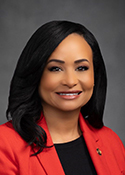
Photo of Katrina Pierson
R Texas House · District 33 On the 2026 ballot

Rep. Katrina Pierson

Compare
Total votes
3,708
all sessions
Attendance
97%
127 missed
Near the chamber average
With party
80%
of cast votes
Lower than 80% of chamber peers
Bipartisan score
11%
some cross-party votes
Higher than 82% of chamber peers
Sponsored
304
bills & resolutions
Near the chamber average
Committees
3
assignments
304 bills and resolutions

Sponsored bills

Total
304
Primary
55
Co-sponsor
249
This page
304
matching current filters
Co-sponsor HB 34
Introduced · Texas House · Co-sponsor
Relating to the definition of "eligible school district" for purposes of the study of school district property values conducted by the comptroller of public accounts.

Maddy summaryHB 34 revises the definition of "eligible school district" for the comptroller's study of school district property values. A district qualifies only if, in the most recent study, its local property value was invalid (not meeting standards) but did not exceed the state value, and for the two prior studies, its local value was valid (met standards). This change applies exclusively to property value studies for tax years beginning on or after January 1, 2026, meaning it will not affect past studies. The bill focuses on clarifying eligibility criteria for the comptroller's ongoing assessment process.

Introduced Jul 14, 2025 1 co-sponsor
Co-sponsor HB 83
Introduced · Texas House · Co-sponsor
Relating to the use by a political subdivision of public funds for lobbying and related activities.

Maddy summaryHB 83 prohibits cities, counties, and other local governments from using public funds to hire lobbyists or pay nonprofits that lobby on their behalf. It specifically bans spending taxpayer money to employ registered lobbyists or support organizations that primarily represent local governments and hire lobbyists. Taxpayers or residents can sue to stop violations and recover legal fees if public funds are improperly used for lobbying. The bill restricts how local governments spend public money on influencing state legislation.

Introduced Jul 14, 2025 1 co-sponsor
Co-sponsor HB 32
Introduced · Texas House · Co-sponsor
Relating to the designation and use of certain spaces and facilities according to biological sex; authorizing a civil penalty and a private civil right of action.

Maddy summaryHB 32, the Texas Women's Privacy Act, requires that certain facilities - such as restrooms, locker rooms, and family violence shelters - be designated and used based on biological sex, defined as the physical condition of being male or female at birth as determined by sex organs, chromosomes, and original birth records. The law applies to correctional facilities, family violence shelters, institutions of higher education, local governments (political subdivisions), and state agencies. It authorizes civil penalties for violations and creates a private right of action, allowing individuals to file lawsuits if they believe the law has been breached. The bill does not apply to state agencies as political subdivisions but covers them separately under the law's definition of "state agency."

Introduced Jul 14, 2025 1 co-sponsor
Primary HB 84
Introduced · Texas House · Lead sponsor
Relating to a statewide order issued by the commissioner of state health services authorizing a pharmacist to dispense ivermectin.

Maddy summaryHB 84 authorizes Texas pharmacists to dispense ivermectin for human use without a doctor's prescription, directly affecting pharmacists and patients seeking this medication. The bill requires the state health commissioner to issue a statewide order with standardized protocols for pharmacists, including patient instructions and annual reporting on dispensing volumes. It also provides legal protection for pharmacists who follow the order, shielding them from liability or disciplinary action. The commissioner must issue this order within 91 days after the legislative session ends, implementing the policy changes outlined in the new Health and Safety Code section.

Introduced Jul 14, 2025 0 co-sponsors
Co-sponsor SB 1362
Signed into law · Texas Senate · Co-sponsor
Relating to prohibiting the recognition, service, and enforcement of extreme risk protective orders; creating a criminal offense.

Maddy summarySB 1362 prohibits Texas state and local entities - including courts, law enforcement, and prosecutors - from recognizing, serving, or enforcing "extreme risk protective orders" (commonly called "red flag" orders). These orders typically restrict firearm access when a court deems someone a risk to themselves or others. The bill creates a criminal offense for violating this prohibition and blocks Texas entities from accepting federal grants meant to implement such orders. It directly affects all Texas government bodies and law enforcement agencies, preventing them from participating in programs that require enforcing these firearm restrictions. The law takes effect September 1, 2025.

Signed into law Jun 22, 2025 1 co-sponsor
Co-sponsor HB 413
Vetoed · Texas House · Co-sponsor
Relating to the release of certain defendants detained in jail pending trial.

Maddy summaryHB 413 would have limited pretrial detention for defendants charged with Class B misdemeanors or more serious offenses, preventing jail stays longer than the maximum sentence they could receive if convicted. It required courts to calculate whether a defendant’s cumulative time in jail before trial exceeded the potential sentence for their offense, mandating release if it did. Exceptions included defendants undergoing competency evaluations or subject to Chapter 46B commitment orders. The bill was vetoed by the governor on June 22, 2025, and never took effect.

Vetoed Jun 22, 2025 1 co-sponsor
Co-sponsor HB 1056
Signed into law · Texas House · Co-sponsor
Relating to the recognition of gold and silver specie as legal tender and the establishment of a transactional currency based on gold and silver; authorizing a fee.

Maddy summaryHB 1056 recognizes physical gold and silver coins meeting specific weight and purity standards as legal tender in Texas for debt payments, while prohibiting government markings except for identifying refiners. It authorizes the state comptroller to establish electronic payment systems backed by bullion held in depositories, allowing transactions using gold/silver-based currency. The bill explicitly states it does not replace U.S. dollars, restrict federal currency, or require businesses to accept gold/silver tender. It also permits the comptroller to set reasonable administrative fees for the system. This law applies to Texas residents and businesses using the state-administered electronic currency system, operating alongside existing federal currency.

Signed into law Jun 22, 2025 1 co-sponsor
Primary SB 25
Signed into law · Texas Senate · Lead sponsor
Relating to health and nutrition standards to promote healthy living, including requirements for food labeling, primary and secondary education, higher education, and continuing education for certain health care professionals; authorizing a civil penalty.

Maddy summarySB 25 requires Texas public school districts and open-enrollment charter schools to provide daily moderate or vigorous physical activity for students in prekindergarten through grade 8. Specifically, it mandates at least 30 minutes daily for grades K-5 and 30 minutes daily for at least four semesters in grades 6-8, with alternatives for scheduling challenges (e.g., 135 minutes weekly). The bill prohibits schools from restricting student participation in physical activity as punishment for academic or behavioral issues. It directly affects K-8 students and school employees responsible for implementing physical education curricula, effective September 1, 2025.

Signed into law Jun 22, 2025 0 co-sponsors
Primary HCR 98
Signed into law · Texas House · Lead sponsor
Urging Congress to enhance coordination among federal, state, and local authorities in the deployment of C-UAS technologies for border security.

Maddy summaryHCR 98 is a Texas concurrent resolution urging Congress to improve coordination between federal, state, and local authorities in deploying Counter-Unmanned Aircraft Systems (C-UAS) for border security. It highlights that current federal law restricts C-UAS operations to four departments (Homeland Security, Justice, Defense, Energy), preventing states from conducting drone detection or mitigation despite border threats. The resolution requests Congress establish joint training, information-sharing protocols, and funding mechanisms to enable state/local participation in C-UAS efforts, referencing FBI support and related federal proposals like H.R.8610. As a non-binding resolution, it does not change laws but formally advocates for enhanced federal-state collaboration.

Signed into law Jun 20, 2025 0 co-sponsors
Primary HB 3801
Signed into law · Texas House · Lead sponsor
Relating to the establishment of the Health Professions Workforce Coordinating Council and a workgroup on nursing career pathways and the abolition of the statewide health coordinating council and the nursing advisory committee of that council.

Maddy summaryHB 3801 establishes the Health Professions Workforce Coordinating Council and a separate workgroup focused on nursing career pathways, while eliminating the existing statewide health coordinating council and its nursing advisory committee. The new council, composed of agency representatives and governor-appointed members with healthcare workforce expertise, will compile data on workforce trends - including high school and higher education graduation rates - to develop strategies for a stronger healthcare system. This law directly affects Texas health agencies, educational institutions, and nursing professionals by centralizing workforce planning under the new council structure. The bill became effective September 1, 2025, replacing outdated advisory bodies with a more focused coordination mechanism.

Signed into law Jun 20, 2025 0 co-sponsors
Showing 41 to 50 of 304 bills
Previous 1 4 5 6 31 Next