

Maddy summaryHB 1288 modifies South Dakota law to allow counties and first/second-class municipalities with comprehensive plans to create local ordinances governing sand, gravel, and aggregate mining operations, provided they don’t conflict with state law. It prohibits local governments from requiring additional bonds beyond state requirements and mandates that the Board of Minerals and Environment must consider local ordinances when reviewing mining permits. The bill also establishes a 60-day conditional permit process if local permits are delayed, requiring applicants to notify the Board once local permits are secured before operations begin. These changes amend Sections 45-6-65 and 45-6B-4 of the state code.
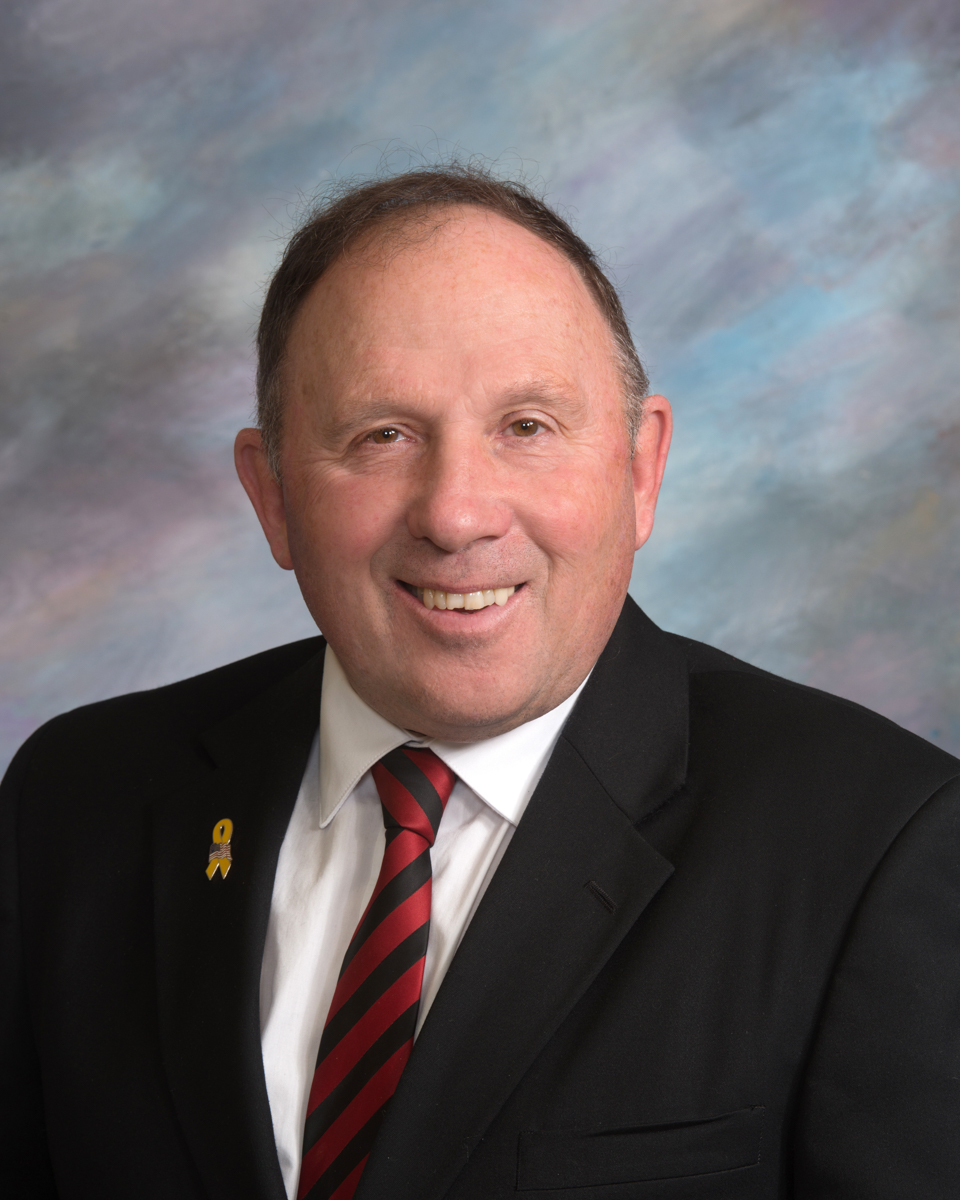
Rep. Tim Goodwin
Sponsored bills
Maddy summaryThis bill (HC 8012) is a South Dakota legislative commoration formally recognizing Captain Royce Williams for his military service. It specifically honors his combat actions during the Korean War, including a classified 35-minute dogfight in 1952 where he reportedly shot down four enemy aircraft. The resolution acknowledges the Navy's 2025 recommendation to upgrade his decoration to the Medal of Honor, though the bill itself does not change any military awards. It serves solely as a symbolic gesture of state recognition, directly affecting Captain Williams through official commemoration.
Maddy summaryHB 1058 requires online betting platforms offering pari-mutuel wagering on horse or dog races to obtain a specific license from South Dakota. It clarifies that both in-state operators (with a physical presence) and out-of-state operators must pay a tax of 1.5% on South Dakota contributions, while multi-jurisdictional hubs pay 0.25% (with portions going to racing and breeding funds). The bill specifies that tax revenue will fund the state, a special racing revolving fund, and a South Dakota-bred racing fund. This applies only to online wagering for authorized horse and dog races, updating existing tax and licensing rules.
Maddy summarySenate Bill 97 adjusts property tax revenue limits for South Dakota taxing districts and school districts. For school districts, it changes the annual revenue increase cap from "lesser of 3% or index factor" to a flat 3% over the prior year's revenue, effective 2021. For general taxing districts, it adds a specific 3.5% cap on revenue increases above normal limits for taxes payable in 2027-2031. The bill also clarifies that property improvements to owner-occupied homes increasing value by 40% or less do not count toward the revenue limit. These changes directly affect local governments and school districts managing property tax revenue.
Maddy summaryHB 1064 allows South Dakota livestock producers to sell meat they raised and processed directly to end consumers in the state, pending federal legalization of such sales. The bill requires meat to be raised, slaughtered, and processed entirely within South Dakota, sold only to final consumers (not resold), and labeled with a warning that it’s uninspected and cannot be redistributed. It becomes effective only after the attorney general certifies that federal law permits such sales, either through new federal legislation or a court ruling declaring the current federal prohibition unconstitutional. This bill does not change current federal restrictions but prepares South Dakota for future direct-to-consumer sales once federal barriers are lifted.
Maddy summaryHB 1121 expands where South Dakota consumers can legally purchase raw milk for personal use. It adds a new allowed location: retail stores owned by the milk producer, provided these stores are not located at the farm where the milk is produced. Currently, raw milk could only be bought directly at the farm, at farmers markets, or at a producer-owned store located on the farm. The bill specifically allows producer-owned retail stores (not at the farm) to sell raw milk directly to consumers.
Maddy summaryHB 1151 bans kratom and kratom products in South Dakota, making it a Class 2 misdemeanor to sell, distribute, purchase, consume, or possess them. It specifically prohibits sales or use by anyone under 21 (except by parents/guardians), and requires strict labeling for products that remain legal, including serving sizes, alkaloid content, and health warnings. The bill also prohibits products containing over 2% 7-hydroxymitragynine, synthetic compounds, or harmful additives. This directly affects consumers, businesses selling kratom, and retailers who must comply with new labeling rules.
Maddy summaryHB 1273 revises definitions and clarifies rules for "life of the mine permits" in South Dakota's mining law. It specifically defines how mining operators can temporarily pause operations (up to 180 days with notice) and extend pauses up to 10 years total, provided they submit plans for resuming work and maintain reclamation measures. This affects mining companies operating under these permits and the Board of Minerals and Environment, which oversees the process. The bill focuses on procedural clarity for permit management without introducing new environmental or financial requirements.
Maddy summaryHB 1097 appropriates $2 million from South Dakota's general fund to the Department of Corrections for a grant to a nonprofit delivering juvenile diversion programming in Sioux Falls. The nonprofit must provide an annual week-long summer camp for sixth graders identified by school resource officers (starting in 2026 for 10 years), along with three follow-up events per year involving participants, families, and law enforcement. The grant requires the nonprofit to report annual outcome measures to a special committee and includes a requirement for police and sheriff's office participation in all program activities. The funds are disbursed yearly starting in 2026, with unspent amounts reverting by June 2036.
Maddy summarySB 189 creates an automatic refund process for agricultural assessments on specific crops and livestock. It directly affects growers who pay mandatory assessments on wheat, oilseeds (like canola), corn, livestock, and pulse crops (such as peas). The key change replaces the current system - where growers must apply for individual refunds within 60 days of each assessment - with a new annual electronic process. Under this bill, growers can submit one online request by December 31 to receive refunds for all assessments paid during the upcoming year, eliminating the need for separate applications per transaction. The bill modifies existing refund procedures across multiple agricultural chapters (wheat, oilseeds, corn, livestock, pulse crops) to implement this streamlined system.