

Maddy summaryThis resolution honors Senator Mary Jo White's life and service in the Pennsylvania Senate, expressing condolences to her family. It recognizes her work on environmental policy, advocacy for women's rights, and her role as the first woman elected to Senate Republican leadership. The resolution serves as a formal tribute to her career and legacy without creating any new laws or policies.
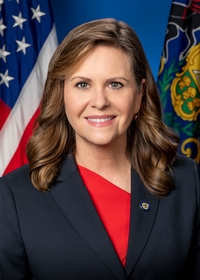
Sen. Camera Bartolotta
Sponsored bills
Maddy summaryThis bill establishes a Pennsylvania program that reimburses residents who earn state-recognized emergency medical services (EMS) certifications (such as EMT or paramedic) after paying for training at a Pennsylvania school. Applicants must submit proof of certification and payment, maintain Pennsylvania residency for two years after certification, and apply within 30 days of completing training. The state will cover full certification costs up to a $3 million total appropriation, with payments issued within two months of a complete application. The program ends when the $3 million is fully spent, with no fixed expiration date beyond that.
Maddy summarySB 523 requires full-time firefighters and EMS providers employed by fire departments or local governments in Pennsylvania to receive comprehensive cancer and cardiovascular screenings every three years. The screenings must cover specific conditions including prostate, lung, skin, and heart health checks, as listed in the bill. Employers must cover all associated costs - including copays, deductibles, and insurance expenses - through existing health benefits or insurance plans. This bill directly affects emergency responders working for public fire departments or municipal services.
Maddy summaryThis bill creates a $500 annual tax credit for Pennsylvania residents who serve as active volunteer certified emergency medical technicians (EMTs) or volunteer firefighters. To qualify, individuals must have at least two full years of service by December 31 of the tax year and respond to at least 20% of their agency's emergency calls during that period. The credit applies to tax liability starting with taxable years beginning after December 31, 2026, and cannot be carried over, refunded, or sold. The Department of Revenue will administer the credit, require self-certification, and submit annual reports to the General Assembly on its usage.
Maddy summarySB 131 proposes a constitutional amendment to replace Pennsylvania’s current Legislative Reapportionment Commission with an 11-member Independent Redistricting Commission. The new commission would be composed of four members from the largest political party, four from the second-largest, and three unaffiliated voters, all required to have voted in recent statewide elections and meet strict eligibility rules (e.g., no current officeholders, lobbyists, or campaign staff). This change directly affects how the state redraws congressional and legislative district boundaries after each federal census, aiming to reduce partisan influence in the process. The bill also specifies redistricting criteria but does not detail specific geographic or population standards. As a proposed constitutional amendment, it remains in committee and has not become law.
Maddy summarySB 516 establishes Pennsylvania's "Lifetime Recovery from Substance Use Grant Program" to fund recovery support services. It requires the Department of Health to create and distribute posters/pamphlets with overdose signs, emergency steps, and naloxone locations to be displayed in public areas of government agencies, transit authorities, and municipalities. The bill directly affects nonprofits, hospitals, counties, and recovery houses that provide services like peer support, housing assistance, and job training for people recovering from substance use. It mandates these providers to apply for grants to expand access to evidence-based recovery support services across the state.
Maddy summarySB 54 establishes a new process for individuals wrongfully convicted in Pennsylvania to seek financial compensation. To qualify, claimants must prove actual innocence through overturned convictions, pardons, or acquittals after retrial, and have served time for the crime. The bill creates a petition process in Commonwealth Court (without requiring attorneys) and specifies eligibility criteria (e.g., excluding accomplices or those who committed perjury) and compensation amounts based on time served. It also modifies immunity laws to ensure wrongful conviction claims aren't blocked by government defenses.
Maddy summarySB 508, the Clean Air Preservation Act, prohibits cloud seeding, solar radiation modification (like reflecting sunlight), and any polluting atmospheric interventions within Pennsylvania. It directly affects any entity - individuals, companies, or government agencies - conducting these activities in the state. The bill requires Pennsylvania State Police or sheriffs to issue immediate cease-and-desist orders for suspected violations, treating them as court orders. Violators face felony charges with fines of at least $500,000 per day or up to two years in prison, plus penalties under Pennsylvania’s existing Air Pollution Control Act.
Maddy summaryThis ceremonial resolution (SR 50) recognizes March 28, 2025, as "Drugs Kill Dreams Day" in Pennsylvania to honor the 25th anniversary of Judge J. Gary DeComo's anti-drug slogan, adopted in 2000. It does not create new laws or funding but encourages Pennsylvanians to participate in existing community-based drug prevention education activities. The resolution specifically thanks Judge DeComo for his campaign, which partners with schools and community groups to promote youth prevention efforts. It serves as a symbolic gesture to raise awareness about ongoing prevention work, not a policy change.
Maddy summarySB 463, the "Whole Milk in Pennsylvania Schools Act," allows Pennsylvania schools to use state or local funds to provide or sell whole Pennsylvania milk (3% fat) or reduced-fat Pennsylvania milk (2% fat) processed within the state. It directly affects all Pennsylvania schools, including public districts, charter schools, and career technical schools. The bill requires school boards to choose PA milk options, mandates a report on milk consumption and availability within two years, and authorizes the Attorney General to pursue federal legal action if schools face funding loss for complying. "Pennsylvania milk" is defined as raw milk from PA cows processed into fluid milk within Pennsylvania.