

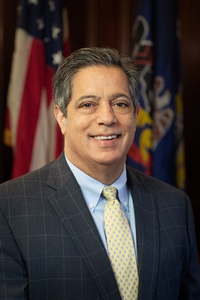
Photo of Jay Costa
D Pennsylvania Senate · District 43

Sen. Jay Costa

Compare
Total votes
5,538
all sessions
Attendance
99%
26 missed
Near the chamber average
With party
97%
of cast votes
Near the chamber average
Bipartisan score
1%
crosses aisle rarely
Near the chamber average
Sponsored
4,283
bills & resolutions
Higher than 98% of chamber peers
Committees
3
assignments
4,283 bills and resolutions

Sponsored bills

Total
4,283
Primary
134
Co-sponsor
4,149
This page
4,283
matching current filters
Co-sponsor SR 32
In committee · Pennsylvania Senate · Co-sponsor
A Resolution recognizing the month of March 2025 as "National Athletic Training Month" in Pennsylvania.

Maddy summaryThis resolution (SR 32) symbolically recognizes March 2025 as "National Athletic Training Month" in Pennsylvania. It honors athletic trainers' roles in health care, including injury prevention, emergency care, and rehabilitation, as highlighted by the Pennsylvania Athletic Trainers' Society and the National Athletic Trainers' Association. The resolution specifically acknowledges Pennsylvania's leadership in athletic training education and the profession's 3,000+ practitioners in the state. As a ceremonial resolution, it has no policy impact - no new requirements, funding, or legal changes are created.

In committee Mar 6, 2025 1 co-sponsor
Co-sponsor SB 385
In committee · Pennsylvania Senate · Co-sponsor
An Act amending Title 23 (Domestic Relations) of the Pennsylvania Consolidated Statutes, in alimony and support, further providing for alimony pendente lite, counsel fees and expenses.

Maddy summarySB 385 modifies Pennsylvania's domestic relations law to bar a spouse convicted of a personal injury crime against their partner from receiving spousal support or temporary alimony during divorce proceedings, unless the court finds a "manifest injustice" exists. This directly affects individuals in divorce cases where one partner has a criminal conviction for harming the other. The law requires courts to consider if there's a history of harassment or prior protection orders when determining if a "manifest injustice" exemption applies. Any spousal support paid after the injury but before the conviction can be recovered by the injured party through a court petition. The changes apply to cases filed 60 days after the law takes effect.

In committee Mar 6, 2025 1 co-sponsor
Co-sponsor SB 38
In committee · Pennsylvania Senate · Co-sponsor
An Act amending the act of June 13, 1967 (P.L.31, No.21), known as the Human Services Code, providing for liability for false claims, for adoption of congressional intent of the Federal False Claims Act, for damages, costs and civil penalties, for powers of Attorney General, for qui tam actions and for civil investigative demands.

Maddy summarySB 38 amends Pennsylvania's Human Services Code to adopt the federal False Claims Act's framework, creating new provisions for holding entities accountable for submitting false claims to the state. It directly affects contractors, grantees, and healthcare providers receiving state funds who knowingly submit false information related to payments or property. Key mechanisms include triple damages for the Commonwealth, civil penalties, and "qui tam" lawsuits allowing private citizens to file claims on behalf of the state. The bill defines "false claims" broadly to cover any knowingly submitted false requests for money or property tied to state programs, with penalties applying to violations like concealing false information or failing to report errors.

In committee Mar 6, 2025 1 co-sponsor
Co-sponsor SB 371
In committee · Pennsylvania Senate · Co-sponsor
An Act providing for medical debt collection protection; and imposing duties on the Attorney General and the Department of Health.

Maddy summarySB 371, the Medical Debt Collection Protection Act, protects low-income patients from aggressive medical debt collection practices. It requires health care providers to screen patients for insurance and financial assistance *before* billing them for emergency or necessary care, and prohibits collectors from placing liens on primary homes or reporting debts to credit bureaus. The law also mandates a 30-day notice to patients before pursuing permissible actions like lawsuits or wage garnishment, including information about complaint procedures. It directly affects uninsured patients and those with household incomes under 300% of the federal poverty level (qualified patients), imposing new duties on the Attorney General and Department of Health for enforcement. The bill is currently pending in the Health & Human Services committee.

In committee Mar 6, 2025 1 co-sponsor
Co-sponsor SB 401
In committee · Pennsylvania Senate · Co-sponsor
An Act amending the act of March 4, 1971 (P.L.6, No.2), known as the Tax Reform Code of 1971, in tax credit and tax benefit administration, further providing for definitions; and providing for the Pennsylvania National Guard employer tax credit.

Maddy summarySB 401 creates a $1,000 tax credit for Pennsylvania employers who hire, have an employee enlist, or have an employee reenlist in the Pennsylvania National Guard. The credit applies against taxes under Articles III or IV of the Tax Reform Code and can be carried over for up to three years if not fully used in the first year. The total annual credit amount is capped at $5 million, with unused credits allocated proportionally if the cap is exceeded. This credit applies to tax years beginning after December 31, 2025, and requires employers to claim it in their first eligible tax year.

In committee Mar 6, 2025 1 co-sponsor
Co-sponsor SB 368
In committee · Pennsylvania Senate · Co-sponsor
An Act amending Title 44 (Law and Justice) of the Pennsylvania Consolidated Statutes, providing for investigations; and imposing duties on the Pennsylvania State Police and the Municipal Police Officers' Education and Training Commission.

Maddy summarySB 368 establishes new standards for eyewitness identification procedures used by Pennsylvania law enforcement. It directly affects police departments, the Pennsylvania State Police, and the Municipal Police Officers' Education and Training Commission by requiring blind lineups (where administrators don't know the suspect's identity), documenting eyewitness descriptions before lineups, and using at least five fillers in both live and photo lineups. The bill mandates prelineup instructions for eyewitnesses about the importance of eliminating innocent people and not feeling pressured to identify someone. It also prohibits administrators from commenting on identifications and sets specific rules for lineup composition and show-up procedures to reduce misidentification risks.

In committee Mar 6, 2025 1 co-sponsor
Co-sponsor SB 369
In committee · Pennsylvania Senate · Co-sponsor
An Act amending Title 42 (Judiciary and Judicial Procedure) of the Pennsylvania Consolidated Statutes, in depositions and witnesses, providing for informant testimony.

Maddy summarySB 369 requires prosecutors to disclose detailed information about informants - such as their criminal history, cooperation agreements, and all statements made to them - 30 days before trial in criminal cases where informant testimony is used. It mandates a court hearing to verify the reliability of such testimony before it can be admitted, considering factors like corroboration and specificity. This directly affects criminal defendants by giving them more information to challenge informant credibility, and prosecutors who must now follow strict disclosure rules. The bill also requires prosecutors to notify victims if informants received benefits like plea deals in exchange for testimony.

In committee Mar 6, 2025 1 co-sponsor
Co-sponsor SB 370
In committee · Pennsylvania Senate · Co-sponsor
An Act amending Title 44 (Law and Justice) of the Pennsylvania Consolidated Statutes, in preliminary provisions, adopting the Uniform Electronic Recordation of Custodial Interrogations Act; requiring recordings of interrogations; and imposing functions on the Attorney General.

Maddy summarySB 370 requires Pennsylvania law enforcement to electronically record (with audio) all custodial interrogations related to "crimes of violence" (serious offenses that would be violent if committed by an adult). Exceptions include immediate danger, a person refusing to be recorded, equipment failure, or interrogations conducted by another jurisdiction. If recording isn't done, officers must write a report explaining why and summarizing the interrogation. This directly affects police departments, officers conducting interrogations, and individuals questioned about violent crimes in Pennsylvania.

In committee Mar 6, 2025 1 co-sponsor
Co-sponsor SB 393
In committee · Pennsylvania Senate · Co-sponsor
An Act authorizing senior citizens to claim an exemption from tax increases as to certain real property; and providing for termination of the exemption.

Maddy summarySB 393, the Senior Citizens' Property Tax Freeze Act, allows Pennsylvania residents aged 65+ who live on their property for at least five years and earn under $65,000 annually to freeze their real property tax increases. To qualify, applicants must submit a notarized form proving eligibility and submit annual income proof. The exemption ends if the property is sold or transferred (except to another eligible senior), and the state will reimburse local governments for lost tax revenue. The law applies starting January 1, 2026, and replaces conflicting existing laws. This directly affects qualifying seniors owning residential property in Pennsylvania.

In committee Mar 6, 2025 1 co-sponsor
Co-sponsor SB 332
In committee · Pennsylvania Senate · Co-sponsor
An Act amending the act of June 3, 1937 (P.L.1333, No.320), known as the Pennsylvania Election Code, in dates of elections and primaries and special elections, further providing for general primary and candidates to be nominated and party officers to be elected.

Maddy summarySB 332 amends Pennsylvania's Election Code to change the date of the general primary election in presidential election years. Currently, the primary is held on the third Tuesday of March in such years, but this bill would move it to the fourth Tuesday of April. This change applies to general primaries starting in 2028 and affects how voters select candidates for statewide offices and the presidency. The bill directly impacts election scheduling for voters, candidates, and officials by altering the timing of primary elections.

In committee Feb 28, 2025 1 co-sponsor
Showing 731 to 740 of 4,283 bills
Previous 1 … 73 74 75 … 429 Next