

Maddy summarySB 122 amends Pennsylvania's firearms law by removing an exception that previously limited certain firearm restrictions to short-barreled pistols, shotguns, rifles, or firearms under specific length measurements. This change means the general rules governing firearm sales and transfers now apply uniformly to all firearms, regardless of size. The bill also eliminates conflicting regulations in the Pennsylvania Code (37 Pa. Code) that contradicted this updated definition. The law, set to take effect in 60 days, directly affects firearm sellers, buyers, and law enforcement across Pennsylvania.
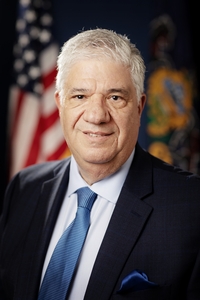
Sen. Wayne Fontana
Sponsored bills
Maddy summarySB 147 creates a program offering financial incentives to Pennsylvania truck owners and fleets purchasing near-zero emission trucks (diesel models from 2010 or later meeting EPA standards). It provides grants covering either the federal excise tax on new trucks or 6% of the used truck price (up to $5,000) to offset costs, but requires trading in a pre-2010 diesel truck that is titled and registered in Pennsylvania. The program, managed by the Department of Transportation, operates on a first-come, first-served basis with funds from a dedicated state incentive fund. Truck owners must register the new vehicle in Pennsylvania for at least two years to qualify for the grant.
Maddy summarySB 143 redefines "sexually exploited child" in Pennsylvania law to include minors involved in sex trafficking or prostitution under specific circumstances. It creates a "safe harbor" that prevents prosecution for offenses like prostitution or obstruction if a child is determined to be sexually exploited, instead requiring county agencies to assess the child’s situation and connect them with support services. The bill mandates law enforcement to notify county agencies when a child may be exploited, and courts must pause delinquency proceedings to verify if the child’s actions resulted from exploitation. These changes directly affect minors under 18 involved in sex trafficking or commercial sexual exploitation, shifting responses from criminal penalties to victim support.
Maddy summarySB 59 clarifies Pennsylvania's definition of "community college" to explicitly include programs like career training, college-parallel courses, and credit courses for high school students. It grants the State Board of Education authority to set mandatory standards for community college facilities, curriculum, faculty qualifications, student enrollment, and degree requirements. The bill also requires the State Board to prescribe all types of diplomas and certificates awarded by community colleges and permits them to offer nursing bachelor's degrees to students with associate's in nursing. This directly affects community colleges and their students across Pennsylvania.
Maddy summarySB 42 amends Pennsylvania's criminal code to explicitly include 3-D printed firearms in all definitions of "firearm" across multiple sections, affecting anyone possessing, manufacturing, or selling such weapons. Key provisions require 3-D printed firearms to comply with standard firearm regulations, including prohibiting their creation without a federal manufacturing license (Section 11). The bill also updates definitions for offenses like assault on law enforcement, discharge of firearms in occupied structures, and paramilitary training to encompass 3-D printed weapons. It directly impacts firearm creators, sellers, and possessors by extending existing licensing, registration, and sales surcharge requirements to 3-D printed firearms.
Maddy summarySB 87 requires members of Pennsylvania's housing authorities to complete an 8-hour mandatory training program within 180 days of taking office or reappointment. The training, developed by the Department of Community and Economic Development and covering topics like fair housing, budgeting, ethics, and building codes, must be provided at no cost to authorities. This applies to all current and new housing authority members, including those appointed after the law takes effect. The program aims to improve governance and accountability for local housing authorities managing public housing projects. The bill takes effect 180 days after enactment.
Maddy summaryThis bill (SB 37) amends Pennsylvania law to prohibit individuals convicted of specific violent or dangerous crimes from possessing firearms. It directly affects people convicted of offenses like murder, aggravated assault, robbery, sexual assault, stalking, or certain types of kidnapping. The key mechanism adds over 50 existing criminal offenses - such as assault involving a firearm, robbery, or child sexual abuse - to a list where a conviction triggers an automatic firearm possession ban. The change clarifies that if someone is convicted of any of these listed crimes, they cannot legally own or carry a firearm.
Maddy summarySB 126 requires Pennsylvania universities that host or support antisemitic events to lose state funding for the 2025-2026 school year. If a university received funding before such an event, it must refund the state. The law defines antisemitism broadly to include acts like denying the Holocaust, comparing Israeli policy to Nazis, or spreading conspiracy theories about Jewish people, with the State Board of Education handling violations through 30-day hearings. This applies to all Pennsylvania universities receiving state funding under the Public School Code.
Maddy summarySB 25 amends Pennsylvania's Professional Nursing Law to update regulations for certified registered nurse practitioners (CRNPs). It clarifies definitions, including "Advanced Practice Registered Nurse-Certified Nurse Practitioner" (APRN-CNP), and specifies their scope of practice, including prescribing authority for certain medications. The bill requires CRNPs to collaborate with physicians through written agreements and immediate communication protocols, while transferring oversight of CRNP licensing from the State Board of Medicine to the State Board of Nursing. These changes directly affect nurse practitioners, the State Board of Nursing, and physicians working with CRNPs in Pennsylvania.
Maddy summaryThis bill creates a property tax freeze program for Pennsylvania seniors. It allows residents aged 65+ who have lived in Pennsylvania for at least five years to freeze their property taxes at the "base year" amount if they meet income requirements ($65,000 annual household income or taxes exceeding 10% of income). The freeze applies only to primary residences and must be renewed annually with proof of continued eligibility. Local governments implement the program, and the state department tracks participation and savings through annual reports.