

Maddy summarySB 1340 amends Pennsylvania's Public School Code to require school districts to publish rules on their websites regarding home school students' participation in extracurricular activities, such as JROTC. It also mandates that school districts ensure JROTC programs are open to home school students who meet eligibility requirements. Additionally, the bill requires military families providing home instruction to notify their local school district within 30 days of starting.
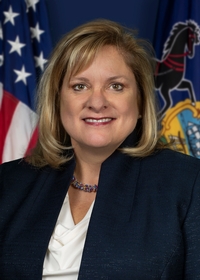
Sen. Tracy Pennycuick
Sponsored bills
Maddy summaryThis resolution designates July 4, 2026, as 'Knoebels Amusement Resort Day' throughout Pennsylvania to honor the park's 100th anniversary. The bill recognizes Knoebels, a family-owned amusement park in Elysburg, for its century of operation and its status as the largest free-admission park in the United States. It highlights the park's history, from its origins as a picnic destination to its current offerings of rides and attractions, while noting its resilience against past flooding challenges. The measure serves as a commemorative tribute rather than enacting new laws or funding.
Maddy summarySenate Resolution 307 formally recognizes the United States Army Field Band for its participation in the Pennsylvania Senate's ceremonial meeting on May 5, 2026. The resolution honors the band's historical legacy and thanks them for performing at the event held at the National Constitution Center in Philadelphia. This document serves as a commemorative acknowledgment rather than a law that changes policy or affects public programs.
Maddy summaryThis bill updates Pennsylvania's vehicle inspection rules by exempting the newest model year vehicles from emission testing for five years and removing the gas cap test requirement for cars manufactured without one. While these newer cars are waived from emission checks, they must still undergo visual inspections to ensure emissions control parts have not been tampered with. Additionally, the legislation directs the state to stop spending money on the enhanced emission inspection program in several specific counties and to submit a revised plan to the federal government proving those areas can still meet air quality standards without it.
Maddy summaryPennsylvania's SB 822 strengthens state preemption over local firearm regulations. It declares that state law exclusively governs all aspects of firearms, ammunition, and related items - including purchase, sale, possession, and transportation - nullifying any conflicting local ordinances, resolutions, or rules. The bill also creates a legal pathway for individuals or organizations adversely affected by local gun rules to seek court relief, including recovery of attorney fees and other costs if they successfully challenge such rules. This directly affects municipalities (cities, towns, counties) and residents or businesses operating under local firearm regulations that conflict with state law. The bill does not change existing firearm laws but explicitly prevents local governments from enacting stricter rules.
Maddy summaryThis bill increases the maximum prison sentences for people convicted of attempting, conspiring, or soliciting murder, including the murder of unborn children and law enforcement officers. It establishes a 40-year maximum for these crimes when serious bodily injury occurs, and up to life imprisonment when serious bodily injury results specifically from attempts against law enforcement officers. Additionally, the law mandates a minimum 20-year prison sentence for anyone convicted of attempting, conspiring, or soliciting the murder of a law enforcement officer where serious bodily injury is caused, or for assaulting a law enforcement officer.
Maddy summarySB 1014 amends Pennsylvania's Public School Code of 1949 to require public schools to adopt a "bell-to-bell phone-free policy" during the entire school day. This policy directly affects all public K-12 schools and students by prohibiting the use of personal electronic devices during instructional time. The key provision mandates that schools establish and enforce this policy, though the bill does not specify exemptions or implementation details. The legislation focuses on reducing distractions in classrooms by limiting student phone access from the start to the end of the school day. It is currently pending in the Education committee.
Maddy summarySB 64 creates an official logotype for veteran-owned businesses in Pennsylvania (defined as businesses where veterans own at least 51% of the interest). Businesses can apply to use the logotype through a department process, with a $250 fee and optional contributions to the Military Family Relief Assistance Fund. The fund, established under existing law, will use these fees and contributions to support military families. The bill also imposes penalties for falsely claiming veteran status to use the logotype. It directly affects veteran-owned businesses and funds military family relief programs.
Maddy summarySB 507 amends Pennsylvania's medical licensing law to reestablish the State Board of Medical Education and Licensure as the State Board of Medicine and update its structure. It directly affects midwifery professionals by creating three new license categories: midwifery, nurse-midwife, and certified midwife. The bill establishes specific requirements and definitions for these licenses under the board's authority. This change clarifies licensing pathways for midwifery practitioners within the state's medical regulatory framework. The bill passed final passage on October 21, 2025.
Maddy summarySB 256 requires child care facilities in Pennsylvania that use fossil fuel appliances (like heaters or fireplaces) to install and maintain operational, approved carbon monoxide alarms. Specifically, facilities must have alarms centrally located near these appliances and in every unit on the same floor within 18 months of the law's effective date. The bill ties compliance to licensing, stating the Department of Human Services cannot issue or renew a license for facilities failing to meet these standards unless a provisional license applies. It directly affects licensed child care facilities, including homes caring for 4-6 non-relative children, licensed schools, and facilities operating 24+ hours daily.