

Maddy summarySB 42 amends Pennsylvania's criminal code to explicitly include 3-D printed firearms in all definitions of "firearm" across multiple sections, affecting anyone possessing, manufacturing, or selling such weapons. Key provisions require 3-D printed firearms to comply with standard firearm regulations, including prohibiting their creation without a federal manufacturing license (Section 11). The bill also updates definitions for offenses like assault on law enforcement, discharge of firearms in occupied structures, and paramilitary training to encompass 3-D printed weapons. It directly impacts firearm creators, sellers, and possessors by extending existing licensing, registration, and sales surcharge requirements to 3-D printed firearms.
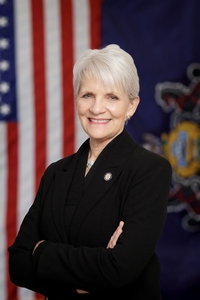
Sen. Carolyn Comitta
Sponsored bills
Maddy summarySB 46 requires Pennsylvania's Attorney General to develop a statewide model policy within 120 days to prevent excessive force by law enforcement officers and school security personnel, after consulting with agencies, associations, and community groups. The policy must include specific standards for de-escalation tactics, reasonable alternatives to force, and prohibitions on chokeholds. All law enforcement agencies and school entities must adopt this model policy within 60 days or create a comparable policy meeting its minimum standards. Failure to comply risks loss of state funding, with annual training and biennial policy reviews mandated to ensure ongoing compliance.
Maddy summaryThis bill (SB 37) amends Pennsylvania law to prohibit individuals convicted of specific violent or dangerous crimes from possessing firearms. It directly affects people convicted of offenses like murder, aggravated assault, robbery, sexual assault, stalking, or certain types of kidnapping. The key mechanism adds over 50 existing criminal offenses - such as assault involving a firearm, robbery, or child sexual abuse - to a list where a conviction triggers an automatic firearm possession ban. The change clarifies that if someone is convicted of any of these listed crimes, they cannot legally own or carry a firearm.
Maddy summarySB 121 establishes the Center for Gun Violence Research in Pennsylvania to conduct nonpartisan, academic research on gun violence causes, prevention, and impacts. The center, to be operated by a state-selected university, will analyze data on gun-related deaths, costs, and prevention strategies, and provide evidence-based findings to policymakers. It requires state agencies to share relevant data and mandates biennial reports to the Governor and General Assembly. The bill directly affects Pennsylvania residents by funding research to address a public health crisis highlighted by the state’s high gun violence death rates and the lack of federal research funding since the 1996 Dickey Amendment.
Maddy summarySB 24 establishes Pennsylvania's Office of New Americans within the Department of Community and Economic Development to support immigrant integration. The office will serve as a central resource for state agencies, immigrants, and organizations by answering inquiries, coordinating policies, analyzing demographic trends, and developing strategies to attract and retain immigrants. It also creates an Advisory Committee with 11 voting members representing state agencies, immigrant-serving organizations, businesses, education, healthcare, and language services to guide the office’s work. The bill directly affects immigrants seeking to integrate into Pennsylvania’s economy and communities, as well as state agencies responsible for licensing, education, and economic development. The Office of New Americans will begin operations upon the bill’s effective date.
Maddy summarySB 25 amends Pennsylvania's Professional Nursing Law to update regulations for certified registered nurse practitioners (CRNPs). It clarifies definitions, including "Advanced Practice Registered Nurse-Certified Nurse Practitioner" (APRN-CNP), and specifies their scope of practice, including prescribing authority for certain medications. The bill requires CRNPs to collaborate with physicians through written agreements and immediate communication protocols, while transferring oversight of CRNP licensing from the State Board of Medicine to the State Board of Nursing. These changes directly affect nurse practitioners, the State Board of Nursing, and physicians working with CRNPs in Pennsylvania.
Maddy summarySB 148 requires applicants for a Pennsylvania concealed firearm license to demonstrate firearm competency through approved training or experience. It directly affects individuals seeking concealed carry permits by adding a new requirement to prove competency before a license can be issued. Key provisions include listing specific acceptable methods (like hunter safety courses, NRA training, or military service) and mandating documentation like certificates or instructor affidavits. The bill amends the application form to include a certification statement about completing such training, which must be submitted with the license application.
Maddy summarySB 75 amends Pennsylvania's Controlled Substance Act to decriminalize minor marijuana offenses. It removes criminal penalties for possessing up to 30 grams of marijuana (or 8 grams of hashish) for personal use, distributing small amounts without intent to sell, or smoking small amounts in public spaces. Instead of misdemeanor charges, these violations now carry only minor fines: $25 for possession or non-sale distribution, and $100 for public smoking. The bill explicitly states these offenses will not trigger license suspensions under Pennsylvania law. This change directly affects individuals caught with small amounts of marijuana for personal use or non-commercial distribution.
Maddy summarySB 106 requires restaurants and similar establishments in Pennsylvania to prominently display health department-developed allergy awareness posters and include menu notices informing customers they must inform servers about food allergies. The bill directly affects public eateries (like restaurants and cafes) and customers with food allergies by mandating these specific awareness measures. Key provisions include the Department of Health creating the required posters in consultation with allergy advocacy groups and requiring menus to state customers' obligation to disclose allergies to staff. The law takes effect 60 days after enactment.
Maddy summarySB 97 updates Pennsylvania's ethics rules for public officials and employees by clarifying what constitutes a "gift" and requiring disclosure of certain gifts. It prohibits officials from accepting gifts valued at $250 or more from lobbyists or individuals seeking official action, while excluding small tokens ($50 or less), family gifts, and public event hospitality. Officials must report gifts totaling $250 or more annually, with penalties including felony charges (up to 5 years in prison or $10,000 fines) for violations involving $250+ gifts. The bill directly affects state legislators, agency staff, and other public employees required to file financial disclosure statements.