

1 co-sponsor
Total votes
2,258
all sessions
Attendance
99%
20 missed
Near the chamber average
With party
98%
of cast votes
Near the chamber average
Bipartisan score
2%
crosses aisle rarely
Higher than 78% of chamber peers
Sponsored
1,806
bills & resolutions
Higher than 78% of chamber peers
Committees
5
assignments
1,806 bills and resolutions
Sponsored bills
Total
1,806
Primary
93
Co-sponsor
1,713
This page
1,806
matching current filters
1 co-sponsor
A Resolution recognizing the month of September 2026 as "Suicide Prevention Month" in Pennsylvania.
Maddy summaryPennsylvania Senate Resolution 358 officially designates September 2026 as Suicide Prevention Month within the state. The resolution cites national and local statistics regarding suicide rates and mental health challenges to support this designation. It aims to raise public awareness, encourage open dialogue about mental health, and promote community engagement during the designated month.
In committee Aug 24, 2026
1 co-sponsor
A Resolution recognizing the month of September 2026 as "National Preparedness Month" in Pennsylvania.
Maddy summaryThis Pennsylvania Senate resolution formally designates September 2026 as "National Preparedness Month" within the state. It encourages residents to take proactive steps for disaster readiness, such as creating family evacuation plans, maintaining essential supplies, and reviewing insurance coverage. The measure also aims to recognize the contributions of emergency managers, first responders, and organizations dedicated to protecting lives and property during crises.
In committee Aug 19, 2026
1 co-sponsor
An Act amending Title 18 (Crimes and Offenses) of the Pennsylvania Consolidated Statutes, in obstructing governmental operations, further providing for obstructing administration of law or other governmental function.
Maddy summaryPennsylvania Senate Bill 1430 amends state criminal law to allow owners, operators, and employees of health care facilities to use nonviolent means to deny entry to law enforcement officers on their premises. This protection applies unless the officer can demonstrate probable cause that a specific individual is present and physically possesses a judicial warrant clearly identifying that person as the subject of the order. The bill defines key terms such as "health care facility" and "judicial warrant," limiting the scope of this exception to written orders from federal or state courts. If enacted, the law would take effect 60 days after its passage.
Criminal JusticeOpposes Criminal JusticeBill restricts law enforcement access to health facilities by requiring specific warrants for entry, limiting police operational capabilities.
HealthcareSupports HealthcareBill grants health care facilities the right to deny entry to law enforcement without a specific warrant, protecting operational autonomy and patient privacy.
In committee Aug 13, 2026
1 co-sponsor
An Act establishing the Jayanna Powell Hit-and-Run Direct Notification System Pilot Program in the city of the first class; requiring registration of motor vehicle repair facilities; and imposing penalties.
Maddy summaryPennsylvania Senate Bill 1425 establishes a five-year pilot program in Philadelphia that requires law enforcement to directly notify all registered motor vehicle repair facilities when a hit-and-run accident results in serious injury or death. The bill mandates that commercial garages and shops register with the city to receive these alerts, which include specific details such as the vehicle's make, model, color, license plate number, and extent of damage. If a repair facility discovers a vehicle in its possession that matches the description in an alert, the owner or operator must report it to law enforcement within 72 hours. Failure to comply with this reporting requirement is punishable by a third-degree misdemeanor, and the city must submit annual reports to state agencies detailing the program's costs and activity.
Criminal JusticeSupports Criminal JusticeBill enhances law enforcement capabilities by mandating direct notification of hit-and-run details to repair shops, aiding in criminal investigation and prosecution.
TransportationSupports TransportationBill enhances transportation safety by establishing a hit-and-run notification system for vehicle repair facilities to aid in accident investigation.
In committee Aug 10, 2026
1 co-sponsor
An Act designating the interchange of Interstate 81 with State Route 4007, known as Exit 119, on the border of Cass Township and Butler Township, Schuylkill County, as the PSP Trooper Michael E. Pahira, Jr. Memorial Interchange.
Maddy summaryPennsylvania Senate Bill 1426 designates the Interstate 81 and State Route 4007 interchange, known as Exit 119 in Schuylkill County, as the PSP Trooper Michael E. Pahira, Jr. Memorial Interchange. The bill honors Trooper Pahira, who died in July 2026 after being struck by a tractor-trailer while conducting a commercial vehicle safety inspection at that specific location. It directs the state Department of Transportation to erect and maintain signs displaying the new name at the interchange.
In committee Aug 10, 2026
1 co-sponsor
An Act amending the act of December 4, 1996 (P.L.911, No.147), known as the Telemarketer Registration Act, further providing for definitions, for registration requirement, for unlawful acts and penalties, for blocking of caller identification and other telemarketing screening products or services prohibited, for unwanted telephone solicitation calls prohibited, for violations and for investigation.
Maddy summarySB 992 updates Pennsylvania's 1996 Telemarketer Registration Act to strengthen rules for phone sales calls. It requires telemarketers to register and prohibits blocking caller ID features used to screen calls, while banning unwanted solicitation calls. The bill also clarifies penalties for violations and enhances enforcement mechanisms for consumer protection. These changes directly affect telemarketers operating in Pennsylvania and aim to reduce unwanted calls for residents.
Signed into law Jul 20, 2026
1 co-sponsor
A Resolution honoring the life and expressing condolences on the passing of former State Senator Shirley M. Kitchen.
Maddy summaryThis resolution honors the life of former State Senator Shirley M. Kitchen and expresses condolences on her passing. It recognizes her career as a social worker, activist, and legislator who served Philadelphia for 20 years, focusing on health care and affordable housing. The document outlines her personal background and public service achievements, including her role as the leader of the 20th Ward Democratic Executive Committee. By formally acknowledging her contributions, the Senate pays tribute to her legacy of community advocacy.
Passed Jul 12, 2026
1 co-sponsor
An Act authorizing the Commonwealth of Pennsylvania to join the Counseling Compact; and providing for the form of the compact.
Maddy summarySB 604 authorizes Pennsylvania to join the Counseling Compact, a multi-state agreement allowing licensed professional counselors to practice across participating states without obtaining separate licenses. This directly affects licensed counselors - especially those serving military families who relocate frequently - and their clients in member states. Key provisions include mutual recognition of licenses, standardized disciplinary processes, and support for telehealth services to improve access to counseling. The compact eliminates the need for counselors to hold multiple state licenses while ensuring accountability under each state’s practice laws where the client is located.
Signed into law Jul 12, 2026
1 co-sponsor
Ask Maddy
·
AI policy assistant
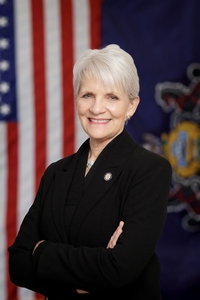
Ask Maddy about Carolyn Comitta
Scope: pennsylvania
Hi! I can help you understand Carolyn Comitta's legislative record. What would you like to know?
Try one of these
i
Maddy answers using official bill text and legislative records. Always verify before sharing.
Sources cited inline