

Maddy summaryThis resolution (SR 40) designates March 9-15, 2025, as "Pulmonary Rehabilitation Week" in Pennsylvania. It symbolically recognizes the importance of pulmonary rehabilitation for improving quality of life for people with chronic respiratory diseases, which are a leading cause of death in the state. The resolution specifically acknowledges the work of the American Association of Cardiovascular and Pulmonary Rehabilitation (AACVPR) and pulmonary specialists in addressing lung health. As a ceremonial resolution, it does not create new laws or obligations.
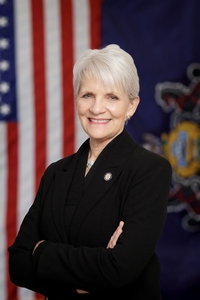
Sen. Carolyn Comitta
Sponsored bills
Maddy summaryThis bill amends Pennsylvania's Public School Code to change how intermediate school service agencies (like regional education providers) handle facility acquisitions and state funding. It grants intermediate unit boards the power to buy, lease, or accept gifts of land/buildings (Section 914-A(11)) but requires pre-approval from the Secretary of Education for all lease/loan agreements involving facilities (Section 919.1-A(a)). The state will provide capital subsidies based on a formula: student enrollment multiplied by average district spending per student, then multiplied by 0.03% (using the latest available data). This directly affects intermediate units and school districts using their services, as it alters facility financing rules and state funding calculations.
Maddy summaryThis resolution (SR 42) symbolically recognizes March 2025 as "National Nutrition Month®" in Pennsylvania, aligning with a national campaign led by the Academy of Nutrition and Dietetics. It does not create new laws or funding; instead, it encourages all Pennsylvanians to participate in the campaign focused on healthy eating habits and the theme "Food Connects Us." The resolution serves as a ceremonial acknowledgment of the importance of nutrition education, referencing the Academy's role and the health benefits of informed food choices. It has no direct legal effect on individuals or policies.
Maddy summarySB 426 establishes the Legislative Youth Advisory Council within Pennsylvania's Administrative Code, creating a 50-member advisory body composed of youth aged 14-18 (one from each senatorial district) to address youth-focused issues like education, health, employment, and policy. The council will advise the General Assembly on legislation and budget matters related to youth, hold at least three meetings annually, and submit annual reports starting in 2026. Members serve two-year terms and may apply for reappointment, with the Lieutenant Governor overseeing appointments and providing administrative support. The bill does not change substantive laws but creates a formal structure for youth input into state government processes.
Maddy summarySR 38 is a symbolic resolution designating March 2025 as "Music in Our Schools Month," "Theater in Our Schools Month," "Dance in Our Schools Month," and "Youth Art Month" in Pennsylvania. It does not create new laws or funding but formally recognizes the value of arts education for students in grades K-12. The resolution highlights research showing arts education improves academic performance, social skills, and student engagement. It aims to raise public awareness about the importance of accessible arts programs, particularly for underserved students. This is a procedural resolution with no direct policy impact on school curricula or budgets.
Maddy summarySB 459 establishes Pennsylvania's Statewide Imagination Library Program, providing free monthly age-appropriate books to children under five years old in the state. The program is funded through a dedicated state account (using state funds, gifts, and federal dollars) and requires local partners to match funding dollar-for-dollar, with waivers possible for financial hardship. The Department of Education administers the program, coordinating with a nonprofit partner to manage book distribution, local program development, and public awareness. This directly affects eligible children and local community organizations participating in the initiative.
Maddy summarySR 45 is a symbolic resolution recognizing February 15, 2025, as "International Childhood Cancer Day" in Pennsylvania. The resolution highlights global childhood cancer statistics - including that cancer is a leading cause of disease-related death among children in the U.S. - and aims to raise awareness, honor children affected by cancer, and encourage support for research and care. It does not create new laws or directly affect specific groups, but calls on Pennsylvanians to join efforts to advance pediatric cancer research and improve access to treatment. The resolution is purely commemorative, with no policy changes or funding mechanisms attached.
Maddy summarySB 434 repeals a specific section (§ 1704) of Pennsylvania's domestic relations law that previously declared marriage between same-sex couples void in the state and stated marriage must be between one man and one woman. The bill removes this legal provision but does not change current marriage laws or rights for same-sex couples in Pennsylvania. It directly affects the state's statutory code by eliminating an outdated policy statement about marriage. The bill is currently referred to the Judiciary committee for further consideration.
Maddy summarySB 443 requires Pennsylvania employers to grant eligible employees up to two hours of paid time off on election days to vote. It applies to all employers in the state and directly affects registered voters who need to cast ballots during work hours. The bill mandates that employers must permit this leave without penalty, though they may specify the exact hours during which the time off can be taken. The policy aims to reduce barriers to voting by ensuring workers can access polling places without losing work time. The bill is currently pending in the State Government committee.
Maddy summarySB 442 allows eligible Pennsylvania voters to register on election day at their polling place by providing proof of residence (such as a driver's license, approved document, or a sworn statement from another registered voter). It requires election judges to process registrations separately from voting, maintain records of attempted registrations, and forward completed forms to county election offices. County boards must verify 25% of new election-day registrations by mail within 10 days and report ineligible registrations to prosecutors. The bill prohibits fraudulent registrations (e.g., registering someone ineligible or in multiple districts) as a misdemeanor offense. This law applies to all future primary, municipal, and general elections after its effective date.