

Maddy summarySB 145 amends Pennsylvania's Public Official Compensation Law to adjust how state legislators' salaries are calculated. It establishes that members of the General Assembly and their officers/leaders receive annual cost-of-living adjustments (COLA) based on the Consumer Price Index for the Pennsylvania-New Jersey-Delaware-Maryland area. The bill specifically blocks COLA increases for the 2020-2021 period and allows legislators to opt out of receiving a COLA by notifying the Chief Clerk 10 days before the adjustment date. This directly affects all current and future Pennsylvania legislators by altering their salary adjustment mechanism.
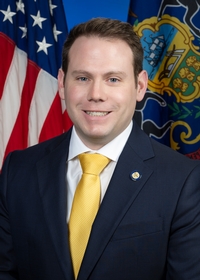
Sen. Jarrett Coleman
Sponsored bills
Maddy summarySB 66 amends Pennsylvania's ethics laws to clarify restrictions on cash gifts for public officials and employees. It defines "cash gift" broadly to include money, gift cards, prepaid cards, and virtual currency, while excluding certain common transactions like family gifts or public contests. The bill prohibits officials from accepting cash gifts from lobbyists or people seeking official action, with penalties of up to $1,000 for gifts under $250 (misdemeanor) or $10,000 plus potential imprisonment for $250+ gifts (felony). These changes directly affect Pennsylvania public officials and employees who may receive such gifts.
Maddy summarySB 97 updates Pennsylvania's ethics rules for public officials and employees by clarifying what constitutes a "gift" and requiring disclosure of certain gifts. It prohibits officials from accepting gifts valued at $250 or more from lobbyists or individuals seeking official action, while excluding small tokens ($50 or less), family gifts, and public event hospitality. Officials must report gifts totaling $250 or more annually, with penalties including felony charges (up to 5 years in prison or $10,000 fines) for violations involving $250+ gifts. The bill directly affects state legislators, agency staff, and other public employees required to file financial disclosure statements.
Maddy summaryThis Pennsylvania bill officially establishes Vietnam War Veterans Day as a state observance to be held annually on March 29. The legislation directs the Governor to issue a yearly proclamation encouraging public schools and educational institutions to hold events that honor the service and sacrifices of Vietnam veterans, while explicitly stating that participation in these events cannot be mandatory. By adding this designation to the state statutes, the bill ensures that the contributions of those who served during the Vietnam Conflict are formally recognized within Pennsylvania, aligning the state with the existing federal observance.
Maddy summaryThis bill requires hospitals to publicly display their prices for medical items and services on their websites to help patients understand costs before receiving care. It mandates that hospitals publish detailed lists of charges, including standard rates, negotiated prices with insurance plans, and discounted cash prices, in both digital and printable formats. Additionally, the legislation prohibits hospitals from taking collection actions, such as sending debt to collectors, against patients if the hospital fails to comply with these price transparency rules. These measures directly affect hospitals and their patients by increasing financial clarity and holding facilities accountable for maintaining accessible pricing information.
Maddy summaryThis Senate resolution officially designates October 2024 as "Down Syndrome Awareness Month" within the state of Pennsylvania. The bill aims to highlight the lives and contributions of individuals with Down syndrome and their families through a formal state recognition. It does not alter any laws, allocate funding, or change existing policies, but rather serves as a symbolic gesture to increase public awareness. The measure was referred to the Rules and Executive Nominations committee for further processing.
Maddy summaryThis resolution directs the Pennsylvania Senate to summon Patrick M. Browne, the Secretary of Revenue, to appear before the Senate for refusing to comply with a subpoena. The subpoena ordered the release of specific tax data related to Neighborhood Improvement Zone programs, which the Department of Revenue declined to provide despite a legal opinion stating the information is not confidential. The bill outlines the Senate's intent to determine if the Secretary is in contempt of the chamber for defying the committee's authority to investigate state agency operations.
Maddy summaryThis bill amends the Professional Nursing Law to create a new program allowing certified registered nurse practitioners to work independently in rural areas without needing a written agreement with a physician. To qualify, a nurse practitioner must hold a current license, have no recent disciplinary actions, and demonstrate at least three years of prior practice experience involving over 3,600 hours. Once approved, eligible practitioners can prescribe treatments and manage patient care solely based on their nursing expertise, provided they continue to meet biennial renewal requirements and complete specific continuing education on patient safety. The legislation also clarifies that these nurses must identify themselves clearly to patients and refer cases beyond their scope of practice, while removing legal liability for collaborating physicians when the nurse practices under this new program.
Maddy summaryThis Pennsylvania bill cancels existing rules that governed the state's CO2 Budget Trading Program, a system designed to manage carbon emissions through a cap-and-trade mechanism. By repealing the specific regulations found in the state's administrative code, the legislation effectively ends the current framework for trading carbon allowances and managing emission limits. The law takes effect immediately upon passage, removing the legal basis for the program's operations without altering the underlying concept of the trading system itself.
Maddy summaryThis bill establishes the Pennsylvania Award for Student Success Scholarship Program, which provides financial assistance to help eligible students attend participating nonpublic schools. To qualify, a student must be a Pennsylvania resident living in a household with income below 250% of the federal poverty guidelines and reside within the attendance boundary of a school designated as low-achieving. The program creates scholarship accounts that parents can use to pay for tuition, school-related fees, and special education services at approved private schools. Additionally, the bill requires school districts with low-achieving schools to notify parents about the program and provide lists of designated schools.