

Maddy summaryHB 1092 establishes a program to refund a portion of Pennsylvania's state budget surplus directly to eligible taxpayers. It requires the State Treasurer and Department of Revenue to identify resident individuals who filed 2024 tax returns and paid their liabilities, then calculate payments based on the General Fund surplus (capped at the June 2024 surplus amount) and the Budget Stabilization Reserve Fund (capped at the fund balance minus 6% of 2024-2025 General Fund revenues). The bill specifies that payments must be made within 45 days of a funding appropriation, with any unused funds returned to the Budget Stabilization Reserve Fund. This program directly affects Pennsylvania residents who filed 2024 individual income tax returns and paid their tax liability.
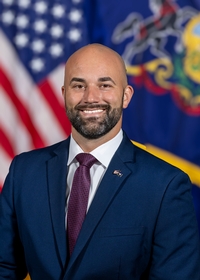
Rep. David Rowe
Sponsored bills
Maddy summaryThis bill amends Pennsylvania's Cosmetology Law to clarify definitions and update licensing procedures. It specifically defines "mobile unit" as a self-contained, at least 24-foot-long vehicle that must be licensed and meet health/safety rules, and expands "salon" to include such mobile units. The bill also requires salon owners changing their physical location (excluding mobile units) to obtain a new license, with the fee for this new license to be set by the licensing board. These changes directly affect cosmetology businesses, particularly those operating mobile services or relocating fixed locations.
Maddy summaryThis Pennsylvania House resolution (HR 160) urges Congress to amend the PACT Act to include veterans exposed to toxic substances at Camp Carroll military base in South Korea. It specifically seeks to extend the PACT Act's health benefits - which currently cover veterans exposed to toxins at other sites - to veterans who served at Camp Carroll during the Vietnam War era and developed related illnesses like cancer or diabetes. The resolution cites a 2011 report confirming chemical burial at Camp Carroll and notes these veterans remain excluded from PACT Act benefits despite documented health impacts. It does not create new law but formally requests congressional action to correct this exclusion.
Maddy summaryHB 1083 updates Pennsylvania's 1931 Barbers' License Law to clarify definitions and modernize regulations. It specifically defines "mobile unit" as a self-contained barber establishment at least 24 feet long that must be licensed by the board and meet health/safety standards. The bill requires the Department of State to maintain public records of licensed barber shops (including addresses of mobile unit owners) and allows a reasonable fee for copies. It also mandates that shops display a visible notice with a consumer complaint phone number and requires inspections to be conducted by authorized agents (not board members), with approved premises displaying a seal or sticker. These changes primarily affect barber shops, mobile barber units, and their operators.
Maddy summaryHB 1069 modifies Pennsylvania's Public School Code to allow military-connected students to enroll in schools before establishing residency. Specifically, it requires school districts to permit children of active-duty military members (with official transfer orders) to enroll immediately upon providing military orders and proof of intent to move (e.g., lease, home purchase contract). The bill mandates that schools accept transferred credits with their original grades for GPA calculations and requires families to submit residency proof within 45 days of the military transfer date. This directly affects military families relocating within Pennsylvania, ensuring continuity in education during relocations.
Maddy summaryThis Pennsylvania House Resolution (HR 2) designates March 25, 2025, as "National Medal of Honor Day" within the state. It symbolically recognizes the Medal of Honor - the military's highest award for valor - as first presented on March 25, 1863, and highlights Pennsylvania's 379 Medal of Honor recipients (second-highest in the U.S.). The resolution has no binding effect or new policy requirements; it solely serves to honor recipients and their service through a ceremonial designation. It does not directly affect any individuals or alter existing laws.
Maddy summaryHB 1061 requires Pennsylvania voter registration applicants to provide documentary proof of U.S. citizenship when applying to register. This applies to all registration methods - online, in-person, by mail, or with a driver's license application. Acceptable proof includes passports, birth certificates, military IDs, naturalization documents, or other government-issued IDs showing U.S. birthplace. The bill mandates that election officials verify citizenship during registration and adds penalties for officials who fail to comply. It directly affects anyone seeking to register to vote in Pennsylvania.
Maddy summaryThis bill proposes a constitutional amendment to Pennsylvania that would ban all taxes on real property, including land and buildings owned by individuals or businesses. The change would take effect on July 1, 2030, and would apply to taxes imposed by the state government, local municipalities, school districts, or any other political subdivision within the Commonwealth. To become law, the amendment must pass both houses of the General Assembly and then be approved by voters in a statewide election. The bill argues that taxing property violates the inherent right to own and protect property, a principle recognized since Pennsylvania's founding in 1776.
Maddy summaryHB 569 amends Pennsylvania's Emergency and Law Enforcement Personnel Death Benefits Act to expand eligibility for death benefits. It explicitly includes coroners (and medical examiners) as covered personnel and adds a presumption that fatal heart attacks or strokes occurring during duty or within 24 hours of physical training/emergency response are work-related. This change directly affects surviving spouses, children, or parents of coroners, firefighters, ambulance/rescue personnel, law enforcement officers, and National Guard members who die in the line of duty. The bill updates the act's definition of "coroner" and ensures benefits are granted for these new circumstances.
Maddy summaryThis resolution designates April 13-19, 2025, as "National Public Safety Telecommunicators Week" in Pennsylvania. It honors 911 dispatchers (also called public safety telecommunicators) who serve as the first point of contact during emergencies and support emergency responders. The resolution recognizes their critical role in ensuring community safety through their professionalism and dedication during high-pressure situations. As a ceremonial resolution, it does not create new laws or policies.