

Maddy summaryHB 1168 allows Pennsylvania vehicle owners and driver's license applicants to voluntarily contribute $5 (for license or one-year registration) or $10 (for two-year registration) to their local fire company when paying fees. These contributions are added to standard registration or license renewal costs and collected by the Department of Motor Vehicles. Quarterly, the funds are transferred to the newly created Local Fire Company Fund and distributed by the State Fire Commissioner to fire companies based on the registered addresses of contributors. The bill directly supports local fire departments through a streamlined, voluntary public contribution mechanism.
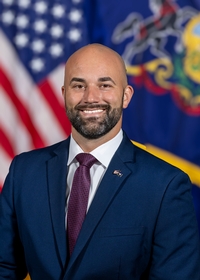
Rep. David Rowe
Sponsored bills
Maddy summaryHB 1170 allows Pennsylvania corrections officers to use electronic control gloves - gloves with electrodes emitting under 500 volts to temporarily immobilize individuals - in specific prison units. It requires these gloves only for officers assigned to units housing inmates who received disciplinary sanctions and are segregated from the general population. The department must create public policies on glove use, training, and maintenance, and officers must complete department-approved training before use. The bill also mandates compliance with existing use-of-force laws (18 Pa.C.S. § 508) and defines the gloves’ technical specifications.
Maddy summaryHB 1171 amends Pennsylvania's Liquor Code to modify rules for businesses holding "wine expanded permits." It allows these permit holders to sell up to 3,000 milliliters (about 101 ounces) of wine per transaction for off-premises consumption during their regular operating hours. The bill also clarifies that wine sales for take-home use cannot occur after 11:00 PM until the business's next permitted operating hours, including Sundays if authorized. This directly affects existing licensed businesses (like wineries or restaurants) with wine expanded permits seeking to sell wine for customers to take away.
Maddy summaryHB 1172 defines "utility terrain vehicle" (UTV) as a four-wheel off-road vehicle with specific size and weight limits (max 64 inches wide or 1,700 pounds), excluding ATVs, snowmobiles, and other vehicle types. The bill clarifies that state, local, and county authorities can designate roads for UTVs, snowmobiles, and ATVs, including whether these roads may share space with regular traffic. It requires helmets for snowmobile and ATV operators and passengers on shared roads but exempts UTVs equipped with bucket seats, seat belts, and roll cages. The law also directs the Department of Transportation to specify approved helmet types through regulations.
Maddy summaryHB 401 designates the eastern box turtle (Terrapene carolina carolina) as Pennsylvania's official state reptile. This symbolic designation recognizes the turtle as a native species found across the state in diverse habitats and facing population declines due to habitat loss and other threats. The bill contains no new regulations, funding, or policy changes - only formal recognition to raise awareness about the species. It takes effect immediately upon passage.
Maddy summaryHB 1037 amends Pennsylvania's Municipalities Planning Code to allow municipalities to permit the replacement of demolished one- or two-family homes with structurally similar residential buildings using the original property's setback standards. This provision directly affects homeowners seeking to rebuild single-family or duplex properties and local governments issuing building permits. The key mechanism requires municipalities to provide these original setback standards to applicants when approving such replacements, streamlining the rebuilding process while maintaining consistent lot coverage. The bill does not change zoning requirements but offers flexibility for residential reconstruction within existing development patterns.
Maddy summaryHB 541 amends Pennsylvania's vehicle registration law to expand who can verify lost, stolen, damaged, or illegible license plates. It allows trained staff in state legislators' district offices (after department-approved training) and contracted messenger service employees to serve as authorized representatives for this purpose. The bill directly affects vehicle owners needing to replace plates by adding these new verification options. It does not change fees, timelines, or the core registration process, only specifying who may complete the verification step.
Maddy summaryHB 1164 authorizes Pennsylvania's Department of Environmental Protection (DEP) to propose a carbon dioxide emissions tax or fee after following a strict public process. It requires the DEP to hold 180 days of public comment, conduct four public hearings across the state, and submit detailed reports to lawmakers on economic impacts, facility-level emissions, and electricity price effects before any such tax can be considered. The bill directly affects electric generation facilities (like power plants) and electricity consumers by mandating transparency and analysis of how a carbon tax would impact costs and operations. Crucially, it does not impose a tax itself but creates the procedural framework for future legislative action on carbon emissions regulation.
Maddy summaryHB 1105 requires Pennsylvania state agencies to undergo regular zero-based budget reviews, mandating that every program be justified from scratch at least once every five years. Starting in 2026, the Secretary of the Budget must review approximately one-fifth of the state budget annually, with agencies required to submit detailed plans explaining each program's legal basis, estimated impacts if discontinued, and itemized costs for maintaining services at both minimum and current levels. This directly affects all state agencies and the Budget Secretary, shifting budget decisions away from incremental adjustments to past spending. The bill aims to eliminate outdated programs by requiring agencies to prove the necessity and cost-effectiveness of each activity through specific documentation, not just historical spending patterns. It takes effect 60 days after enactment.
Maddy summaryHB 1112 allows Pennsylvania electric utility customers to request traditional electromechanical analog meters instead of smart meters. Customers can elect this option by notifying their utility company, and if the utility has already installed smart meters, they may charge the customer for the switch - amortized over 12 months - but cannot impose additional fees. The bill directly affects residential and commercial electricity customers who prefer analog meters for privacy or cost reasons. It defines "electromechanical analog meters" as devices with no wireless capabilities, no power line transmission/reception, and specific safety features, while ensuring costs are recovered through approved utility rates.