

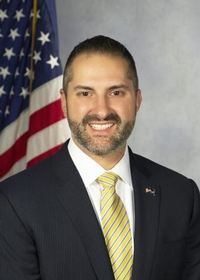
Photo of Steve Malagari
D Pennsylvania House · District 53 On the 2026 ballot

Rep. Steve Malagari

Compare
Total votes
7,497
all sessions
Attendance
99%
33 missed
Near the chamber average
With party
98%
of cast votes
Higher than 87% of chamber peers
Bipartisan score
1%
crosses aisle rarely
Lower than 93% of chamber peers
Sponsored
1,414
bills & resolutions
Higher than 87% of chamber peers
Committees
5
assignments
1,414 bills and resolutions

Sponsored bills

Total
1,414
Primary
79
Co-sponsor
1,335
This page
1,414
matching current filters
Co-sponsor HB 79
Passed · Pennsylvania House · Co-sponsor
An Act establishing requirements for hospital-based financial assistance; providing for hospital-based financial assistance forms, for information about hospital-based financial assistance programs and for reporting of hospital-based financial assistance policies; and imposing duties on the Department of Health.

Maddy summaryHB 79 requires hospitals to establish clear financial assistance programs for patients who cannot afford care, including standardized forms and easily accessible information about eligibility and coverage. It mandates that hospitals publicly share details about their financial aid policies and report their program rules to the Department of Health. These requirements directly affect hospitals operating in the state and patients seeking financial help with medical bills. The bill aims to standardize and increase transparency in hospital financial aid offerings.

Passed May 22, 2025 1 co-sponsor
Co-sponsor HB 926
Passed · Pennsylvania House · Co-sponsor
An Act providing for violence prevention committees in health facilities, for duties of committees, for workplace violence reporting requirements and for powers and duties of the Department of Labor and Industry; and imposing fines and administrative penalties.

Maddy summaryHB 926 requires healthcare facilities to establish violence prevention committees to address workplace violence. These committees must develop safety plans, and facilities must report violent incidents to the Department of Labor and Industry. The Department gains authority to enforce compliance, impose fines, and issue administrative penalties for violations. This bill directly affects hospitals, clinics, and all healthcare workplaces covered under state labor regulations.

Passed May 22, 2025 1 co-sponsor
Co-sponsor HB 1062
Passed · Pennsylvania House · Co-sponsor
An Act amending Title 53 (Municipalities Generally) of the Pennsylvania Consolidated Statutes, in neighborhood blight reclamation and revitalization, providing for State blight data collection system; and establishing the Property Maintenance Code Serious Violations Registry and the Property Maintenance Code Serious Violations Registry Account.

Maddy summaryHB 1062 creates a statewide system for tracking neighborhood blight by requiring municipalities to collect data on property maintenance violations. It establishes a Property Maintenance Code Serious Violations Registry to list properties with repeated severe maintenance issues and a dedicated funding account to support blight remediation efforts. The bill directly affects Pennsylvania municipalities, property owners, and landlords in areas designated as blighted, providing local governments with standardized data to target enforcement. Key provisions include mandatory data collection by cities/towns, a centralized registry for serious violations, and dedicated funding through the new account to aid property rehabilitation. If enacted, this would standardize blight reporting and funding across Pennsylvania communities.

Passed May 22, 2025 1 co-sponsor
Co-sponsor HB 393
Passed · Pennsylvania House · Co-sponsor
An Act amending the act of May 1, 1933 (P.L.103, No.69), known as The Second Class Township Code, in taxation and finance, further providing for township and special tax levies.

Maddy summaryHB 393 amends Pennsylvania's Second Class Township Code to increase annual tax limits for fire and ambulance services. It raises the maximum fire tax rate from 3 mills to 10 mills and ambulance tax from 0.5 mills to 5 mills, allowing townships to fund equipment, training, and emergency services. Townships can use up to half the revenue for staff salaries (with board approval) and must seek voter approval if rates exceed these new limits. This directly affects second-class townships needing to finance local fire and ambulance operations under the code.

Passed May 22, 2025 1 co-sponsor
Co-sponsor HB 937
Passed · Pennsylvania House · Co-sponsor
An Act amending Title 16 (Counties) of the Pennsylvania Consolidated Statutes, in coroner, further providing for fees for reports.

Maddy summaryHB 937 amends Pennsylvania's county statutes to establish specific fee amounts that coroners may charge for death investigation reports. It directly affects county coroners and individuals or entities requiring these official reports, such as families or legal representatives. The bill sets new, fixed fee schedules for coroner reports under Title 16 of the Pennsylvania Consolidated Statutes, replacing prior unspecified or variable fee structures. This change provides clarity on billing for a routine administrative service within county government operations.

Passed May 22, 2025 1 co-sponsor
Co-sponsor HB 504
Passed · Pennsylvania House · Co-sponsor
An Act providing for community energy facilities; imposing duties on the Pennsylvania Public Utility Commission, electric distribution companies and subscriber organizations; and providing for prevailing wage and labor requirements.

Maddy summaryHB 504, the Community Energy Act, establishes a framework for third-party-owned community energy projects (like solar gardens) in Pennsylvania. It requires electric distribution companies to connect these facilities, provides bill credits to subscribers (homeowners, renters, and businesses) for energy generated, and ensures guaranteed savings by linking subscription payments to bill reductions. Key provisions include setting size limits (max 5,000 kW for most facilities), mandating that at least 50% of subscriptions come from small users or farms, and requiring fair wages for construction workers. The bill directly affects electric companies (with new connection duties), community energy organizations (as owners/operators), and subscribers (who gain access to shared renewable energy).

Passed May 22, 2025 1 co-sponsor
Co-sponsor HB 721
Passed · Pennsylvania House · Co-sponsor
An Act amending the act of October 13, 2010 (P.L.506, No.72), known as the Construction Workplace Misclassification Act, further providing for definitions, for improper classification of employees and for criminal penalties; providing for private right of action; further providing for administrative penalties, for retaliation for action prohibited, for availability of information, for use of penalty funds and for funding; and imposing penalties.

Maddy summaryHB 721 amends Pennsylvania's Construction Workplace Misclassification Act to strengthen protections for construction workers who are incorrectly classified as independent contractors instead of employees. The bill allows affected workers to file lawsuits against companies for misclassification and imposes criminal penalties for repeated violations, while also adding safeguards against employer retaliation for reporting violations. It expands administrative penalties for misclassification and requires that penalty funds be used to support enforcement efforts. This directly affects construction companies that misclassify workers and construction workers who lose benefits like overtime pay, health insurance, or workers' compensation due to improper classification.

Passed May 22, 2025 1 co-sponsor
Co-sponsor HB 500
Passed · Pennsylvania House · Co-sponsor
An Act amending the act of March 4, 1971 (P.L.6, No.2), known as the Tax Reform Code of 1971, in Pennsylvania Economic Development for a Growing Economy (PA EDGE) Tax Credits, repealing provisions relating to local resource manufacturing, providing for Reliable Energy Investment Tax Credit, repealing provisions relating to Pennsylvania milk processing and providing for Pennsylvania milk processing; in regional clean hydrogen hubs, further providing for definitions, for eligibility, for application and approval of tax credit, for use of tax credits and for applicability; in semiconductor manufacturing and biomedical manufacturing and research, further providing for definitions and for application and approval of tax credit and providing for geothermal energy and for sustainable aviation fuel; and, in application of Prevailing Wage Act, further providing for definitions.

Maddy summaryHB 500 repeals existing tax credit provisions for local resource manufacturing (petrochemicals/fertilizers) and Pennsylvania milk processing, while creating new tax credits for clean energy and advanced manufacturing sectors. It establishes tax credits for reliable energy investments, regional clean hydrogen hubs, semiconductor manufacturing, biomedical research, geothermal energy, and sustainable aviation fuel. Eligible businesses must meet specific criteria for capital investment, job creation, and project location to apply for these credits through the Department of Revenue. The bill also updates definitions and application processes for these new credits, with annual funding limits and rules for credit usage.

Passed May 22, 2025 1 co-sponsor
Co-sponsor HB 1490
In committee · Pennsylvania House · Co-sponsor
An Act amending the act of May 22, 1951 (P.L.317, No.69), known as The Professional Nursing Law, providing for Certified Registered Nurse Practitioner Pilot Program.

Maddy summaryHB 1490 creates a pilot program allowing eligible Certified Registered Nurse Practitioners (CRNPs) to practice independently in Pennsylvania's health professional shortage areas. To qualify, CRNPs must hold a current license, have no disciplinary actions in the past five years, and complete 3,600 hours of collaborative practice with a physician in primary care (family, internal medicine, gynecology, or pediatrics) within the last five years. Under the program, participating CRNPs can prescribe medications and practice without a collaborative agreement in shortage areas, but must disclose their non-physician status to patients and notify the board if they change practice settings. The program requires biennial renewal with 10 hours of additional patient safety continuing education and limits practice to primary care within designated shortage areas.

In committee May 21, 2025 1 co-sponsor
Co-sponsor HB 1471
In committee · Pennsylvania House · Co-sponsor
An Act amending the act of March 4, 1971 (P.L.6, No.2), known as the Tax Reform Code of 1971, in personal income tax, further providing for income taxes imposed by other states.

Maddy summaryHB 1471 amends Pennsylvania's Tax Reform Code to adjust how residents can claim credits for income taxes paid to other states or territories (including U.S. territories, Puerto Rico, and the District of Columbia) on income also subject to Pennsylvania tax. The bill limits the credit to the proportion of Pennsylvania tax corresponding to the income taxed by the other jurisdiction, preventing credits that exceed Pennsylvania's tax liability. It also simplifies documentation by allowing taxpayers to submit a certified statement instead of full copies of their state tax returns to verify tax paid. This change applies to taxable years beginning after December 31, 2021.

In committee May 21, 2025 1 co-sponsor
Showing 331 to 340 of 1,414 bills
Previous 1 … 33 34 35 … 142 Next