

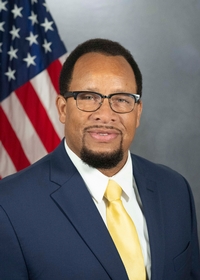
Photo of Keith Harris
D Pennsylvania House · District 195

Rep. Keith Harris

Compare
Total votes
1,634
all sessions
Attendance
100%
of floor votes
Near the chamber average
With party
99%
of cast votes
Near the chamber average
Bipartisan score
0%
crosses aisle rarely
Near the chamber average
Sponsored
471
bills & resolutions
Higher than 83% of chamber peers
Committees
6
assignments
471 bills and resolutions

Sponsored bills

Total
471
Primary
6
Co-sponsor
465
This page
471
matching current filters
Co-sponsor HB 823
In committee · Pennsylvania House · Co-sponsor
An Act amending the act of March 10, 1949 (P.L.30, No.14), known as the Public School Code of 1949, in terms and courses of study, further providing for fire and emergency evacuation drills.

Maddy summaryHB 823 amends Pennsylvania's Public School Code to replace annual fire drills with "school security drills" in all public school buildings. It requires schools to conduct one security drill per year (after the first 90 days of school), with specific rules: drills must be age-appropriate, avoid violent simulations (like fake weapons or injuries), include mental health professionals, and require 7 days' advance notice to parents. Schools must also hold a debriefing period with mental health support immediately after each drill. This bill directly affects all Pennsylvania public schools and their students, shifting focus from fire safety to comprehensive security planning.

In committee Mar 6, 2025 1 co-sponsor
Co-sponsor HB 805
In committee · Pennsylvania House · Co-sponsor
An Act amending the the act of October 24, 2012 (P.L.1209, No.151), known as the Child Labor Act, further providing for administration and for penalties.

Maddy summaryHB 805 amends Pennsylvania's Child Labor Act to strengthen oversight of child labor enforcement. It requires the Department of Labor and Industry to submit an annual report to the General Assembly by April 1, detailing complaints, violations (including by industry and county), and specific data on cases involving unaccompanied alien minors released by federal authorities. The bill also clarifies that knowingly employing minors without proper care is a second-degree misdemeanor, punishable by fines up to $5,000 or up to two years in jail per violation. Additionally, it mandates cross-reporting to Immigration and Customs Enforcement for suspected immigration violations and to Human Services for child abuse concerns during investigations.

In committee Mar 4, 2025 1 co-sponsor
Co-sponsor HB 803
In committee · Pennsylvania House · Co-sponsor
An Act amending the act of March 10, 1949 (P.L.30, No.14), known as the Public School Code of 1949, in school health services, providing for maintenance and use of opioid antagonists.

Maddy summaryHB 803 requires Pennsylvania high schools (grades 9-12) to maintain opioid antagonists like naloxone (Narcan) on-site and train staff to use them during suspected overdose emergencies. Schools must develop a policy within 60 days with the Department of Education, detailing safe storage, administration procedures, and mandatory hospital transport after use. Trained staff, including nurses or teachers, can administer the medication in good faith without facing legal liability, criminal charges, or professional penalties. This law directly affects all public, charter, private, and nonpublic high schools in Pennsylvania, aiming to improve emergency response to opioid overdoses among students and staff.

In committee Mar 4, 2025 1 co-sponsor
Co-sponsor HB 747
In committee · Pennsylvania House · Co-sponsor
An Act amending Title 64 (Public Authorities and Quasi-Public Corporations) of the Pennsylvania Consolidated Statutes, in Commonwealth Financing Authority, further providing for indebtedness.

Maddy summaryHB 747 increases the debt limit for Pennsylvania's Business in Our Sites Program from $300 million to $375 million under the Commonwealth Financing Authority. This change directly affects the program, which supports business development on underutilized sites across the state. The bill amends Section 1543(b)(1) of Title 64 to allow the authority to incur higher aggregate indebtedness for this specific program. The amendment takes effect 60 days after enactment.

In committee Mar 3, 2025 1 co-sponsor
Co-sponsor HB 791
In committee · Pennsylvania House · Co-sponsor
An Act amending Title 35 (Health and Safety) of the Pennsylvania Consolidated Statutes, in Commonwealth services, further providing for Pennsylvania State Fire Academy.

Maddy summaryHB 791 adds a religious exemption to Pennsylvania's firefighter certification requirements. It allows individuals whose religion prohibits shaving or trimming beards to receive an exemption from beard-related training standards, provided they pass a fit test for self-contained breathing apparatus masks. The exemption applies only to certification standards under existing rules and requires meeting the State Fire Commissioner's mask seal standards. This directly affects individuals seeking firefighter certification who have religious objections to beard removal. The bill takes effect 60 days after enactment.

In committee Mar 3, 2025 1 co-sponsor
Co-sponsor HB 752
In committee · Pennsylvania House · Co-sponsor
An Act amending Titles 18 (Crimes and Offenses) and 42 (Judiciary and Judicial Procedure) of the Pennsylvania Consolidated Statutes, in falsification and intimidation, further providing for failure to comply with 42 Pa.C.S. Ch. 97 Subch. I registration requirements; and, in sentencing, further providing for registration.

Maddy summaryHB 752 amends Pennsylvania law to strengthen sex offender registration requirements for individuals classified as "sexually violent predators" under 42 Pa.C.S. § 9799.55(b)(3). It creates a new felony offense (second degree) for knowingly violating registration rules, and adds strict residency restrictions requiring these individuals to live at least 2,500 feet from schools or day-care centers. The bill mandates relocation within six months if they currently live too close to such facilities, or if new schools open nearby, with exceptions for lease expiration. This directly affects individuals subject to lifetime registration under Pennsylvania's sex offender laws.

In committee Mar 3, 2025 1 co-sponsor
Co-sponsor HB 723
In committee · Pennsylvania House · Co-sponsor
An Act amending the act of March 4, 1971 (P.L.6, No.2), known as the Tax Reform Code of 1971, in tax credit and tax benefit administration, further providing for determination of eligibility and method of submission.

Maddy summaryHB 723 amends Pennsylvania's Tax Reform Code to require state departments to check if applicants for tax credits or benefits have engaged in anti-union activities within the past decade. It directly affects businesses or individuals seeking tax benefits by blocking eligibility if they have: - Faced federal or state unfair labor practice complaints (e.g., under NLRB rules or Pennsylvania Labor Relations Act), - Settled union-related charges without formal complaints, or - Violated court orders or state labor board decisions. The bill adds specific screening steps to the tax credit application process, defining "anti-union activity" through clear legal references. It takes effect 60 days after enactment.

In committee Feb 25, 2025 1 co-sponsor
Co-sponsor HB 715
In committee · Pennsylvania House · Co-sponsor
An Act amending the act of January 17, 1968 (P.L.11, No.5), known as The Minimum Wage Act of 1968, further providing for penalties.

Maddy summaryHB 715 amends Pennsylvania's Minimum Wage Act of 1968 to increase penalties for employers who pay workers below the required minimum wage. It reclassifies violations based on the number of offenses and the total unpaid wages: under $150 for a first offense is a summary offense, while over $150 for a first or second offense becomes a misdemeanor, and third or subsequent offenses are felonies. The bill also establishes that each week an employee is underpaid and each affected employee counts as a separate offense, making penalties more severe for repeated violations. Employers cannot avoid liability by having employees agree to work for less than the minimum wage.

In committee Feb 24, 2025 1 co-sponsor
Co-sponsor HB 718
In committee · Pennsylvania House · Co-sponsor
An Act amending the act of July 14, 1961 (P.L.637, No.329), known as the Wage Payment and Collection Law, further providing for definitions; providing for duty of department to report and for investigations; further providing for civil remedies and penalties, for liquidated damages and for criminal penalties; providing for employer liability; and establishing the Wage Enforcement Fund.

Maddy summaryHB 718 amends Pennsylvania's Wage Payment and Collection Law to strengthen wage enforcement, directly affecting employers (including state/local governments, corporations, and contractors) and workers owed unpaid wages. It requires the Department of Labor to collect quarterly data on wage violations, fines, unpaid wages, and complaint resolution, then submit semiannual reports to lawmakers and post them publicly. The bill mandates quarterly investigations of "high-violation industries" (those with 25+ violations in two years) and updates penalties to $2,000 per violation or triple unpaid wages, whichever is greater, plus attorney fees. Employers failing to pay within 10 days of notice face these penalties, with each week of underpayment counted as a separate violation.

In committee Feb 24, 2025 1 co-sponsor
Co-sponsor HB 717
In committee · Pennsylvania House · Co-sponsor
An Act amending Title 62 (Procurement) of the Pennsylvania Consolidated Statutes, in source selection and contract formation, further providing for debarment or suspension.

Maddy summaryHB 717 amends Pennsylvania's procurement law to add wage law violations as a specific reason for barring state contractors from future government contracts. It directly affects state contractors who fail to pay wages owed to workers under the 1961 Wage Payment and Collection Law. The bill adds a new subsection (531(b)(6.1)) to the debarment rules, requiring state agencies to suspend or debar contractors found in violation of wage payment laws. This change creates a direct link between wage compliance and eligibility for state contracts. The bill takes effect 60 days after enactment.

In committee Feb 24, 2025 1 co-sponsor
Showing 421 to 430 of 471 bills
Previous 1 … 42 43 44 … 48 Next