

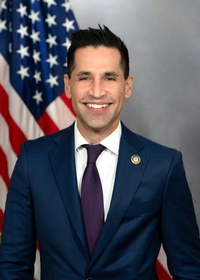
Photo of Tarik Khan
D Pennsylvania House · District 194 On the 2026 ballot

Rep. Tarik Khan

Compare
Total votes
4,016
all sessions
Attendance
100%
of floor votes
Near the chamber average
With party
99%
of cast votes
Near the chamber average
Bipartisan score
0%
crosses aisle rarely
Lower than 78% of chamber peers
Sponsored
2,253
bills & resolutions
Higher than 97% of chamber peers
Committees
5
assignments
2,253 bills and resolutions

Sponsored bills

Total
2,253
Primary
87
Co-sponsor
2,166
This page
2,253
matching current filters
Co-sponsor HB 933
In committee · Pennsylvania House · Co-sponsor
An Act amending the act of October 13, 2010 (P.L.506, No.72), known as the Construction Workplace Misclassification Act, further providing for improper classification of employees, for administrative penalties, for stop-work orders, for certain agreement prohibited and for use of penalty funds.

Maddy summaryHB 933 increases penalties for construction employers who misclassify workers as independent contractors, raising fines to $2,500 for a first violation and $5,000 for subsequent violations. It expands accountability to include general contractors and other parties who knowingly contract with employers that misclassify workers, subjecting them to the same penalties. The bill also adds a three-year ban on public contracts for intentional violators and clarifies that stop-work orders can require construction to halt within 24 hours for intentional misclassification, applying to successor businesses.

In committee Mar 17, 2025 1 co-sponsor
Co-sponsor HB 942
In committee · Pennsylvania House · Co-sponsor
An Act amending Title 34 (Game) of the Pennsylvania Consolidated Statutes, in Pennsylvania Game Commission, further providing for Game Commission officers and employees.

Maddy summaryHB 942 amends Pennsylvania's Game Commission law to change how full-time enforcement officers are paid. It requires that all full-time officers whose duty is to enforce game laws be classified for compensation "in the same manner as members of the Pennsylvania State Police." This change directly affects Game Commission enforcement officers by aligning their pay structure with State Police standards. The bill applies to compensation earned on or after its effective date, 60 days after enactment. (1-2 sentences as it's a procedural pay classification change.)

In committee Mar 17, 2025 1 co-sponsor
Co-sponsor HB 936
In committee · Pennsylvania House · Co-sponsor
An Act amending the act of June 13, 1967 (P.L.31, No.21), known as the Human Services Code, in public assistance, further providing for definitions and for copayments for subsidized child care.

Maddy summaryHB 936 modifies Pennsylvania's child care subsidy program by reducing copayments for parents who work in the child care field. It requires that families where a parent or caretaker is employed as a child-care worker or direct support professional (in either family child-care homes or licensed centers) pay no more than 15% of their annual income for subsidized care, regardless of their income level. This change applies to all qualifying child care settings defined in the bill, including family child-care homes (serving 4-6 unrelated children) and centers (serving 7+ children). The policy aims to lower financial barriers for child care workers seeking subsidized care for their own children.

In committee Mar 17, 2025 1 co-sponsor
Co-sponsor HB 922
In committee · Pennsylvania House · Co-sponsor
An Act amending the act of May 17, 1921 (P.L.682, No.284), known as The Insurance Company Law of 1921, in casualty insurance, providing for fertility preservation coverage.

Maddy summaryHB 922 requires health insurance plans in Pennsylvania to cover fertility preservation services, such as freezing eggs, sperm, or embryos, without cost-sharing (like deductibles or copays). This applies to individuals under 45 at risk of infertility due to medical treatments (e.g., cancer therapy), including covered spouses and dependents. The bill mandates coverage for specific services like storage, consultations, embryo transfers, and related diagnostics, while prohibiting preexisting condition exclusions or arbitrary limits on coverage. It also requires storage coverage for five years (or until age 18 for minors) and aligns with medical guidelines from the American Society for Reproductive Medicine.

In committee Mar 17, 2025 1 co-sponsor
Co-sponsor HB 111
Passed · Pennsylvania House · Co-sponsor
An Act prohibiting discrimination in certain life insurance policies based on certain drugs.

Maddy summaryHB 111 prohibits life insurance companies in Pennsylvania from denying coverage, limiting benefits, or charging higher rates to applicants or policyholders solely because they have been prescribed an opioid overdose reversal agent (like naloxone). The bill directly affects individuals who use these medications, including those with opioid use disorder or at risk of overdose. It defines "adverse action" to include these discriminatory practices and makes such actions violations of existing laws against unfair insurance practices. The law takes effect 60 days after enactment.

Passed Mar 17, 2025 1 co-sponsor
Co-sponsor HB 33
Passed · Pennsylvania House · Co-sponsor
An Act amending the act of April 17, 2016 (P.L.84, No.16), known as the Medical Marijuana Act, in preliminary provisions, further providing for definitions; in practitioners, further providing for practitioner registration; in medical marijuana controls, further providing for electronic tracking and for laboratory; and, in Medical Marijuana Advisory Board, further providing for advisory board.

Maddy summaryHB 33 amends Pennsylvania's Medical Marijuana Act to clarify definitions and strengthen oversight of testing labs and practitioners. It defines key terms like "independent laboratory" (requiring no ties to marijuana businesses) and "approved laboratory" (testing medical marijuana samples under department approval). The bill gives the Department of Health new authority to impose conditions on medical practitioners, such as limiting certifications or requiring supervision, to protect patient safety. These changes directly affect medical marijuana patients, healthcare providers who certify them, and labs testing products for quality and safety. The updates aim to improve accountability in the program through clearer rules for lab accreditation and practitioner oversight.

Passed Mar 17, 2025 1 co-sponsor
Co-sponsor HB 908
In committee · Pennsylvania House · Co-sponsor
An Act amending Title 42 (Judiciary and Judicial Procedure) of the Pennsylvania Consolidated Statutes, in sentencing, providing for termination of long-term parole supervision.

Maddy summaryThis bill allows Pennsylvania courts to end long-term parole supervision for eligible individuals who have been under supervision for at least five consecutive years and are at least 40 years old. The process requires a formal petition filed by either the Department of Corrections or the parolee, which must be reviewed by the sentencing court. Courts must evaluate multiple factors including community safety risks, the individual's conduct history, financial hardship, and efficient use of department resources before deciding whether to terminate supervision. The law applies to all parole cases regardless of when the sentence was originally imposed and ensures victims, prosecutors, and relevant parties receive notice and an opportunity to be heard during the review process.

In committee Mar 13, 2025 1 co-sponsor
Co-sponsor HB 895
In committee · Pennsylvania House · Co-sponsor
An Act amending the act of October 15, 1980 (P.L.950, No.164), known as the Commonwealth Attorneys Act, in Office of Attorney General, providing for citizens' intervention in conspiracies; and imposing duties on the Office of Attorney General.

Maddy summaryHB 895 establishes a process for Pennsylvania citizens to report specific federal consumer protection violations to the Office of Attorney General through a public website, email, or phone line. The bill requires the Attorney General to create this system and assign each citizen a unique identifier and password, along with collecting contact details for potential testimony. If the Attorney General secures a monetary recovery based on a citizen's information about violations like fraud, privacy breaches, or consumer credit issues, a witness award must be requested. This law directly affects citizens with knowledge of the listed federal offenses and the Office of Attorney General.

In committee Mar 13, 2025 1 co-sponsor
Co-sponsor HB 887
In committee · Pennsylvania House · Co-sponsor
An Act amending Titles 18 (Crimes and Offenses) and 53 (Municipalities Generally) of the Pennsylvania Consolidated Statutes, in firearms and other dangerous articles, further providing for limitation on the regulation of firearms and ammunition; and, in general provisions relating to home rule and optional plan government, repealing provisions relating to limitation on municipal powers.

Maddy summaryHB 887 prevents Pennsylvania counties and municipalities from regulating the ownership, possession, transfer, or transportation of firearms, ammunition, or components - except when on property they own, operate, or maintain (like buildings, parks, or vehicles). It repeals a current law (Title 53 § 2962(g)) that banned local governments from creating firearm regulations. The bill directly affects all local governments by limiting their authority to enact firearm-related ordinances. This change takes effect 60 days after enactment.

In committee Mar 13, 2025 1 co-sponsor
Co-sponsor HB 891
In committee · Pennsylvania House · Co-sponsor
An Act amending the act of March 4, 1971 (P.L.6, No.2), known as the Tax Reform Code of 1971, providing for Keystone State Apprenticeship Tax Credit; establishing the Keystone State Apprenticeship Tax Credit Program; and imposing duties on the Department of Labor and Industry.

Maddy summaryHB 891 creates the Keystone State Apprenticeship Tax Credit Program, providing tax incentives to Pennsylvania businesses that hire apprentices. It directly affects employers participating in approved apprenticeship programs, with preference given to those training disadvantaged youth (low-income individuals aged 16-24) and businesses in key sectors like clean energy, healthcare, and technology. The program allocates up to $10 million annually in tax credits from 2025 to 2030, administered by the Department of Labor and Industry, which will determine eligibility and prioritize employers based on specific criteria like apprentice graduation rates and program novelty. Businesses must register apprenticeship agreements with the department to qualify for the credit.

In committee Mar 13, 2025 1 co-sponsor
Showing 901 to 910 of 2,253 bills
Previous 1 … 90 91 92 … 226 Next