

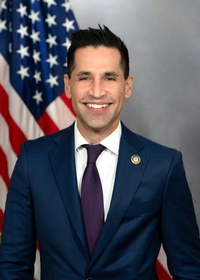
Photo of Tarik Khan
D Pennsylvania House · District 194 On the 2026 ballot

Rep. Tarik Khan

Compare
Total votes
4,016
all sessions
Attendance
100%
of floor votes
Near the chamber average
With party
99%
of cast votes
Near the chamber average
Bipartisan score
0%
crosses aisle rarely
Lower than 78% of chamber peers
Sponsored
2,253
bills & resolutions
Higher than 97% of chamber peers
Committees
5
assignments
2,253 bills and resolutions

Sponsored bills

Total
2,253
Primary
87
Co-sponsor
2,166
This page
2,253
matching current filters
Co-sponsor HB 2037
In committee · Pennsylvania House · Co-sponsor
An Act amending the act of September 27, 1961 (P.L.1700, No.699), known as the Pharmacy Act, further providing for authority to administer injectable medications, biologicals and immunizations and for laboratory waiver.

Maddy summaryThis bill expands the scope of practice for pharmacists in Pennsylvania by allowing them to administer injectable medications, biologicals, and immunizations to patients aged three and older. It establishes new requirements for training, parental consent for minors, and reporting procedures while also permitting pharmacists to delegate these tasks to specific healthcare professionals and qualified pharmacy technicians under strict supervision. Additionally, the legislation grants pharmacies with existing federal waivers the ability to perform certain laboratory tests for common illnesses like COVID-19 and the flu without adhering to some state clinical laboratory regulations.

In committee Sep 23, 2024 1 co-sponsor
Co-sponsor HB 2045
In committee · Pennsylvania House · Co-sponsor
An Act amending Title 53 (Municipalities Generally) of the Pennsylvania Consolidated Statutes, providing for multi-family housing zoning ordinances.

Maddy summaryThis bill amends Pennsylvania zoning laws to allow municipalities with over 5,000 residents in growing counties to permit multi-family housing, specifically duplexes, triplexes, and quadplexes, on lots where single-family homes are allowed. The legislation requires that rules for these smaller multi-unit buildings cannot be more restrictive than those for single-family homes, while also defining specific criteria for what constitutes each housing type. Localities can petition a county or regional planning agency to review proposed developments to ensure existing infrastructure can support them, potentially requiring developers to make necessary improvements. The act applies only to municipalities meeting specific population and growth thresholds and takes effect 180 days after passage.

In committee Sep 23, 2024 1 co-sponsor
Co-sponsor HB 2212
In committee · Pennsylvania House · Co-sponsor
An Act amending the act of April 12, 1951 (P.L.90, No.21), known as the Liquor Code, in licenses and regulations and liquor, alcohol and malt and brewed beverages, further providing for unlawful acts relative to liquor, malt and brewed beverages and licensees.

Maddy summaryThis bill amends Pennsylvania's Liquor Code to prohibit liquor license holders from displaying alcoholic beverages next to nonalcoholic drinks that share similar brand names, logos, or packaging. To prevent consumer confusion, the law requires businesses to post clear and distinct signage identifying which products are alcoholic and which are not. The measure directly affects all individuals licensed to sell alcohol in the state by establishing this specific display restriction. It also defines "nonalcoholic beverages" as any product marketed or sold as anything other than an alcoholic beverage. The changes are set to take effect 60 days after the bill is enacted.

In committee Sep 23, 2024 1 co-sponsor
Co-sponsor HB 2238
In committee · Pennsylvania House · Co-sponsor
An Act amending Title 12 (Commerce and Trade) of the Pennsylvania Consolidated Statutes, providing for consumer protection and prohibiting the use of perfluoroalkyl and polyfluoroalkyl substances in certain products; imposing powers and duties on the Department of Environmental Protection; and imposing penalties.

Maddy summaryThis Pennsylvania bill prohibits the intentional addition of perfluoroalkyl and polyfluoroalkyl substances, commonly known as PFAS, to a wide range of consumer products including cookware, cosmetics, food packaging, and artificial turf. While the law generally bans these chemicals, it allows for their use in specific items if the Department of Environmental Protection determines that no safer alternative exists and the chemical is critical for the product's function. The Department of Environmental Protection is tasked with enforcing these restrictions, managing a public database of PFAS information, and imposing penalties for violations.

In committee Sep 23, 2024 1 co-sponsor
Co-sponsor HB 2311
In committee · Pennsylvania House · Co-sponsor
An Act amending the act of March 10, 1949 (P.L.30, No.14), known as the Public School Code of 1949, establishing the School Mental Health Screening Grant and Development Program.

Maddy summaryThis bill creates a new grant program to help Pennsylvania school districts provide annual mental health screenings for students in grades six through twelve. Starting in the 2025-2026 school year, eligible school entities can apply for funding to hire staff, purchase materials, or partner with outside organizations to conduct these evidence-based screenings. The program requires applicants to submit detailed plans outlining how they will screen students, protect privacy, and connect those who need help with licensed mental health professionals or community resources. Additionally, the Department of Education will consult with national mental health experts and maintain a list of qualified vendors to assist participating schools.

In committee Sep 23, 2024 1 co-sponsor
Co-sponsor HB 2356
In committee · Pennsylvania House · Co-sponsor
An Act providing for meal breaks or rest periods for employees; and imposing penalties.

Maddy summaryThis bill, known as the Paid Rest Period for Workers Act, requires employers in Pennsylvania to give employees at least 30 consecutive minutes for a meal break or rest period after working five or more consecutive hours. These breaks must be paid and counted as work time, though the law allows for exceptions during workplace emergencies or if a union contract already offers equal or better protections. The Secretary of Labor and Industry is authorized to investigate violations by inspecting worksites and reviewing records, and employers who fail to comply face fines of up to $500 per affected employee per missed break. Additionally, the law provides a mechanism for the state to recover lost wages on behalf of employees who were denied these required paid breaks.

In committee Sep 23, 2024 1 co-sponsor
Primary HB 2353
In committee · Pennsylvania House · Lead sponsor
An Act providing for civil liability for fraudulent misrepresentation of candidates; and imposing penalties.

Maddy summaryHB 2353 establishes civil liability for entities that use artificial intelligence or other automated systems to create deceptive campaign advertisements featuring current or former candidates. The bill defines "covered persons" as firms, political committees, foreign governments, and individuals acting on their behalf, while also clarifying that generative AI and synthetic content like deepfakes fall under these regulations. To avoid liability, covered persons must provide clear and conspicuous disclosures stating that an advertisement contains manipulated or generated content, with specific formatting requirements for text, video, and audio formats. If a covered person fails to provide such a disclosure and is found liable, the law requires the immediate removal of the advertisement and imposes financial penalties based on the jurisdiction where the candidate filed with election officials.

In committee Sep 23, 2024 0 co-sponsors
Co-sponsor HB 2373
In committee · Pennsylvania House · Co-sponsor
An Act amending the act of May 25, 1933 (P.L.1050, No.242), referred to as the Second Class City Firemen Relief Law, further providing for requirements of membership, for married persons and pensions to surviving spouses and for eligibility of surviving spouses.

Maddy summaryThis bill updates Pennsylvania's Second Class City Firemen Relief Law to clarify membership rules and improve benefits for surviving spouses and children. It requires new members to sign an agreement forfeiting fund rights upon leaving the fire department and mandates that active members contribute six percent of their wages plus a one-dollar monthly fee, while retirees pay one dollar monthly. The legislation establishes specific death benefits, including a lump sum for all dues paid and monthly survivor payments for widows who die on duty, which continue for up to five hundred weeks or until remarriage. Additionally, it outlines how pensions are distributed to dependent children or parents if there is no surviving spouse, ensuring that total family benefits do not exceed fifty percent of the deceased member's salary.

In committee Sep 23, 2024 1 co-sponsor
Co-sponsor HB 2384
In committee · Pennsylvania House · Co-sponsor
An Act amending the act of July 7, 1980 (P.L.380, No.97), known as the Solid Waste Management Act, in general provisions, further providing for definitions; and, in residual waste, providing for prohibition on road spreading and land application of oil and gas wastewater.

Maddy summaryThis Pennsylvania bill amends the Solid Waste Management Act to clarify definitions and restrict how oil and gas wastewater is handled. It explicitly adds various types of oil and gas wastewater, such as production water and brine, to the legal definition of "residual waste." The legislation prohibits spreading this wastewater on roads or applying it to land, with the sole exception of tophole water used at the specific well site where it was extracted. Additionally, the bill bans vehicles transporting this wastewater from having mechanisms that could facilitate the prohibited disposal or reuse methods. These changes aim to limit the environmental impact of oil and gas operations by preventing the use of wastewater for dust suppression, road deicing, or road stabilization.

In committee Sep 23, 2024 1 co-sponsor
Co-sponsor HB 2382
In committee · Pennsylvania House · Co-sponsor
An Act providing for grant awards to entities in rural counties and designated medically underserved areas to pay for the education debt of practitioners employed at the entity.

Maddy summaryThis bill amends an existing law to expand eligibility for grants that help pay off student loans for healthcare workers serving in rural areas or medically underserved communities. The primary change broadens the definition of eligible recipients from just physicians and nurses to include all types of medical practitioners, such as midwives, and adds rural health clinics as qualifying employers. Additionally, the bill adjusts the grant award structure to allow payments in increments of up to $10,000 and extends the repayment period for recipients from 60 to 90 months. These modifications aim to increase the pool of eligible professionals and improve the financial terms of the loan repayment assistance program.

In committee Sep 23, 2024 1 co-sponsor
Showing 1,251 to 1,260 of 2,253 bills