

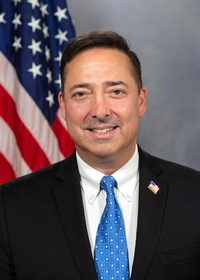
Photo of Chris Pielli
D Pennsylvania House · District 156 On the 2026 ballot

Rep. Chris Pielli

Compare
Total votes
3,688
all sessions
Attendance
100%
of floor votes
Near the chamber average
With party
99%
of cast votes
Near the chamber average
Bipartisan score
0%
crosses aisle rarely
Lower than 76% of chamber peers
Sponsored
1,149
bills & resolutions
Higher than 94% of chamber peers
Committees
6
assignments
1,149 bills and resolutions

Sponsored bills

Total
1,149
Primary
53
Co-sponsor
1,096
This page
1,149
matching current filters
Co-sponsor HB 812
In committee · Pennsylvania House · Co-sponsor
An Act amending Title 35 (Health and Safety) of the Pennsylvania Consolidated Statutes, establishing the Protecting Hospital Workers from Workplace Violence Grant Program and the Protecting Hospital Workers from Workplace Violence Grant Fund; providing for duties of Department of Health; and making a transfer.

Maddy summaryHB 812 establishes a grant program to fund security improvements protecting hospital and emergency care workers from workplace violence. It directly affects hospitals and freestanding emergency medical facilities in Pennsylvania, which can apply for grants to implement violence prevention projects. The bill requires applicants to submit detailed plans with timelines, budgets, and measurable goals for reducing verbal/physical violence, with priority given to innovative, sustainable approaches. The Department of Health will administer the program, accept applications starting March 1, 2025, and manage the dedicated grant fund.

In committee Mar 5, 2025 1 co-sponsor
Co-sponsor HB 801
In committee · Pennsylvania House · Co-sponsor
An Act amending Title 42 (Judiciary and Judicial Procedure) of the Pennsylvania Consolidated Statutes, in civil actions and proceedings, providing for consumer debt default judgments.

Maddy summaryHB 801 creates new rules for default judgments in consumer debt collection cases in Pennsylvania. It requires creditors to include specific details in their complaints before a court can issue a default judgment, such as the consumer’s name/address, creditor’s name, last payment date, and exact debt amount. The law applies to unsecured debts (like credit cards) and secured debts where only a money judgment is sought, but excludes government debt collections and cases seeking property possession. This aims to increase transparency and prevent creditors from using vague or incomplete claims to win default judgments against consumers.

In committee Mar 4, 2025 1 co-sponsor
Co-sponsor HB 803
In committee · Pennsylvania House · Co-sponsor
An Act amending the act of March 10, 1949 (P.L.30, No.14), known as the Public School Code of 1949, in school health services, providing for maintenance and use of opioid antagonists.

Maddy summaryHB 803 requires Pennsylvania high schools (grades 9-12) to maintain opioid antagonists like naloxone (Narcan) on-site and train staff to use them during suspected overdose emergencies. Schools must develop a policy within 60 days with the Department of Education, detailing safe storage, administration procedures, and mandatory hospital transport after use. Trained staff, including nurses or teachers, can administer the medication in good faith without facing legal liability, criminal charges, or professional penalties. This law directly affects all public, charter, private, and nonpublic high schools in Pennsylvania, aiming to improve emergency response to opioid overdoses among students and staff.

In committee Mar 4, 2025 1 co-sponsor
Co-sponsor HB 742
In committee · Pennsylvania House · Co-sponsor
An Act amending Title 44 (Law and Justice) of the Pennsylvania Consolidated Statutes, in DNA data and testing, further providing for policy, for definitions, for DNA sample required upon conviction, delinquency adjudication and certain ARD cases, for collection from persons accepted from other jurisdictions, for expungement and for mandatory cost.

Maddy summaryHB 742 amends Pennsylvania law to expand DNA collection requirements beyond felony sex offenses. It defines "other specified offenses" for adults (including certain felonies, misdemeanors like assault, and offenses requiring sex offender registration) and for juveniles (such as murder, aggravated assault, or terrorism when tried as an adult). The bill mandates DNA sampling upon conviction, delinquency adjudication, or certain ARD cases for these offenses, applies to individuals transferred from other jurisdictions, and includes provisions for expungement and mandatory costs. This affects individuals convicted of specified crimes who may now have DNA collected for the state database.

In committee Mar 3, 2025 1 co-sponsor
Co-sponsor HB 776
In committee · Pennsylvania House · Co-sponsor
An Act amending the act of March 10, 1949 (P.L.30, No.14), known as the Public School Code of 1949, in high schools, further providing for assessment of civic knowledge.

Maddy summaryHB 776 requires Pennsylvania high school students to score at least 60% on a civic knowledge assessment to graduate or earn a general equivalency diploma, starting in the 2028-2029 school year. The bill amends the Public School Code to add this graduation requirement, which applies to all students except those with an individualized education program (IEP) if their IEP specifies an exemption. The assessment measures knowledge of civic topics like government structure and citizenship. This policy directly affects all Pennsylvania public high school students seeking graduation or a general equivalency diploma.

In committee Mar 3, 2025 1 co-sponsor
Co-sponsor HB 790
In committee · Pennsylvania House · Co-sponsor
An Act amending the act of July 19, 1979 (P.L.130, No.48), known as the Health Care Facilities Act, in licensing of health care facilities, providing for hospital emergency abortion services.

Maddy summaryHB 790 requires Pennsylvania hospitals with emergency departments to provide abortion services when an individual has an emergency medical condition that necessitates an abortion to stabilize their health. This applies to all hospitals in the state with emergency departments, directly affecting those facilities and the patients seeking emergency care. The bill defines "emergency medical condition" to include life-threatening situations like ectopic pregnancy, preeclampsia, or complications from pregnancy loss, requiring hospitals to offer the service unless the patient or their legal representative refuses after being informed of risks and benefits. Hospitals must take reasonable steps to secure written consent for refusal to ensure compliance. The law takes effect 60 days after enactment.

In committee Mar 3, 2025 1 co-sponsor
Co-sponsor HB 778
In committee · Pennsylvania House · Co-sponsor
An Act amending the act of March 10, 1949 (P.L.30, No.14), known as the Public School Code of 1949, in professional employees, providing for Pre-K Teacher Salary Supplement Pilot Program.

Maddy summaryHB 778 establishes a three-year pilot program to increase pre-kindergarten (Pre-K) teacher salaries in Pennsylvania to match those of elementary school teachers with similar qualifications. It directly affects Pre-K teachers working in programs located in high-poverty areas (school districts with ≥20% poverty or census tracts at ≤80% of the statewide median poverty level). The program requires the Department of Education to calculate salary gaps using a specific formula, provide subsidies to eligible Pre-K programs to close those gaps, and collect data for a legislative report. The bill mandates strict use of funds solely for teacher salary increases and includes requirements for reporting program outcomes to the legislature.

In committee Mar 3, 2025 1 co-sponsor
Co-sponsor HB 780
In committee · Pennsylvania House · Co-sponsor
An Act amending the act of March 10, 1949 (P.L.30, No.14), known as the Public School Code of 1949, establishing the Early Childhood Educator Tuition Assistance Program and the Early Childhood Educator Tuition Assistance Fund.

Maddy summaryHB 780 creates a tuition assistance program for early childhood educators in Pennsylvania. It provides grants to cover tuition costs (minus other financial aid) for individuals pursuing associate degrees or certifications in early childhood education, targeting those earning under 400% of the federal poverty level, enrolled in at least six credit hours per semester, and working 25+ hours weekly in approved early childhood programs. Recipients must agree to work in Pennsylvania early childhood education for two years after completing their program. Funding comes from a new state fund, with annual reports tracking enrollment, retention, wages, and job demand. The program aims to support workforce development in early childhood education through financial assistance tied to service commitments.

In committee Mar 3, 2025 1 co-sponsor
Co-sponsor HB 779
In committee · Pennsylvania House · Co-sponsor
An Act amending the act of March 10, 1949 (P.L.30, No.14), known as the Public School Code of 1949, in professional employees, providing for Head Start Teacher Salary Supplement Pilot Program.

Maddy summaryHB 779 establishes a three-year pilot program to increase salaries for Head Start teachers in Pennsylvania. It targets Head Start programs located in school districts with at least 20% poverty or census tracts with 80% or lower median poverty. The program calculates a salary supplement by comparing Head Start teachers' qualifications to public elementary school teachers in the same district, then provides funds to align their pay. The Department of Education will select participating programs, collect data, and report findings to the legislature after one year.

In committee Mar 3, 2025 1 co-sponsor
Co-sponsor HB 782
In committee · Pennsylvania House · Co-sponsor
An Act amending Title 66 (Public Utilities) of the Pennsylvania Consolidated Statutes, in rates and distribution systems, further providing for recovery of advertising expenses; and, in restructuring of electric utility industry, providing for membership in regional transmission organization.

Maddy summaryHB 782 prohibits Pennsylvania electric utilities from including lobbying or political activities in their rate base, meaning these costs cannot be passed on to customers through utility rates. It requires utilities with over 75,000 customers to file annual reports detailing all lobbying and political spending, including employee hours, third-party vendor payments, and specific expense breakdowns. The bill also states that advertising expenses can only be recovered if the utility demonstrates they are reasonable and meet defined criteria. This legislation directly affects large electric utilities operating in Pennsylvania.

In committee Mar 3, 2025 1 co-sponsor
Showing 631 to 640 of 1,149 bills
Previous 1 … 63 64 65 … 115 Next