

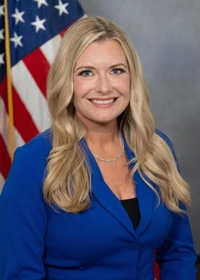
Photo of Missy Cerrato
D Pennsylvania House · District 151 On the 2026 ballot

Rep. Missy Cerrato

Compare
Total votes
3,235
all sessions
Attendance
100%
of floor votes
Near the chamber average
With party
99%
of cast votes
Higher than 83% of chamber peers
Bipartisan score
0%
crosses aisle rarely
Lower than 82% of chamber peers
Sponsored
1,308
bills & resolutions
Higher than 90% of chamber peers
Committees
5
assignments
1,308 bills and resolutions

Sponsored bills

Total
1,308
Primary
24
Co-sponsor
1,284
This page
1,308
matching current filters
Co-sponsor HB 729
In committee · Pennsylvania House · Co-sponsor
An Act amending Title 75 (Vehicles) of the Pennsylvania Consolidated Statutes, in licensing of drivers, further providing for duplicate and substitute drivers' licenses and learners' permits.

Maddy summaryHB 729 eliminates fees for one duplicate Pennsylvania identification card (including required photos) during the term of an initial or renewal card for individuals already exempt from license fees under Section 1901(b.1) of the law. This directly affects Pennsylvania residents who qualify for fee exemptions (such as low-income or disabled individuals) when replacing lost or damaged ID cards. The bill amends Section 1513(c) of Title 75 (Vehicles) to prohibit charging fees for a single duplicate ID card during the active period of their primary card. The change applies only to the first duplicate replacement needed within the card's validity period.

In committee Feb 25, 2025 1 co-sponsor
Co-sponsor HB 723
In committee · Pennsylvania House · Co-sponsor
An Act amending the act of March 4, 1971 (P.L.6, No.2), known as the Tax Reform Code of 1971, in tax credit and tax benefit administration, further providing for determination of eligibility and method of submission.

Maddy summaryHB 723 amends Pennsylvania's Tax Reform Code to require state departments to check if applicants for tax credits or benefits have engaged in anti-union activities within the past decade. It directly affects businesses or individuals seeking tax benefits by blocking eligibility if they have: - Faced federal or state unfair labor practice complaints (e.g., under NLRB rules or Pennsylvania Labor Relations Act), - Settled union-related charges without formal complaints, or - Violated court orders or state labor board decisions. The bill adds specific screening steps to the tax credit application process, defining "anti-union activity" through clear legal references. It takes effect 60 days after enactment.

In committee Feb 25, 2025 1 co-sponsor
Co-sponsor HB 736
In committee · Pennsylvania House · Co-sponsor
An Act amending Title 53 (Municipalities Generally) of the Pennsylvania Consolidated Statutes, in consolidated county assessment, further providing for exemptions from taxation.

Maddy summaryHB 736 amends Pennsylvania's property tax exemption rules for charitable institutions, clarifying that tax-exempt status applies only when property is used for the institution's primary purposes (e.g., hospitals, universities, charities). It specifies that property used for commercial activities or not regularly essential to the institution's mission loses exemption eligibility. The bill directly affects qualifying nonprofit institutions and local governments collecting property taxes. Key provisions require all revenue from exempt property to support the institution's core mission, not commercial ventures, and explicitly deny exemptions for commercial use. The changes take effect 60 days after enactment.

In committee Feb 25, 2025 1 co-sponsor
Co-sponsor HB 737
In committee · Pennsylvania House · Co-sponsor
An Act amending the act of May 22, 1933 (P.L.853, No.155), known as The General County Assessment Law, in subjects of taxation and exemptions, further providing for exemptions from taxation.

Maddy summaryHB 737 clarifies tax exemption rules for charitable institutions under Pennsylvania's General County Assessment Law. It specifies that hospitals, universities, and charitable organizations (including residential housing providers receiving federal low-income subsidies) retain tax exemption only if their property isn't used commercially and all revenue supports their charitable mission. The bill adds that subsidized housing units must have at least 95% federal funding to maintain exemption, with any surplus monitored and used solely for charitable purposes. This directly affects institutions relying on tax-exempt status for property ownership and operations.

In committee Feb 25, 2025 1 co-sponsor
Co-sponsor HB 732
In committee · Pennsylvania House · Co-sponsor
An Act amending Title 23 (Domestic Relations) of the Pennsylvania Consolidated Statutes, in protection from abuse, further providing for relief and providing for shared telephone plans.

Maddy summaryHB 732 amends Pennsylvania's domestic relations law to help domestic violence victims gain independence from abusers tied to shared telephone plans. The bill requires courts to order abusers to remove victims from shared phone contracts within three days and cover any termination fees. It also mandates telecommunications providers to let victims opt out without fees or penalties when presenting valid documentation like a protection order or police report, and to provide a new phone number within 24 hours. This directly affects domestic violence victims who are financially or contractually linked to abusers through shared phone accounts. The law applies to phone plans entered into on or after its effective date.

In committee Feb 25, 2025 1 co-sponsor
Co-sponsor HB 715
In committee · Pennsylvania House · Co-sponsor
An Act amending the act of January 17, 1968 (P.L.11, No.5), known as The Minimum Wage Act of 1968, further providing for penalties.

Maddy summaryHB 715 amends Pennsylvania's Minimum Wage Act of 1968 to increase penalties for employers who pay workers below the required minimum wage. It reclassifies violations based on the number of offenses and the total unpaid wages: under $150 for a first offense is a summary offense, while over $150 for a first or second offense becomes a misdemeanor, and third or subsequent offenses are felonies. The bill also establishes that each week an employee is underpaid and each affected employee counts as a separate offense, making penalties more severe for repeated violations. Employers cannot avoid liability by having employees agree to work for less than the minimum wage.

In committee Feb 24, 2025 1 co-sponsor
Co-sponsor HB 718
In committee · Pennsylvania House · Co-sponsor
An Act amending the act of July 14, 1961 (P.L.637, No.329), known as the Wage Payment and Collection Law, further providing for definitions; providing for duty of department to report and for investigations; further providing for civil remedies and penalties, for liquidated damages and for criminal penalties; providing for employer liability; and establishing the Wage Enforcement Fund.

Maddy summaryHB 718 amends Pennsylvania's Wage Payment and Collection Law to strengthen wage enforcement, directly affecting employers (including state/local governments, corporations, and contractors) and workers owed unpaid wages. It requires the Department of Labor to collect quarterly data on wage violations, fines, unpaid wages, and complaint resolution, then submit semiannual reports to lawmakers and post them publicly. The bill mandates quarterly investigations of "high-violation industries" (those with 25+ violations in two years) and updates penalties to $2,000 per violation or triple unpaid wages, whichever is greater, plus attorney fees. Employers failing to pay within 10 days of notice face these penalties, with each week of underpayment counted as a separate violation.

In committee Feb 24, 2025 1 co-sponsor
Co-sponsor HB 717
In committee · Pennsylvania House · Co-sponsor
An Act amending Title 62 (Procurement) of the Pennsylvania Consolidated Statutes, in source selection and contract formation, further providing for debarment or suspension.

Maddy summaryHB 717 amends Pennsylvania's procurement law to add wage law violations as a specific reason for barring state contractors from future government contracts. It directly affects state contractors who fail to pay wages owed to workers under the 1961 Wage Payment and Collection Law. The bill adds a new subsection (531(b)(6.1)) to the debarment rules, requiring state agencies to suspend or debar contractors found in violation of wage payment laws. This change creates a direct link between wage compliance and eligibility for state contracts. The bill takes effect 60 days after enactment.

In committee Feb 24, 2025 1 co-sponsor
Co-sponsor HB 716
In committee · Pennsylvania House · Co-sponsor
An Act amending the act of July 14, 1961 (P.L.637, No.329), known as the Wage Payment and Collection Law, further providing for notification; providing for duty of employer; and imposing criminal and civil penalties.

Maddy summaryHB 716 amends Pennsylvania's Wage Payment and Collection Law to require employers to provide employees with specific pay details (including rate, time of payment, and fringe benefits) at hiring and to post a summary of the law in a visible workplace location. Employers who fail to meet these notification or posting requirements face a $500 fine per violation. The bill also extends the time limit for employees to file legal claims for unpaid wages: if an employer didn't provide required notice or post the summary, the deadline becomes the later of three years after wages were due or the day the requirements were satisfied. This affects all employers in Pennsylvania subject to the Wage Payment and Collection Law.

In committee Feb 24, 2025 1 co-sponsor
Co-sponsor HB 700
In committee · Pennsylvania House · Co-sponsor
An Act amending the act of April 9, 1929 (P.L.343, No.176), known as The Fiscal Code, in general budget implementation, further providing for Department of Human Services.

Maddy summaryHB 700 creates a new, non-lapsing "Home and Community-Based Services for Individuals with Intellectual Disabilities Augmentation Account" within Pennsylvania's General Fund. It directs funds from the sale of former state centers for intellectual disabilities, annual transfers from the General Fund (based on prior-year funding levels), and operational cost savings from closed centers into this account. The money must be used by the Department of Human Services to provide home and community-based supports, housing assistance, and emergency waiting list services for individuals with intellectual disabilities. This bill directly affects people with intellectual disabilities receiving these services and the Department of Human Services managing the funds.

In committee Feb 24, 2025 1 co-sponsor
Showing 501 to 510 of 1,308 bills
Previous 1 … 50 51 52 … 131 Next