

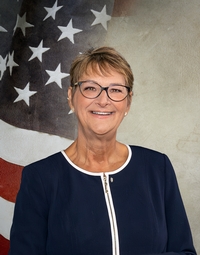
Photo of Maureen Madden
D Pennsylvania House · District 115 On the 2026 ballot

Rep. Maureen Madden

Compare
Total votes
8,291
all sessions
Attendance
98%
164 missed
Near the chamber average
With party
98%
of cast votes
Near the chamber average
Bipartisan score
1%
crosses aisle rarely
Near the chamber average
Sponsored
3,312
bills & resolutions
Higher than 89% of chamber peers
Committees
1
assignment
3,312 bills and resolutions

Sponsored bills

Total
3,312
Primary
52
Co-sponsor
3,260
This page
3,312
matching current filters
Co-sponsor HR 105
In committee · Pennsylvania House · Co-sponsor
A Resolution directing the Joint State Government Commission to conduct a study on the availability, type and demand for supportive housing.

Maddy summaryThis resolution directs Pennsylvania's Joint State Government Commission to study supportive housing availability, types, and demand across the state. The study will examine both temporary and permanent supportive housing options, focusing on vulnerable populations including those experiencing homelessness, living with chronic health conditions, or struggling with low incomes. The Commission must provide policy recommendations and a final report within 18 months to legislative leaders, informing future planning for supportive housing needs. This is a procedural study request - not a law creating new housing - and aims to gather data to guide potential future policy decisions.

In committee Mar 10, 2025 1 co-sponsor
Co-sponsor HB 839
In committee · Pennsylvania House · Co-sponsor
An Act amending the act of May 17, 1921 (P.L.682, No.284), known as The Insurance Company Law of 1921, in quality health care accountability and protection, further providing for continuity of care.

Maddy summaryHB 839 amends Pennsylvania's 1921 Insurance Company Law to ensure patients can continue care with their current healthcare providers during network changes. It requires insurers to provide a 120-day transitional period (up from 60 days) for patients if a provider leaves a network or a contract expires, with extensions possible for clinical needs - especially for pregnancy-related care through postpartum. Insurers must notify patients of network changes and cannot allow non-participating providers to bill patients directly during this period, covering services at the same terms as in-network providers. The law applies to new or renewed health insurance policies 180 days after enactment and takes effect 60 days after passage.

In committee Mar 10, 2025 1 co-sponsor
Co-sponsor HB 844
In committee · Pennsylvania House · Co-sponsor
An Act amending the act of December 3, 1959 (P.L.1688, No.621), known as the Housing Finance Agency Law, establishing the Housing Construction Loan Program and the Housing Construction Loan Fund; and providing for duties of Pennsylvania Housing Finance Agency.

Maddy summaryHB 844 creates Pennsylvania's Housing Construction Loan Program and a dedicated Housing Construction Loan Fund under the Pennsylvania Housing Finance Agency. The program provides loans to eligible builders (those operating in Pennsylvania for at least three years) for constructing new homes sold to low- and moderate-income households, and to those households for financing such homes. Key provisions limit loans to 80% of a county’s median home price, cap terms at 15 years, and require all sales to remain affordable to target households. Funds for the program come from state appropriations, grants, and loan repayments, managed through the State Treasury.

In committee Mar 10, 2025 1 co-sponsor
Co-sponsor HB 829
In committee · Pennsylvania House · Co-sponsor
An Act amending the act of March 10, 1949 (P.L.30, No.14), known as the Public School Code of 1949, in duties and powers of boards of school directors, further providing for kindergartens; in pupils and attendance, further providing for age limits and temporary residence, for definitions and for when provided; and, in early learning programs, providing for full-day kindergarten.

Maddy summaryHB 829 amends Pennsylvania's Public School Code to require school districts to offer full-day kindergarten for children aged three to five, lowering the age limit from four years. It updates the definition of "compulsory school age" to explicitly allow children as young as three to attend kindergarten without tuition, while maintaining the upper age limit at 18. The bill also adjusts transportation provisions to include free bus service for full-day kindergarten students, similar to existing rules for other grade levels. These changes directly affect public school districts, early learning programs, and families with children aged three to five.

In committee Mar 10, 2025 1 co-sponsor
Co-sponsor HB 838
In committee · Pennsylvania House · Co-sponsor
An Act amending Title 75 (Vehicles) of the Pennsylvania Consolidated Statutes, in registration of vehicles, further providing for person with disability plate and placard.

Maddy summaryHB 838 creates a program allowing qualified health care facilities - such as hospitals, medical specialist centers, and physical therapy centers - to issue temporary disability parking placards valid for up to six months. Individuals seeking a temporary placard must apply directly to an enrolled facility and sign a statement confirming they meet the disability criteria. The facility then requires a health care provider to certify the disability and submit the application electronically to the state department to update records. This change streamlines access to temporary parking permits without requiring individuals to go through the state’s standard application process.

In committee Mar 10, 2025 1 co-sponsor
Co-sponsor HB 831
In committee · Pennsylvania House · Co-sponsor
An Act establishing a moratorium on for-profit hospital ownership; and directing the Joint State Government Commission to study and issue a report on for-profit hospitals.

Maddy summaryHB 831 establishes a 24-month moratorium on transferring hospital ownership to for-profit entities in Pennsylvania. It directly affects hospitals and health systems seeking to change ownership structures, pausing approvals for such transactions. The bill also requires the Joint State Government Commission to study for-profit hospital ownership patterns, including causes for their rise, cost/benefit comparisons with non-profits, and policy recommendations. The Commission must issue a report to state leaders within 18 months of the law's effective date. The moratorium and study requirements expire 24 months after the bill takes effect.

In committee Mar 10, 2025 1 co-sponsor
Co-sponsor HB 841
In committee · Pennsylvania House · Co-sponsor
An Act amending the act of April 9, 1929 (P.L.177, No.175), known as The Administrative Code of 1929, in disposition of Commonwealth surplus land, further providing for annual property survey.

Maddy summaryHB 841 requires Pennsylvania state agencies to complete an annual survey of all Commonwealth-owned real property by March 1 each year. Agencies must identify surplus land and, in consultation with the Department of Community and Economic Development, assess each surplus parcel's potential for affordable housing development for very low-income, low-income, and middle-income households. The Department of Community and Economic Development will compile these surveys, report to the legislature, and evaluate whether surplus properties can be transferred to other agencies for more appropriate use. This bill amends the Administrative Code of 1929 to establish these annual requirements for managing state-owned property.

In committee Mar 10, 2025 1 co-sponsor
Co-sponsor HB 835
In committee · Pennsylvania House · Co-sponsor
An Act amending Title 61 (Prisons and Parole) of the Pennsylvania Consolidated Statutes, in Pennsylvania Board of Probation and Parole, providing for early parole for educational and vocational certification.

Maddy summaryHB 835 would allow Pennsylvania's Board of Probation and Parole to shorten an offender's parole supervision period by 90 days if they earn a high school diploma, college degree, or approved vocational certificate while on parole and stay in compliance with release terms. This applies to most parolees but excludes those convicted of violent crimes as defined under state law (42 Pa.C.S. § 9714(g)). The bill creates a direct incentive for parolees to pursue education and job training during supervision. It would take effect 60 days after enactment.

In committee Mar 10, 2025 1 co-sponsor
Co-sponsor HR 104
In committee · Pennsylvania House · Co-sponsor
A Resolution directing the Joint State Government Commission to conduct a study on the cost and effectiveness of current and ongoing Housing First programs across the United States and the potential effectiveness of Housing First programs in this Commonwealth.

Maddy summaryThis resolution directs Pennsylvania's Joint State Government Commission to study Housing First programs across the U.S. and their potential application in Pennsylvania. The study must examine program costs, effectiveness in reducing homelessness (especially among chronically unhoused individuals and veterans), comparisons with traditional shelter models, and impacts of recent events like the pandemic. The commission will compile a report within 18 months covering specific aspects, including Pennsylvania's homeless population demographics and academic effects on unhoused children. This study aims to inform future housing policy decisions without mandating program implementation.

In committee Mar 10, 2025 1 co-sponsor
Co-sponsor HB 824
In committee · Pennsylvania House · Co-sponsor
An Act amending the act of June 28, 1995 (P.L.89, No.18), known as the Conservation and Natural Resources Act, in Department of Conservation and Natural Resources, further providing for community recreation and heritage conservation.

Maddy summaryHB 824 amends Pennsylvania's Conservation and Natural Resources Act to require the Department of Conservation and Natural Resources to prioritize grant applications for playgrounds, playground equipment, and recreation areas that address accessibility for people with disabilities. The bill specifies that projects must include features like ramped play areas, accessible swings, wheelchair-friendly tables, and adaptations for blind or visually impaired individuals to receive priority. It mandates that the department favor universally designed recreation areas - where all equipment and the space itself are fully accessible - over projects with only partial accessibility. This change directly affects communities applying for state grants to build or improve local playgrounds, ensuring new facilities meet inclusive design standards from the start.

In committee Mar 6, 2025 1 co-sponsor
Showing 481 to 490 of 3,312 bills
Previous 1 … 48 49 50 … 332 Next