

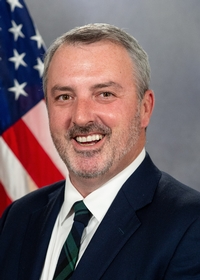
Photo of Kyle Donahue
D Pennsylvania House · District 113 On the 2026 ballot

Rep. Kyle Donahue

Compare
Total votes
3,891
all sessions
Attendance
100%
of floor votes
Near the chamber average
With party
99%
of cast votes
Higher than 87% of chamber peers
Bipartisan score
0%
crosses aisle rarely
Lower than 91% of chamber peers
Sponsored
810
bills & resolutions
Higher than 82% of chamber peers
Committees
6
assignments
810 bills and resolutions

Sponsored bills

Total
810
Primary
16
Co-sponsor
794
This page
810
matching current filters
Co-sponsor HB 405
In committee · Pennsylvania House · Co-sponsor
An Act amending Title 15 (Corporations and Unincorporated Associations) of the Pennsylvania Consolidated Statutes, in general provisions relating to business corporations, providing for eligibility for receipt of State resources.

Maddy summaryHB 405 would require businesses with 200+ Pennsylvania employees to meet specific standards to receive state contracts, funding, or grants. Corporations would be ineligible if they violated federal labor laws (within 5 years), committed unfair labor practices (within 5 years), broke Pennsylvania's prevailing wage law (within 5 years), or failed to submit bylaws ensuring at least 20% of their governing board consists of employee-elected members. The bill applies only to new or renewed state contracts, funding, or grants approved after its effective date (60 days after enactment). This directly affects large corporations seeking state business by linking eligibility to labor compliance and employee representation requirements.

In committee Jan 29, 2025 1 co-sponsor
Co-sponsor HB 371
In committee · Pennsylvania House · Co-sponsor
An Act amending the act of October 6, 1998 (P.L.705, No.92), known as the Keystone Opportunity Zone, Keystone Opportunity Expansion Zone and Keystone Opportunity Improvement Zone Act, in preliminary provisions, further providing for definitions; and, in keystone opportunity zones, further providing for qualified businesses.

Maddy summaryHB 371 amends Pennsylvania's Keystone Opportunity Zone Act to add new requirements for businesses seeking tax exemptions, deductions, or credits. It directly affects businesses operating within designated Keystone zones that make capital investments exceeding $25,000 for construction, reconstruction, or facility repairs. The key provision mandates that 70% of workers on such projects must be "skilled craft laborers" (defined as those with relevant training or apprenticeship completion), and all workers must receive the state-mandated prevailing wage rate. Businesses must verify these requirements annually through the Department of Labor and Industry, enforcing existing Pennsylvania Prevailing Wage Act standards for qualifying projects.

In committee Jan 28, 2025 1 co-sponsor
Co-sponsor HB 390
In committee · Pennsylvania House · Co-sponsor
An Act amending the act of March 4, 1971 (P.L.6, No.2), known as the Tax Reform Code of 1971, in personal income tax, providing for preceptor tax deduction.

Maddy summaryHB 390 creates a $1,000 annual tax deduction for Pennsylvania health care providers who volunteer to supervise clinical training for students. It directly affects licensed physicians, nurses, physician assistants, and nurse anesthetists who provide uncompensated, volunteer-based clinical training (minimum 80 hours annually per student) to eligible students in approved programs. The bill establishes a Preceptor Certification Committee within the Department of Health to verify eligibility, process applications within 30 days, and issue certificates confirming the deduction. To claim the deduction, providers must submit this certificate with their tax return, and the deduction cannot exceed the tax owed. The policy change specifically targets volunteer clinical education support without altering tax rates or creating new tax credits.

In committee Jan 28, 2025 1 co-sponsor
Co-sponsor HB 389
In committee · Pennsylvania House · Co-sponsor
An Act amending the act of March 10, 1949 (P.L.30, No.14), known as the Public School Code of 1949, establishing the New Nursing Faculty Grant Program; providing for duties of the Pennsylvania Higher Education Assistance Agency; and making an appropriation.

Maddy summaryHB 389 establishes the New Nursing Faculty Grant Program to support nursing education in Pennsylvania. It provides $10,000 grants to eligible nursing faculty members at accredited medical colleges who are PA residents, employed full-time (or have a pending offer), and have no more than three years of experience. The Pennsylvania Higher Education Assistance Agency (PHEAA) will administer the program, prioritizing positions historically difficult to fill, with applications submitted by nursing program deans. Grants cover professional expenses and aim to increase enrollment capacity at nursing programs.

In committee Jan 28, 2025 1 co-sponsor
Co-sponsor HR 41
In committee · Pennsylvania House · Co-sponsor
A Resolution directing the Joint State Government Commission to conduct a study of emergency child care and provide recommendations.

Maddy summaryHR 41 is a resolution directing Pennsylvania's Joint State Government Commission to study emergency child care needs and develop recommendations. The study will examine current availability (including Pennsylvania's 12 crisis nurseries), staffing challenges (like low wages averaging $12.43/hour), funding sources (including federal programs), and how other states license facilities. It requires the Commission to form an advisory committee with child care providers, parents, health/human services officials, and county representatives. The Commission must submit its report to the House within 18 months. This resolution does not create new laws but aims to inform future policy decisions.

In committee Jan 28, 2025 1 co-sponsor
Co-sponsor HB 357
In committee · Pennsylvania House · Co-sponsor
An Act amending the act of March 4, 1971 (P.L.6, No.2), known as the Tax Reform Code of 1971, in realty transfer tax, further providing for excluded transactions.

Maddy summaryHB 357 amends Pennsylvania's 1971 Tax Reform Code to exempt specific property transfers from realty transfer tax. It directly affects surviving spouses and minor children of public safety personnel (police, firefighters, etc.) who died while performing official duties, as defined by the 1976 Emergency and Law Enforcement Personnel Death Benefits Act. The key provision excludes transfers where the property was the deceased's principal residence, and the transfer occurs within five years of death under defined conditions (e.g., the surviving spouse married within one year before the death, or the property was the deceased's residence regardless of the child's current residence). This creates a tax exemption for these specific family transitions without altering the broader tax structure. The bill takes effect 60 days after enactment.

In committee Jan 27, 2025 1 co-sponsor
Co-sponsor HB 334
In committee · Pennsylvania House · Co-sponsor
An Act amending the act of March 4, 1971 (P.L.6, No.2), known as the Tax Reform Code of 1971, in tax credit and tax benefit administration, further providing for definitions; and providing for Pennsylvania Individual Recruitment and Retention Tax Credit.

Maddy summaryHB 334 creates a $2,500 Pennsylvania Individual Recruitment and Retention Tax Credit for specific new professionals who move to the state after December 2024. It directly affects qualifying taxpayers certified in teaching (e.g., instructional or special education certificates), law enforcement (e.g., police academy graduates), or healthcare (e.g., registered nurses) who become Pennsylvania residents and secure employment in those fields. The credit reduces their state income tax bill for wages earned in qualifying roles, available for three consecutive years (including the first qualifying year), and requires proof of certification to the Department of Revenue. The credit expires December 31, 2030, and applies only to individuals becoming qualifying taxpayers between 2025 and 2027.

In committee Jan 27, 2025 1 co-sponsor
Co-sponsor HB 317
In committee · Pennsylvania House · Co-sponsor
An Act amending Title 18 (Crimes and Offenses) of the Pennsylvania Consolidated Statutes, in computer offenses, providing for artificial intelligence; and imposing a penalty.

Maddy summaryHB 317 requires creators and distributors of AI-generated content in Pennsylvania to watermark at least 30% of images, text, simulations, or videos with 50% opacity and the label "Artificial Intelligence Generated Material." It directly affects individuals and businesses producing AI content, with exceptions for film/TV productions using AI for visual effects without involving specific individuals or with their written consent. Violations carry a $1,000 fine for a first offense and $10,000 for repeat offenses within five years. The law takes effect 60 days after enactment.

In committee Jan 27, 2025 1 co-sponsor
Co-sponsor HB 320
In committee · Pennsylvania House · Co-sponsor
An Act amending Title 66 (Public Utilities) of the Pennsylvania Consolidated Statutes, in rates and distribution systems, further providing for voluntary changes in rates.

Maddy summaryHB 320 amends Pennsylvania's public utility law to strengthen notice requirements for rate changes. It requires utilities to provide 60 days' advance notice to the Public Utility Commission and customers about proposed rate changes, using plain language in all customer communications. The bill mandates that rate change notices must clearly highlight the change on mail envelopes or exteriors, and all changes must be filed as new or updated tariffs. This directly affects utility companies (like gas, electric, and water providers) and their customers by increasing transparency around billing adjustments. The law takes effect 60 days after enactment.

In committee Jan 27, 2025 1 co-sponsor
Co-sponsor HB 323
In committee · Pennsylvania House · Co-sponsor
An Act amending Title 15 (Corporations and Unincorporated Associations) of the Pennsylvania Consolidated Statutes, in general provisions relating to nonprofit corporations, providing for eligibility for receipt of State resources.

Maddy summaryHB 323 requires nonprofit corporations (both domestic and foreign with 200+ Pennsylvania employees) to meet specific conditions to receive state contracts, funding, or grants. Key provisions include: prohibiting eligibility if the nonprofit violated federal labor laws in the past five years, was found guilty of unfair labor practices in Pennsylvania within five years, or fails to submit bylaws requiring at least 20% of board members to be current employees elected by staff. Healthcare-related funding (like Medicaid reimbursements) and past violations occurring before the law's effective date are exempt. The law applies to new state contracts, funding, or grants approved on or after its effective date, which is 60 days after enactment.

In committee Jan 27, 2025 1 co-sponsor
Showing 421 to 430 of 810 bills
Previous 1 … 42 43 44 … 81 Next