

Maddy summaryHB 1091 amends Pennsylvania's intestate succession laws, which determine who inherits property when someone dies without a will. It specifically adjusts the distribution shares for relatives other than a surviving spouse, such as children or parents, in cases where no spouse is alive. The bill modifies existing rules to clarify or change how these non-spouse heirs receive assets from an estate. This directly affects individuals who die intestate with surviving children or other relatives but no spouse, altering their inheritance rights under current law.
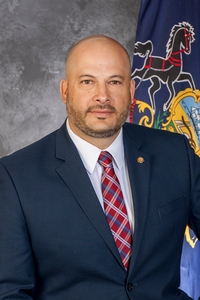
Rep. Jonathan Fritz
Sponsored bills
Maddy summaryThe provided context does not include the specific provisions or content of HB 1693. While the bill's title mentions amending Title 29 regarding "immigration compliance and public safety," no details about its concrete mechanisms, affected groups, or policy changes are included in the given information. Without the bill's text or explanatory summary, a factual description of its provisions cannot be provided. The only verifiable detail is that it was referred to the Judiciary committee on July 2, 2025.
Maddy summaryHB 1687 amends Pennsylvania's Unemployment Compensation Law to change how the maximum number of weeks an unemployed worker can receive benefits is calculated. It bases the maximum weeks (ranging from 12 to 20) on the seasonal adjusted statewide unemployment rate from the six months preceding the claim application date, using the most recent U.S. Bureau of Labor Statistics data. This directly affects Pennsylvania workers filing for unemployment benefits on or after the effective date, as their benefit duration will now adjust based on current statewide unemployment rates. The bill specifies that total benefits in a single year cannot exceed the weekly benefit amount multiplied by the weeks determined under this new formula. The change takes effect six months after enactment.
Maddy summaryHB 1689 creates a "Streamlining Permits for Economic Expansion and Development Program" within Pennsylvania's Department of Environmental Protection. It allows businesses or developers seeking permits to pay for expedited reviews by qualified professionals (e.g., engineers, geologists) who meet specific experience and ethics requirements. The program mandates a 10-business-day priority review timeline for eligible permits, with the qualified professional conducting an initial review and the permitting entity completing a final review within established deadlines. This change directly affects applicants for permits under the PA EDGE tax credit program by providing a faster, structured process for permit approvals.
Maddy summaryHB 825 amends Pennsylvania's public utilities law to allow utility companies to install "double utility poles" that carry both power lines and communication lines (like fiber optic cables) on the same pole structure. This change directly affects public utility providers regulated under Title 66 by altering their permitted infrastructure options. The key provision modifies the utilities' powers and duties to facilitate this dual-use pole configuration, potentially streamlining infrastructure deployment. Specific impacts on communities, costs, or regulatory details are not described in the provided context.
Maddy summaryHB 1619 establishes a new regulatory program within the Department of Revenue to oversee "skill gaming" (games where skill determines outcomes, not chance). It requires businesses offering such games to obtain licenses, comply with specific zoning rules for where they can operate, and follow new operational standards. The bill imposes both criminal penalties for serious violations and civil penalties for lesser breaches. This directly affects skill gaming businesses, local governments managing zoning, and the Department of Revenue, which gains authority to issue licenses and enforce rules.
Maddy summaryHB 1618 would update the Liquor Code to create a new permit type for restaurant satellite locations. This allows restaurants to operate multiple physical locations (like separate dining rooms or adjacent buildings) under a single liquor license, rather than requiring separate permits for each site. The bill directly affects restaurants seeking to expand their physical footprint without duplicating liquor licensing processes. It would streamline operations for restaurant chains and multi-location establishments by providing a standardized permit pathway.
Maddy summaryHB 1596 exempts certain personal electronics and school supplies from Pennsylvania's sales tax during a specific annual August period. It excludes from tax the purchase of personal computers, tablets, or related devices under $1,500 for individual nonbusiness use, and school supplies like notebooks, art materials, or calculators priced at $50 or less per item. The exemption applies only to individual purchases made during the "exclusion period" (the first Saturday to the third Saturday in August), not to business purchases or items like servers, video game consoles, or music discs. This bill directly affects consumers buying eligible items during the defined August sales tax holiday.
Maddy summaryHR 227 is a ceremonial resolution designating August 17-23, 2025, as "Little League World Series Week" in Pennsylvania. It recognizes the Little League World Series, held annually in South Williamsport, as a celebration of youth sports, community volunteers, and Pennsylvania’s historical role as the founding home of Little League (1939). The resolution encourages Pennsylvanians to observe the week by attending events, honoring volunteers, and supporting local youth sports. As a non-binding resolution, it does not create new laws or policies but formally acknowledges the event’s cultural and economic significance to the state.
Maddy summaryHB 1519 amends Pennsylvania's 1921 Insurance Company Law to require casualty insurance policies to cover mental illness treatments. This directly affects insurance companies writing casualty policies and policyholders seeking mental health services. The key provision mandates that insurers include mental health coverage in standard casualty policies, aligning it with other health coverage requirements. The bill focuses on expanding access to mental health care by ensuring it is covered under these specific insurance policies.