

Maddy summaryHB 569 amends Pennsylvania's Emergency and Law Enforcement Personnel Death Benefits Act to expand eligibility for death benefits. It explicitly includes coroners (and medical examiners) as covered personnel and adds a presumption that fatal heart attacks or strokes occurring during duty or within 24 hours of physical training/emergency response are work-related. This change directly affects surviving spouses, children, or parents of coroners, firefighters, ambulance/rescue personnel, law enforcement officers, and National Guard members who die in the line of duty. The bill updates the act's definition of "coroner" and ensures benefits are granted for these new circumstances.
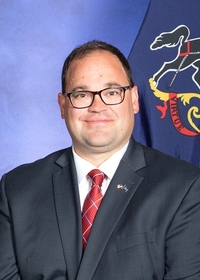
Rep. Michael Stender
Sponsored bills
Maddy summaryThis resolution designates April 13-19, 2025, as "National Public Safety Telecommunicators Week" in Pennsylvania. It honors 911 dispatchers (also called public safety telecommunicators) who serve as the first point of contact during emergencies and support emergency responders. The resolution recognizes their critical role in ensuring community safety through their professionalism and dedication during high-pressure situations. As a ceremonial resolution, it does not create new laws or policies.
Maddy summaryHB 1050 defines new types of electronic games under Pennsylvania's small games of chance law, specifically creating legal terms for electronic pull-tab devices, games, and systems. It clarifies that these electronic games cannot resemble casino-style games like slots or poker and must follow strict technical rules (e.g., no mobile phone use, no spinning reels). The bill directly affects licensed organizations already operating games like pull-tabs, ensuring new electronic formats comply with existing regulations. Key provisions include banning duplicate hold combinations in event games and requiring distinguishable features for multiple prize sets. This is a definitional update, not a policy change to prize limits or licensing.
Maddy summaryHB 159 amends Pennsylvania law to strengthen penalties for illegally transporting, selling, importing, or releasing nonnative fish and wildlife. It directly affects individuals, businesses, or organizations handling nonnative species, including pet trade sellers, anglers, and conservation groups. The bill increases misdemeanor penalties: violations involving non-native fish become third-degree misdemeanors for negligence or first-degree for intentional acts, while violations with endangered/threatened species escalate to second-degree (negligent/intentional) misdemeanors. It clarifies that each animal, egg, or fish involved in a violation counts as a separate offense, intensifying consequences for repeated or large-scale violations. The changes aim to better protect Pennsylvania's ecosystems and native species from invasive threats.
Maddy summaryHB 962 allows eligible organizations, such as charities and non-profits, to conduct virtual raffles and drawings using electronic payments like credit cards or mobile apps. The bill requires organizations to verify that participants are physically in Pennsylvania, are at least 18 years old, and provide accurate identity information through methods like government ID checks. It also restricts how winners are announced - only simple internet-based conferencing (e.g., Zoom) without animations, images, or slot machine technology can be used. These rules aim to modernize virtual game operations while ensuring compliance with state and federal gambling laws.
Maddy summaryThis resolution designates March 19, 2025, as "The Pennsylvania State University IFC/Panhellenic Dance Marathon (THON) Day" in Pennsylvania. It honors THON for raising over $17 million during its 2025 event to support the Four Diamonds Fund at Penn State Hershey Children's Hospital, which provides financial and emotional aid for pediatric cancer patients and funds cancer research. The resolution recognizes THON's role as the world's largest student-run philanthropy event, which has raised over $200 million since 1977 for childhood cancer care.
Maddy summaryHB 685 requires Pennsylvania schools to accept U.S. currency as payment for admission to school-sponsored activities, such as athletic events, assemblies, or field trips. It applies to all school entities, including public school districts, charter schools, and private schools participating in school activities. The bill mandates that cash must be accepted when fees are charged, while allowing schools to also accept other payment methods like credit cards. It defines "cash" as U.S. coins and paper money recognized as legal tender and clarifies that schools may refuse payments in large denominations that exceed the fee amount.
Maddy summaryHB 927 proposes a constitutional amendment to Pennsylvania that would prohibit the state from issuing driver's licenses or similar vehicle operation permits to individuals without lawful presence in the United States. This would directly affect non-citizens residing in Pennsylvania without legal immigration status, preventing them from obtaining or renewing driver's licenses under this policy. The amendment requires approval by the Pennsylvania General Assembly and subsequent voter approval at the next applicable election, as outlined in Section 2 of the resolution. If adopted, it would change the state constitution to mandate legal immigration status as a prerequisite for license issuance.
Maddy summaryHB 913 renames Pennsylvania's Department of Environmental Protection to the Department of Environmental Services. The bill updates all references to the department in state law and outlines a phased transition for documents, signage, licenses, and computer systems to avoid disruption during the name change. It repeals outdated references to the "Department of Environmental Protection" while preserving existing powers, duties, and contracts. This is a procedural change with no impact on environmental policies or regulations.
Maddy summaryPennsylvania's House Resolution 125 is a petition to Congress requesting an Article V constitutional convention to propose amendments focused on three specific areas: imposing fiscal restraints on the federal government, limiting federal power and jurisdiction, and setting term limits for federal officials and members of Congress. The resolution specifies that any convention must be limited to these topics only, cannot consider changes to the Bill of Rights, and requires two-thirds of states to apply for the same purpose before Congress acts. It details Pennsylvania's delegate selection process (five members chosen by the legislature with voting rules) and includes conditions like Congress only setting the convention's time/place, states having equal voting power, and delegates disqualifying if accepting gifts. The resolution explicitly recommends ratification of any amendments through state legislatures rather than conventions.