

In committee Apr 15, 2025
1 co-sponsor
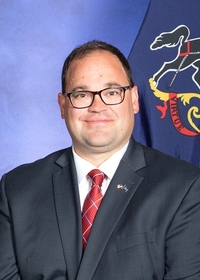
Rep. Michael Stender
Total votes
3,042
all sessions
Attendance
100%
1 missed
Near the chamber average
With party
97%
of cast votes
Near the chamber average
Bipartisan score
2%
crosses aisle rarely
Near the chamber average
Sponsored
284
bills & resolutions
Near the chamber average
Committees
4
assignments
284 bills and resolutions
Sponsored bills
Total
284
Primary
18
Co-sponsor
266
This page
284
matching current filters
An Act amending Title 51 (Military Affairs) of the Pennsylvania Consolidated Statutes, in veteran-owned small businesses, providing for small diverse business.
Maddy summaryHB 1190 amends Pennsylvania law to automatically classify veteran-owned small businesses as "small diverse businesses" under Title 51 (Military Affairs). This change eliminates the need for veteran-owned small businesses to seek separate verification to qualify under programs designated for small diverse businesses. The bill directly affects veteran entrepreneurs operating small businesses in Pennsylvania who previously faced additional administrative steps. The policy takes effect 60 days after enactment, streamlining access to relevant state contracting and support programs.
In committee Apr 15, 2025
1 co-sponsor
An Act amending Title 75 (Vehicles) of the Pennsylvania Consolidated Statutes, in registration of vehicles, providing for contributions to local fire companies; in fees, further providing for payments to special funds; and establishing the Local Fire Company Fund.
Maddy summaryHB 1168 allows Pennsylvania vehicle owners and driver's license applicants to voluntarily contribute $5 (for license or one-year registration) or $10 (for two-year registration) to their local fire company when paying fees. These contributions are added to standard registration or license renewal costs and collected by the Department of Motor Vehicles. Quarterly, the funds are transferred to the newly created Local Fire Company Fund and distributed by the State Fire Commissioner to fire companies based on the registered addresses of contributors. The bill directly supports local fire departments through a streamlined, voluntary public contribution mechanism.
In committee Apr 9, 2025
0 co-sponsors
An Act amending the act of July 31, 1968 (P.L.805, No.247), known as the Pennsylvania Municipalities Planning Code, in subdivision and land development, further providing for contents of subdivision and land development ordinance.
Maddy summaryHB 1037 amends Pennsylvania's Municipalities Planning Code to allow municipalities to permit the replacement of demolished one- or two-family homes with structurally similar residential buildings using the original property's setback standards. This provision directly affects homeowners seeking to rebuild single-family or duplex properties and local governments issuing building permits. The key mechanism requires municipalities to provide these original setback standards to applicants when approving such replacements, streamlining the rebuilding process while maintaining consistent lot coverage. The bill does not change zoning requirements but offers flexibility for residential reconstruction within existing development patterns.
In committee Apr 8, 2025
1 co-sponsor
An Act amending the act of June 13, 1967 (P.L.31, No.21), known as the Human Services Code, in public assistance, further providing for verification of eligibility.
Maddy summaryHB 1156 amends Pennsylvania's Human Services Code to strengthen eligibility verification for medical assistance and food stamp programs. The bill requires the state department to regularly review data from other agencies, including monthly checks for gambling winnings over $3,000 (via the Gaming Control Board), death records (from the Department of Health), and residency changes (via out-of-state EBT), plus quarterly checks for employment and income changes (from Labor and Revenue). It also prohibits the department from accepting eligibility determinations from health insurance exchanges without verification and bans self-attestation for key factors like income, residency, or household composition without prior verification. These changes update the verification process to align with current data-sharing capabilities.
In committee Apr 7, 2025
1 co-sponsor
An Act amending Title 16 (Counties) of the Pennsylvania Consolidated Statutes, in eminent domain and injury to property, further providing for restrictions as to certain property.
Maddy summaryHB 1086 prohibits the government from taking land or property used for cemeteries, burying grounds, or places of public worship - including land owned by religious or cemetery institutions but not currently used for those purposes - through eminent domain under Pennsylvania's current laws. The bill directly affects property owners and institutions operating cemeteries or places of worship by adding a legal barrier to government acquisition. It amends Title 16 of Pennsylvania law to explicitly restrict eminent domain actions targeting these specific properties, with no exception provided in the cited text. The law takes effect 60 days after enactment.
In committee Apr 1, 2025
1 co-sponsor
A Resolution urging the Congress of the United States to expand the Sergeant First Class Heath Robinson Honoring Our Promise to Address Comprehensive Toxics (PACT) Act of 2022 to include the health impacts of exposure to toxic substances at the United States military base Camp Carroll, South Korea.
Maddy summaryThis Pennsylvania House resolution (HR 160) urges Congress to amend the PACT Act to include veterans exposed to toxic substances at Camp Carroll military base in South Korea. It specifically seeks to extend the PACT Act's health benefits - which currently cover veterans exposed to toxins at other sites - to veterans who served at Camp Carroll during the Vietnam War era and developed related illnesses like cancer or diabetes. The resolution cites a 2011 report confirming chemical burial at Camp Carroll and notes these veterans remain excluded from PACT Act benefits despite documented health impacts. It does not create new law but formally requests congressional action to correct this exclusion.
HealthcareSupports HealthcareExtends PACT Act health benefits to veterans exposed to toxins at Camp Carroll, expanding coverage for toxin-related illnesses like cancer and diabetes.
VeteransSupports VeteransUrges expansion of PACT Act benefits to cover Camp Carroll veterans' toxin exposure health issues, directly advancing healthcare access for veterans.
In committee Apr 1, 2025
1 co-sponsor
An Act amending Title 34 (Game) of the Pennsylvania Consolidated Statutes, in fiscal affairs, establishing the Deterrent Fencing Cost-Share Program and the Deterrent Fencing Cost-Share Program Fund; and imposing duties on the Department of Agriculture.
Maddy summaryThis bill establishes a state-funded program to help agricultural landowners install wildlife deterrent fencing. Eligible landowners who have experienced verifiable crop damage from wildlife (documented through at least 10% loss, physical evidence, and an in-person assessment) can receive 50% cost-sharing for approved fencing. The Department of Agriculture will administer the program, verifying damage and overseeing construction to meet specific wildlife-targeted standards. Funding is set at $4 million for the first year and $2 million annually thereafter, sourced from the Game Fund, with unspent funds after 2036 returned to the Game Fund.
In committee Mar 28, 2025
1 co-sponsor
An Act amending the act of April 9, 1929 (P.L.343, No.176), known as The Fiscal Code, in Board of Finance and Revenue, further providing for restricted account within Agricultural College Land Scrip Fund.
Maddy summaryHB 1047 creates a dedicated restricted account within the Agricultural College Land Scrip Fund to specifically support agricultural research and extension services at Pennsylvania's land grant university. The bill mandates that the State Treasurer distribute these funds equally each month during the fiscal year, beginning within ten days of the appropriation. This payment is guaranteed to occur without delay, withholding, or blocking by other laws, regardless of whether the university receives other appropriations for the same fiscal year. The policy ensures dedicated, uninterrupted funding for these agricultural programs.
Budget & TaxesSupports Budget & TaxesBill creates dedicated restricted account for agricultural research funding, mandates timely disbursement without delays, ensuring fiscal management for public service
EducationSupports EducationCreates dedicated fund for agricultural research at land grant university, directly supporting higher education funding and research activities.
In committee Mar 25, 2025
1 co-sponsor
An Act amending the act of April 12, 1951 (P.L.90, No.21), known as the Liquor Code, in licenses and regulations and liquor, alcohol and malt and brewed beverages, further providing for breweries; and, in distilleries, wineries, bonded warehouses, bailees for hire and transporters for hire, further providing for limited distilleries and distilleries.
Maddy summaryHB 1041 allows a single business to hold both a brewery license and a limited distillery license at the same physical location in Pennsylvania. The bill requires that the areas for each operation be clearly separated (though they may overlap), specifies that both licenses must operate within permitted hours, and states that citations for violations can apply to either or both licenses. This directly affects breweries and distilleries seeking to combine operations under one roof, particularly those allowing on-premise consumption. The law modifies existing Liquor Code provisions (Sections 446 and 505.4) to formalize these dual-license arrangements. The bill takes effect 60 days after enactment.
In committee Mar 25, 2025
1 co-sponsor
Ask Maddy
·
AI policy assistant
Ask Maddy about Michael Stender
Scope: pennsylvania
Hi! I can help you understand Michael Stender's legislative record. What would you like to know?
Try one of these
i
Maddy answers using official bill text and legislative records. Always verify before sharing.
Sources cited inline