

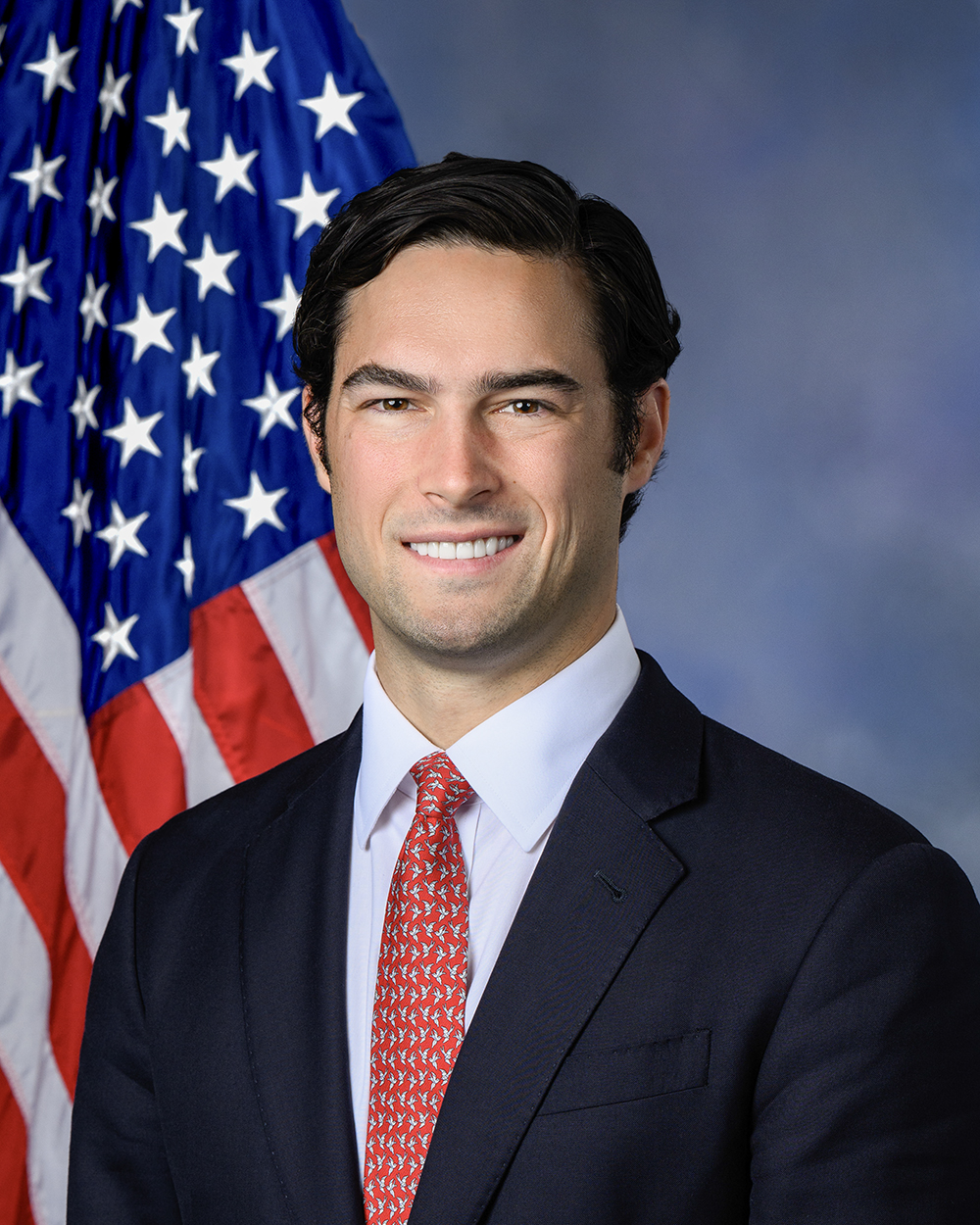
Photo of Brandon Gill
R United States House · District 26 · Texas On the 2026 ballot

Rep. Brandon Gill

Compare
Total votes
650
all sessions
Attendance
98%
12 missed
Near the chamber average
With party
91%
of cast votes
Lower than 92% of chamber peers
Bipartisan score
4%
crosses aisle rarely
Higher than 91% of chamber peers
Sponsored
352
bills & resolutions
Near the chamber average
Committees
9
assignments
352 bills and resolutions

Sponsored bills

Total
352
Primary
26
Co-sponsor
326
This page
352
matching current filters
Co-sponsor HR 7678
In committee · Oregon House · Co-sponsor
Gun Owner Registration Information Protection Act

Maddy summaryHR 7678, the Gun Owner Registration Information Protection Act, prohibits federal funding for state or local databases that track lawfully owned firearms or their owners. The bill allows federal funding for databases recording lost or stolen firearms but bans it for databases listing legal gun ownership. This means states cannot use federal money to create or maintain systems that compile information about legally owned guns. The bill directly affects state and local governments that rely on federal funds for firearm ownership databases.

In committee Feb 25, 2026 1 co-sponsor
Co-sponsor HR 2189
Passed · Oregon House · Co-sponsor
To modernize Federal firearms laws to account for advancements in technology and less-than-lethal weapons, and for other purposes.

Law-Enforcement Innovate to De-Escalate Act This bill removes less-than-lethal projectile devices (e.g., certain TASERs) from regulation under the Gun Control Act. The term less-than-lethal projectile device means a device that (1) is not designed or intended to expel (and may not be readily converted to discharge) commonly used ammunition or projectiles exceeding a velocity of 500 feet per second; (2) is designed and intended to be used in a manner not likely to cause death or serious bodily injury; and (3) does not accept (and cannot be readily modified to accept) an ammunition feeding device. The bill also requires the Bureau of Alcohol, Tobacco, Firearms and Explosives to determine whether a device satisfies the definition of a less-than-lethal projectile device within 90 days of a request.

Passed Feb 24, 2026 1 co-sponsor
Co-sponsor HR 7611
In committee · Oregon House · Co-sponsor
Protecting Puppies from Sharia Act

Maddy summaryThis bill is not a real legislative proposal but a widely circulated hoax. It falsely claims to prohibit federal funding for states that "prohibit dog ownership" while misrepresenting Sharia law as a threat to pet ownership - a claim with no basis in reality, as Sharia law does not regulate pet ownership and no U.S. jurisdiction prohibits dog ownership. The bill contains factual inaccuracies (e.g., falsely equating Sharia law with being "against the pursuit of happiness") and would be unconstitutional due to religious discrimination. It was never introduced in Congress and appears to be a satirical or misleading online post.

In committee Feb 20, 2026 1 co-sponsor
Co-sponsor HR 1319
In committee · Oregon House · Co-sponsor
Modern Worker Empowerment Act

This bill specifies a legal standard for determining whether an individual is considered an independent contractor rather than an employee for the purposes of federal labor laws that address issues such as the federal minimum wage, overtime compensation, and collective bargaining. The rights and protections provided by these laws exclusively apply to employees. Under the bill, an individual is considered an independent contractor if (1) another individual or entity does not exercise significant control over the details of how the individual's work is performed, without regard to any control the other individual or entity may exercise over the final result of the work performed; and (2) while performing such work, the individual has opportunities and risks inherent with entrepreneurship (for example, the discretion to exercise professional judgment). The bill also sets forth factors that may not be used to determine whether an individual is an employee. Specifically, factors such as whether another individual or entity requires the individual to meet certain legal, health and safety, insurance, or performance requirements may not be used to make such a determination.

In committee Feb 20, 2026 1 co-sponsor
Primary HJRES 142
Signed into law · Oregon House · Lead sponsor
Disapproving the action of the District of Columbia Council in approving the D.C. Income and Franchise Tax Conformity and Revision Temporary Amendment Act of 2025.

This joint resolution reinstates provisions of District of Columbia (DC) tax law to conform with federal tax law. As background, DC generally automatically adopts changes to federal tax law (known as rolling conformity). Therefore, upon enactment of the 2025 reconciliation act (commonly known as the One Big Beautiful Bill Act), many of its tax provisions became DC law. DC subsequently enacted its own legislation (the DC Income and Franchise Tax Conformity and Revision Temporary Amendment Act of 2025) that decoupled DC tax law from these federal provisions. This joint resolution nullifies the DC legislation, thereby generally realigning DC tax law with the tax provisions of the 2025 reconciliation act. Specifically, the joint resolution reinstates for DC provisions that •    increase the higher basic standard deduction; •    increase deductible charitable cash contributions (for taxpayers who take the standard deduction); •    establish a $6,000 tax deduction for taxpayers 65 years and older; •    allow a tax deduction of qualified tips, qualified overtime pay, and qualified car loan interest; •    authorize an elective 100% depreciation allowance for nonresidential real property; and •    authorize businesses to deduct 100% of research and experimental costs retroactive to tax year 2022. The DC legislation also amended several other provisions of DC tax law, including restoring the DC child tax credit. The joint resolution negates these changes.

Signed into law Feb 18, 2026 0 co-sponsors
Co-sponsor HR 7592
In committee · Oregon House · Co-sponsor
Zero-Based Regulatory Budgeting to Unleash American Energy Act of 2026

Maddy summaryHR 7592 requires key energy regulatory agencies - including the Department of Energy, Bureau of Land Management, Bureau of Ocean Energy Management, Bureau of Safety and Environmental Enforcement, Office of Surface Mining, and Federal Energy Regulatory Commission - to set expiration dates for specific energy-related regulations. Existing regulations must expire within one year of enactment, while new regulations expire after five years unless renewed. Renewal requires public comment on costs/benefits and agency determination that the regulation has a "net deregulatory effect," with extensions limited to five years per renewal. If not renewed, regulations cease to be enforceable and are removed from federal rules. The bill directly affects how these agencies manage energy and environmental regulations under specific statutes like the Energy Policy Act and Surface Mining Control Act.

In committee Feb 17, 2026 1 co-sponsor
Co-sponsor HR 1028
In committee · Oregon House · Co-sponsor
Protection of Women in Olympic and Amateur Sports Act of 2026

Protection of Women in Olympic and Amateur Sports Act This bill requires certified national governing bodies (NGBs) of amateur sports (e.g., USA Gymnastics) to prohibit a person whose sex is male from participating in an amateur athletic competition that is designated for females, women, or girls. Under the bill, male  means an individual who has, had, will have—or would have, but for a developmental or genetic anomaly or historical accident—the reproductive system that at some point produces, transports, and utilizes sperm for fertilization.

In committee Feb 17, 2026 1 co-sponsor
Co-sponsor HR 7510
In committee · Oregon House · Co-sponsor
Preventing Research Ownership Transfer to External Competitive Threats (PROTECT) Act of 2026

Maddy summaryHR 7510, the PROTECT Act of 2026, prohibits U.S. universities and their affiliated researchers from transferring intellectual property rights (like patents or research data) in covered research to "covered foreign governments" - defined as nations including Russia, China, Iran, or others deemed national security threats by the Secretary of State. The law bans contracts, licenses, or sales granting such foreign governments ownership or control over U.S. academic research, particularly in critical energy or defense fields. Violations risk civil penalties up to $5 million per incident, with seized funds forfeited to the U.S. government. It directly affects universities conducting research involving sensitive intellectual property and their ability to collaborate with entities tied to designated threat nations.

In committee Feb 11, 2026 1 co-sponsor
Co-sponsor HR 7442
In committee · Oregon House · Co-sponsor
National Bridge Funding Reform Act

Maddy summaryHR 7442 establishes a new National Bridge Program under federal highway law to allocate funding for bridge replacement, rehabilitation, and construction. It changes how funds are distributed: 75% based on the total deck area of bridges on federal-aid highways in each state, and 25% based on the deck area of bridges in poor condition. This directly affects state transportation departments managing federal-aid highway bridges, requiring them to prioritize projects using this updated formula starting after December 31, 2024. The bill eliminates prior programs (Carbon Reduction and PROTECT) and revises related funding mechanisms.

In committee Feb 10, 2026 1 co-sponsor
Showing 61 to 70 of 352 bills
Previous 1 6 7 8 36 Next