

K2 Veterans Care Act of 2021 This bill establishes a presumption of service-connection for certain diseases becoming manifest in a veteran who served on active duty at Karshi-Khanabad (K2) Air Base in Uzbekistan between January 1, 2001, and December 31, 2005. Specifically, there must be a presumption of service-connection for veterans who manifest illnesses that have a positive association with exposure to jet fuel, volatile organic compounds, high levels of particulate matter, depleted uranium, asbestos, or lead-based paint, as determined by the National Academies of Sciences, Engineering, and Medicine (NASEM). Under a presumption of service-connection, specific conditions diagnosed in certain veterans are presumed to have been caused by the circumstances of their military service. Health care benefits and disability compensation may then be awarded. Veterans who served at K2 Air Base during the specified period are eligible for Department of Veterans Affairs hospital care, medical services, and nursing home care for an illness that has been determined by NASEM to have a positive association with exposure to jet fuel, volatile organic compounds, high levels of particulate matter, depleted uranium, asbestos, or lead-based paint.
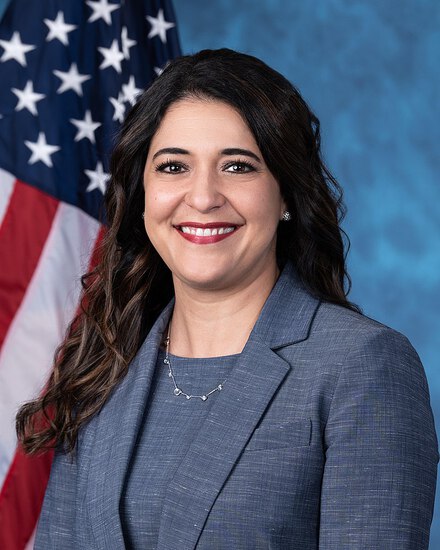
Rep. Stephanie I. Bice
Sponsored bills
Main Street Tax Certainty Act This bill makes permanent the tax deduction for qualified business income. (Under current law, the deduction expires after December 31, 2025.) Qualified business income is defined as the net amount of qualified items of income, gain, deduction and loss with respect to any trade or business, excluding capital gains or losses, dividends, interest income, or income earned outside the U.S.
Keystone XL Pipeline Construction and Jobs Preservation Act This bill authorizes the TransCanada Keystone Pipeline to construct, connect, operate, and maintain the pipeline facilities in Phillips County, Montana, for the import of oil from Canada to the United States.
This resolution commemorates the 30th anniversary of Operation Desert Storm's 100-hour ground campaign, honors the legacy of the 697,000 U.S. Desert Storm veterans, and pays tribute to the 299 men and women who lost their lives.
This resolution opposes lifting specified sanctions on Iran and resolves that these sanctions may be terminated only after Iran has ceased providing support for acts of international terrorism and has dismantled its nuclear, biological, and chemical weapons and related technologies.
National Right-to-Work Act This bill repeals those provisions of the National Labor Relations Act and the Railway Labor Act that permit employers to make an agreement with a labor union to require employees to join such union as a condition of employment. Currently, at least 27 states have enacted laws prohibiting employers from compelling employees to become members of a union as a condition of employment.
Protecting Our Wealth of Energy Resources Act or the POWER Act This bill requires the President and federal agencies to obtain the approval of Congress before prohibiting or substantially delaying certain new energy or mineral leases or permits on federal lands, including oil and gas leases, coal leases, hard rock leases, or critical minerals leases. In addition, the President and agencies must obtain the approval of Congress before withdrawing certain federal lands from mineral and geothermal leasing activities.
Saving America's Energy Future Act This bill prohibits the Department of Agriculture and the Department of the Interior from declaring a moratorium on issuing new oil and gas leases and drill permits on certain federal lands. In addition, the bill prohibits the departments from declaring a moratorium on renewals of such permits.
Iran Nuclear Verification Act This bill prohibits the United States from becoming a party to the Joint Comprehensive Plan of Action (JCPOA) or any other agreement with Iran that relates to Iran's nuclear program until the President makes certain certifications. The JCPOA is an agreement, signed by Iran and several other world powers (including the United States), that places restrictions on Iran's nuclear program in exchange for certain sanctions relief. The United States withdrew from the JCPOA in 2018. The United States may not become a party to any such agreement until the President certifies to Congress that United Nations nuclear inspectors are allowed full access to all of Iran's nuclear facilities, and that they have completed their comprehensive report relating to those facilities.
Iran Hostages Congressional Gold Medal Act This bill requires the Speaker of the House of Representatives and the President pro tempore of the Senate to arrange for the award of a Congressional Gold Medal commemorating the bravery and endurance of the 53 hostages of the Iran Hostage Crisis. Following its award, the medal shall be given to the National Museum of American History of the Smithsonian Institution for display and research. The Department of the Treasury must strike duplicate medals in silver for presentation to a hostage (or the personal representative of a deceased hostage), and Treasury may also strike and sell duplicate medals in bronze.