

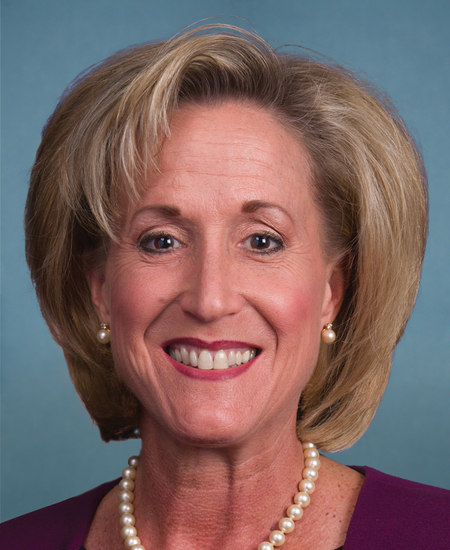
Photo of Ann Wagner
R United States House · District 2 · Missouri On the 2026 ballot

Rep. Ann Wagner

Compare
Total votes
2,818
all sessions
Attendance
98%
53 missed
Near the chamber average
With party
93%
of cast votes
Near the chamber average
Bipartisan score
4%
crosses aisle rarely
Near the chamber average
Sponsored
664
bills & resolutions
Lower than 81% of chamber peers
Committees
6
assignments
664 bills and resolutions

Sponsored bills

Total
664
Primary
62
Co-sponsor
602
This page
664
matching current filters
Co-sponsor HR 9885
In committee · Oregon House · Co-sponsor
Nationwide Consumer and Fuel Retailer Choice Act of 2024

Maddy summaryThis bill amends the Clean Air Act to modify ethanol waiver processes and fuel volatility standards. It adds a new provision allowing fuel to enter commerce if it meets Reid Vapor Pressure requirements through similarity to certified vehicles or existing waivers, and adjusts vapor pressure limits from 10% to 10-15% in several sections. Small refineries that retired credits for 2016-2018 compliance years may now have those credits returned or applied to future years if their petitions remained pending as of December 1, 2022. The changes directly affect fuel retailers, ethanol producers, and small refineries by altering compliance pathways for fuel standards and credit management under the renewable fuel program.

In committee Sep 27, 2024 1 co-sponsor
Co-sponsor HRES 1469
Passed · Oregon House · Co-sponsor
Ensuring accountability for key officials in the Biden-Harris administration responsible for decisionmaking and execution failures throughout the withdrawal from Afghanistan.

Maddy summaryHRES 1469 is a formal House resolution condemning 15 specific officials in the Biden-Harris administration for their roles in the 2021 Afghanistan withdrawal. It alleges failures including inadequate planning for evacuations, disregarding warnings about Taliban actions, and misleading the public - leading to the Abbey Gate terrorist attack that killed 13 U.S. service members. The resolution does not create new legal requirements but formally condemns these individuals for "decisionmaking and execution failures" during the withdrawal. It directly addresses President Biden, Vice President Harris, National Security Advisor Jake Sullivan, Secretary of State Antony Blinken, and other senior officials named in the resolution. This is a symbolic statement of congressional disapproval, not a binding policy change.

Passed Sep 25, 2024 1 co-sponsor
Co-sponsor HR 1719
In committee · Oregon House · Co-sponsor
Honoring Our Fallen Heroes Act of 2023

Maddy summaryHR 1719, the Honoring Our Fallen Heroes Act of 2023, establishes a presumption that certain cancers diagnosed in public safety officers (like police and firefighters) are work-related if linked to their duties. It defines 22 specific cancers (including lung, mesothelioma, and WTC-related cancers) as "exposure-related," allowing officers or their families to receive benefits without proving direct work connection, provided they were diagnosed within 15 years of leaving active service. The bill also creates a process for adding new cancers to the list based on scientific evidence, requiring the Bureau to review petitions and make decisions within 180 days. This applies to deaths or disabilities occurring on or after January 1, 2023, directly affecting officers who developed covered cancers during service.

In committee Sep 25, 2024 1 co-sponsor
Co-sponsor HJRES 136
Passed · Oregon House · Co-sponsor
Providing for congressional disapproval under chapter 8 of title 5, United States Code, of the rule submitted by the Environmental Protection Agency relating to "Multi-Pollutant Emissions Standards for Model Years 2027 and Later Light-Duty and Medium-Duty Vehicles".

Maddy summaryHJRES 136 is a resolution seeking to block an Environmental Protection Agency (EPA) rule that would have set new emissions standards for light and medium-duty vehicles sold in 2027 and later model years. The EPA rule, published in April 2024, aimed to require vehicle manufacturers to meet stricter pollution limits for these vehicles. If passed, this resolution would cancel the rule, preventing the EPA from enforcing the new standards. It uses a congressional process that allows Congress to reject agency rules with a simple majority vote.

Passed Sep 23, 2024 1 co-sponsor
Co-sponsor HRES 1476
In committee · Oregon House · Co-sponsor
Encouraging the Department of State and civil society to further the Abraham Accords by encouraging peace and tolerance in education.

Maddy summaryHRES 1476 is a non-binding House resolution encouraging the U.S. Department of State and civil society to support educational reforms aligned with the Abraham Accords. It specifically urges diplomatic engagement to help countries like the UAE, Bahrain, Morocco, Saudi Arabia, and Indonesia remove antisemitic content and hate speech from school curricula while adding materials promoting peace, tolerance, and mutual respect. The resolution directs the State Department to prioritize curriculum reform discussions in bilateral talks with Middle Eastern partners. It also calls on international organizations like the UN to strengthen counter-incitement efforts in education and supports expanding the Abraham Accords to other nations. This resolution focuses on fostering educational changes to build regional stability, not on mandating specific policy outcomes.

In committee Sep 19, 2024 1 co-sponsor
Co-sponsor HJRES 163
In committee · Oregon House · Co-sponsor
Providing for congressional disapproval under chapter 8 of title 5, United States Code, of the rule submitted by the Environmental Protection Agency relating to "New Source Performance Standards for Greenhouse Gas Emissions From New, Modified, and Reconstructed Fossil Fuel-Fired Electric Generating Units; Emission Guidelines for Greenhouse Gas Emissions From Existing Fossil Fuel-Fired Electric Generating Units; and Repeal of the Affordable Clean Energy Rule".

Maddy summaryThis bill (HJRES 163) is a congressional disapproval resolution targeting an Environmental Protection Agency (EPA) rule finalized on May 9, 2024. The EPA rule established new emissions standards for greenhouse gases from fossil fuel power plants (both new and existing) and repealed a previous rule called the Affordable Clean Energy Rule. The resolution would block this EPA rule from taking effect by invoking the Congressional Review Act (Chapter 8 of Title 5, U.S. Code). If passed, it would prevent the EPA rule from being enforced, directly affecting fossil fuel power plant operators and the EPA’s regulatory authority over emissions.

In committee Sep 18, 2024 1 co-sponsor
Co-sponsor HJRES 133
In committee · Oregon House · Co-sponsor
Providing for congressional disapproval under chapter 8 of title 5, United States Code, of the rule submitted by the Environmental Protection Agency relating to "Greenhouse Gas Emissions Standards for Heavy-Duty Vehicles-Phase 3".

Maddy summaryHJRES 133 is a congressional resolution seeking to block an Environmental Protection Agency (EPA) rule titled "Greenhouse Gas Emissions Standards for Heavy-Duty Vehicles-Phase 3." This rule, published in the Federal Register on April 22, 2024, established new emissions requirements for large trucks and commercial vehicles. The resolution, if passed, would prevent the EPA rule from taking effect by formally disapproving it under standard congressional review procedures. The measure directly affects the EPA’s regulatory authority and vehicle manufacturers who would have been required to comply with the proposed standards.

In committee Sep 18, 2024 1 co-sponsor
Co-sponsor HR 7159
Passed · Oregon House · Co-sponsor
Pacific Partnership Act

Maddy summaryHR 7159, the Pacific Partnership Act, mandates the U.S. government to develop a comprehensive strategy for engagement with Pacific Island nations. It requires the President, by January 1, 2026, and every four years thereafter, to submit a detailed strategy to Congress outlining U.S. diplomatic, defense, and economic goals in the region, including assessments of threats like natural disasters, illegal fishing, and foreign military activity. The strategy must detail plans to address these threats, coordinate with Pacific Island governments and regional organizations like the Pacific Islands Forum, and outline required resources and staffing. This bill directly affects U.S. foreign policy operations and shapes how the federal government engages with Pacific Island nations on shared security, economic, and environmental priorities.

Passed Sep 10, 2024 1 co-sponsor
Primary HR 7151
Passed · Oregon House · Lead sponsor
Export Control Enforcement and Enhancement Act

Maddy summaryHR 7151, the Export Control Enforcement and Enhancement Act, streamlines the process for adding or removing entities from the U.S. Entity List (which restricts exports to foreign entities deemed a national security risk). It requires the End-User Review Committee to vote on proposed changes within 30 days (with limited exceptions for additional information), and mandates a "presumption of denial" for exports to entities on the list or to embargoed countries - meaning exporters must prove their request won’t risk misuse. The bill also clarifies that exceptions to the denial rule require explicit committee approval and requires congressional notification for such exceptions. This directly affects U.S. exporters seeking licenses for controlled items (like technology or equipment) destined for listed entities or embargoed nations.

Passed Sep 10, 2024 0 co-sponsors
Co-sponsor HR 554
Passed · Oregon House · Co-sponsor
Taiwan Conflict Deterrence Act of 2023

Maddy summaryHR 554, the Taiwan Conflict Deterrence Act of 2023, requires the U.S. Treasury to report annually for three years on financial assets held by specific Chinese Communist Party officials involved with Taiwan, including Politburo members and certain Central Committee members. It mandates that U.S. financial institutions cannot engage in significant transactions with these officials or their immediate family (spouses, children, parents) if the Treasury finds they benefit from funds detailed in the reports. The prohibition on financial transactions expires either 30 days after the President certifies the threat to U.S. interests has ended or 25 years after the final report is submitted. The law aims to deter actions by China that threaten Taiwan by targeting financial ties of high-level officials.

Passed Sep 10, 2024 1 co-sponsor
Showing 201 to 210 of 664 bills
Previous 1 20 21 22 67 Next