

Maddy summaryThis bill clarifies liability for payroll tax errors when third-party payroll services (like professional employer organizations) rely on employer certifications. It allows these services to depend on employer-provided information unless they knew or should have known of an error. If an error is discovered, the employer bears full liability unless the third party had "constructive knowledge" of the error, in which case liability is shared based on the portion of the error the third party knew about. The bill also prevents the IRS from delaying payroll tax credits or auditing employers solely because a third party relied on an erroneous certification from that employer. It directly affects third-party payroll services and the businesses that use their services for tax filings.
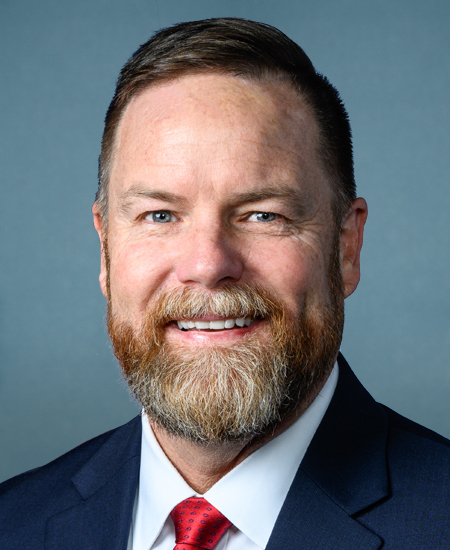
Rep. Aaron Bean
Sponsored bills
Maddy summary# Summary of the SHIPS for America Act This comprehensive legislation focuses on strengthening the U.S. maritime industry, shipbuilding capacity, and maritime workforce to enhance national security and economic competitiveness. ## Key Areas of Focus 1. **Shipbuilding & Maritime Infrastructure** - Establishes a United States Center for Maritime Innovation to accelerate adoption of commercial technologies - Creates a National Shipbuilding Research Program - Requires an annual survey of anticipated commercial vessel construction - Includes provisions for streamlined environmental reviews of maritime infrastructure 2. **Workforce Development** - Establishes the United States Merchant Marine Career Retention Program to maintain mariner qualifications - Creates Centers of Excellence for Domestic Maritime Workforce Training and Education - Implements military-to-maritime transition programs - Establishes a Maritime Career and Technical Education Advisory Committee 3. **Education & Training** - Expands educational assistance for merchant mariners - Creates eligibility for Naval Postgraduate School for merchant mariners - Establishes maritime education programs from K-12 through higher education - Provides for international exchanges for mariners and naval architects 4. **National Security & Strategic Readiness** - Requires reports on National Defense Reserve Fleet utilization - Includes measures to de-risk the maritime sector from Chinese influence - Enhances shipbuilding capacity for national security needs - Establishes programs to ensure sufficient mariner workforce for national defense 5. **Funding Mechanisms** - Authorizes appropriations from the Maritime Security Trust Fund - Includes funding for workforce programs, education, and shipbuilding initiatives - Establishes specific funding levels for various programs over multiple fiscal years The legislation aims to create a sustainable domestic maritime industrial base that supports both commercial shipping and national defense requirements, with a particular emphasis on developing and retaining a skilled U.S. maritime workforce.
Maddy summaryThis bill designates the POW/MIA Memorial and Museum under construction in Jacksonville, Florida, as the official "National POW/MIA Memorial and Museum." It requires the museum to submit a detailed report to Congress within 90 days, including a five-year budget, organizational structure, bylaws, and accreditation details. The designation may be withdrawn if the museum is not operational within five years of the bill's enactment or if the required report is late. The museum honors prisoners of war and those missing in action since World War II through educational exhibits and reflective spaces for the public.
Canadian Snowbird Act This bill authorizes the Department of Homeland Security to admit into the United States qualifying Canadian citizens as long-term nonimmigrant visitors. A qualifying Canadian citizen is an individual who (1) is at least 50 years old, (2) maintains a Canadian residence, (3) owns a U.S. residence or has rented a U.S. accommodation for the duration of the individual's stay, (4) is not inadmissible or deportable, (5) will not engage in employment or labor for hire in the United States other than for a non-U.S.-based person or entity by whom the Canadian citizen was employed in Canada or for whom the Canadian citizen performed services in Canada, and (6) will not seek certain forms of assistance or benefits. A qualified individual may be admitted for up to 240 days during any single 365-day period. The spouse of such an individual may be admitted under the same terms, except that the spouse is not required to separately satisfy the requirement for owning or renting a residence in the United States. An individual admitted into the United States under this bill shall have nonresident alien tax status.
Maddy summaryThis bill temporarily allows doctors to prescribe and dispense certain Medicare-covered medications directly to seniors in their offices from 2026 to 2030, under specific conditions. It requires prior in-person visits, limits dispensing to group practices, and mandates billing through the physician’s practice. The bill also directs the GAO to study whether physician-owned pharmacies are becoming common and how such arrangements might affect prescribing. It directly affects seniors receiving Medicare Part D drugs and physician practices participating in these arrangements. The exception expires in 2030, with no changes to Medicare Part D program rules.
Maddy summaryHR 2925, the Maritime Fuel Tax Parity Act, extends an existing tax exemption for alternative motorboat fuels to small vessels operating exclusively between ports on the Atlantic or Pacific coasts of the United States. The bill amends the Internal Revenue Code to include these single-coast vessels under the current exemption, ensuring they pay the same excise tax rate as other qualifying vessels. This change applies to fuel sales after December 31, 2023, directly affecting small maritime businesses that operate only along one coastal region. The key provision modifies Section 4041(g) to clarify that the tax exemption covers these specific vessels, promoting tax parity without creating new taxes or altering broader fuel regulations.
Maddy summaryThis bill requires FEMA to reimburse local governments and electric cooperatives for interest paid on disaster recovery loans. It covers interest calculated as the lesser of actual payments or what would have been paid at the current prime rate, for loans where at least 90% of funds were used for disaster-related projects. The reimbursement includes interest from the past nine years and mandates FEMA to process payments within one year of the bill's enactment.
Maddy summaryThis bill modifies tax rules for health savings accounts (HSAs) to help employees transition from health flexible spending accounts (FSAs) or health reimbursement arrangements (HRAs) to HSAs when switching to a high-deductible health plan. It allows employees to transfer unused FSA/HRA funds directly to an HSA during the plan year, with limits based on existing HSA contribution rules. Employers must report these transfers on employees' W-2 forms as taxable compensation. The changes apply to transfers made after December 2025 and primarily affect workers using employer-sponsored health benefits who switch coverage types.
Maddy summaryThis bill, titled "Secure Family Futures Act of 2025" but actually focused on tax code changes, primarily affects a specific subset of insurance companies. It amends the Internal Revenue Code to exclude certain debts (like bonds or notes) held by these companies from being counted as capital assets (Section 2), and extends their capital loss carryover period to 10 years for losses from foreign expropriation or losses incurred by these companies (Section 3). The changes apply to debts acquired and losses arising after December 31, 2025. The bill's title is misleading, as it does not relate to family policy but is a technical tax amendment targeting defined insurance industry entities.
Maddy summaryHR 2584, the Protect TANF Resources for Families Act, prohibits states from using federal Temporary Assistance for Needy Families (TANF) funds to replace state or local funding for TANF programs. It requires states to certify that federal TANF funds will only supplement, not supplant, existing state spending, with this rule taking effect October 1, 2025. The bill also extends the TANF program through September 30, 2026, maintaining current funding levels and operations as authorized for fiscal year 2023. This directly affects states administering TANF and the low-income families receiving these benefits, ensuring federal funds are used as intended to support, not replace, state contributions.