

Promoting the Unbiased Role of Employees in the Executive Act or the PURE Executive Act This bill expands restrictions on post-employment lobbying for senior executive branch personnel. Specifically, the bill prohibits senior personnel (e.g., deputy secretaries) and very senior personnel (e.g., cabinet members) from lobbying agencies for five years after their employment ends. The bill also prohibits such personnel from lobbying on behalf of foreign entities, including foreign corporations, at any time after their employment ends. Currently, senior and very senior personnel may not lobby agencies for one year and two years post-employment, respectively, and may not lobby on behalf of foreign governments or political parties for one year post-employment.
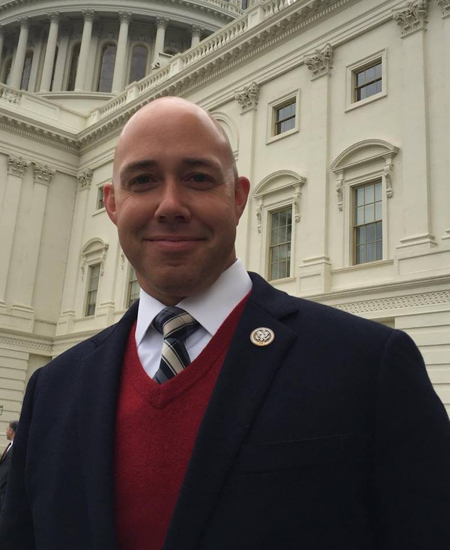
Rep. Brian J. Mast
Sponsored bills
Regulations from the Executive in Need of Scrutiny Act of 20 21 This bill revises provisions relating to congressional review of agency rulemaking. Specifically, the bill establishes a congressional approval process for a major rule. A major rule may only take effect if Congress approves of the rule. A major rule is a rule that results in (1) an annual effect on the economy of $100 million or more; (2) a major increase in costs or prices for consumers, individual industries, government agencies, or geographic regions; or (3) significant adverse effects on competition, employment, investment, productivity, innovation, or the ability of U.S.-based enterprises to compete with foreign-based enterprises. In addition, the bill establishes a congressional disapproval process for a nonmajor rule. A nonmajor rule may only take effect if Congress does not disapprove of the rule.
Border Visibility and Security Act This bill directs the Department of Homeland Security (DHS) to install surveillance technology and take other actions with respect to the U.S.-Mexico border. DHS shall deploy the most practical and effective technology available to achieve situational awareness and operational control of the border. Such technology may include radar surveillance systems, tunnel detection technology, and unmanned aerial vehicles. DHS is authorized to waive legal requirements as necessary in order to implement the necessary surveillance technology along the border. DHS shall also (1) construct a navigable road along at least 700 miles of the southwest border, (2) permanently eradicate certain foliage that grows along the Rio Grande river, and (3) report to Congress a comprehensive strategy about the barriers and technologies needed to secure operational control along the border. Drug cartel funds that have been criminally forfeited to the U.S. government shall be reserved for security measures along the U.S.-Mexico border.
Iran Sanctions Relief Review Act of 2021 This bill restricts the President's authority to unilaterally undertake certain actions with respect to Iran and increases congressional oversight of those actions. Specifically, the President must report to Congress before terminating or waiving sanctions related to Iran or taking a licensing action that significantly alters U.S. foreign policy with respect to Iran. Each report must (1) describe the proposed action and its rationale, and (2) indicate whether or not the action is intended to significantly alter foreign policy concerning Iran. If the intention is to alter that policy, the report must provide additional information about the policy objectives and anticipated effects of the action. After the President submits a report, the bill provides Congress with a 30-day period to review it; this period is extended to 60 days for reports submitted between July 10 and September 7. During this period, Congress may enact a joint resolution approving or disapproving the action. During the review period, the President may not take the action unless Congress passes a joint resolution of approval; if Congress enacts a joint resolution of disapproval, the bill prohibits the President from taking the action. The bill also outlines procedures for the introduction and consideration of these types of joint resolutions.
Foreign Influence Transparency Act This bill addresses foreign influence in higher education and in certain other academic, religious, and artistic pursuits. Current law exempts from foreign agent registration requirements a person engaging in activities in furtherance of religious, scholastic, academic, or scientific pursuits or of the fine arts. The bill specifies that this exemption applies only to those activities that do not promote the political agenda of a foreign government. Under current law, an institution of higher education (IHE) must disclose to the Department of Education (ED) a gift or contract that is from a foreign source and is valued at $250,000 or more, considered alone or in combination with all other gifts from or contracts with the foreign source. The bill instead requires an IHE to disclose such a gift or contract that is valued at $50,000 or more, considered alone or in combination with all other gifts or contracts. An IHE must include in its disclosure report the contents of any such contract and make the contents available for public disclosure. Additionally, an IHE that enters into an agreement with a Confucius Institute (i.e., a cultural institute directly or indirectly funded by the Chinese government) must immediately make available the full text of the agreement to the public, ED, and Congress. Finally, the bill prohibits an IHE that does not comply with these disclosure requirements from enrolling foreign students under the Student and Exchange Visitor Program.
Non-Opioids Prevent Addiction In the Nation Act or the NOPAIN Act This bill temporarily establishes separate payments for certain non-opioid treatments under the Medicare prospective payment system for hospital outpatient department services and the payment system for ambulatory surgical center services. The bill applies to pain management treatments that are able to replace or reduce opioid consumption, as shown through clinical trials or data.
This resolution calls on the Office for Civil Rights within the Department of Education and state attorneys general to assist elementary and secondary schools in complying with existing civil rights laws and investigate and enforce such laws. In addition, the resolution condemns the practice of requiring teachers to receive education in critical race theory as a condition of certification.
This bill eliminates federal pandemic unemployment compensation on May 31, 2021. Under current law, this supplementary compensation is available to claimants in participating states until September 6, 2021.
This bill prohibits any executive agency from contravening Executive Order 13950 (Combating Race and Sex Stereotyping), except as such order relates to contractors and grant recipients.
Defund the Wuhan Institute of Virology Act This bill prohibits making federal funds available to the Wuhan Institute of Virology in China. The Government Accountability Office must report to Congress on federal funds given to the institute over the past 15 years. The report must list any such funds that the institute provided to the Chinese government, the Chinese Communist Party, or affiliates of these entities.