

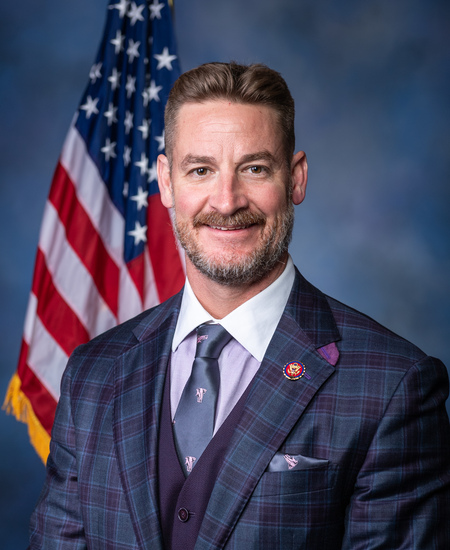
Photo of W. Gregory Steube
R United States House · District 17 · Florida On the 2026 ballot

Rep. W. Gregory Steube

Compare
Total votes
2,818
all sessions
Attendance
94%
175 missed
Near the chamber average
With party
87%
of cast votes
Lower than 94% of chamber peers
Bipartisan score
7%
crosses aisle rarely
Higher than 93% of chamber peers
Sponsored
1,507
bills & resolutions
Higher than 76% of chamber peers
Committees
7
assignments
1,507 bills and resolutions

Sponsored bills

Total
1,507
Primary
234
Co-sponsor
1,273
This page
1,507
matching current filters
Co-sponsor HRES 1497
In committee · Oregon House · Co-sponsor
Commemorating the 13 United States servicemembers killed at Abbey Gate during and as a result of President Biden's disastrous Afghanistan withdrawal.

Maddy summaryH.Res. 1497 is a House resolution that commemorates the fifth anniversary of the Abbey Gate bombing, in which 13 U.S. servicemembers were killed during the withdrawal from Afghanistan. The bill lists the names of the fallen soldiers and formally condemns the Biden-Harris administration for what it describes as dereliction of duty and the forfeiture of military property to the Taliban. It asserts that the withdrawal was a disastrous failure that ignored security warnings and left Americans at risk, while also criticizing the lack of accountability from officials involved in the decision-making process.

In committee Aug 27, 2026 1 co-sponsor
Co-sponsor HR 10157
In committee · Oregon House · Co-sponsor
Freedom to Home Distill Act

Maddy summaryThe Freedom to Home Distill Act would allow individuals to legally produce small amounts of alcohol at home for personal use without paying federal excise taxes or facing criminal penalties. To qualify, a household could distill up to 10 proof gallons per year if it has one adult, or 20 proof gallons if it has two or more adults, provided the spirits are never sold or transferred to others. The bill exempts home distillers from standard business requirements such as registering their equipment and paying taxes, but it mandates that any stills purchased for this purpose must have specific safety features like pressure release valves and a capacity of no more than 50 gallons. These changes would take effect for spirits produced after December 31, 2026.

In committee Aug 27, 2026 1 co-sponsor
Primary HR 10178
In committee · Oregon House · Lead sponsor
SHIELD Act

Maddy summaryThe SHIELD Act would prohibit local school districts that receive federal education funds from allowing organizations that provide abortions to distribute information about those services to students on school grounds or through the district's virtual platforms. This ban specifically covers sharing or reposting such materials on social media on behalf of outside abortion providers. The bill defines "abortion-related service" as any medical, surgical, or support care directly related to terminating a pregnancy.

In committee Aug 27, 2026 0 co-sponsors
Co-sponsor HR 9722
In committee · Oregon House · Co-sponsor
Fair Treatment of Religious Organizations Act of 2026

Maddy summaryThe Fair Treatment of Religious Organizations Act of 2026 changes how the IRS determines if a group qualifies for tax-exempt status based on its religious beliefs. Specifically, it ensures that beliefs regarding marriage, sexuality, or gender identity are not automatically considered illegal or against public policy when evaluating a religious organization's purpose. Additionally, the bill clarifies that a belief does not need to be central to a religion to be recognized as a valid religious belief for tax purposes. These rules will apply to tax years starting after December 31, 2025, affecting how various faith-based groups are assessed under the Internal Revenue Code.

In committee Aug 27, 2026 1 co-sponsor
Co-sponsor HR 2555
In committee · Oregon House · Co-sponsor
Freedom of Association in Higher Education Act of 2026

Maddy summaryHR 2555, the Freedom of Association in Higher Education Act of 2025, protects students who join or form single-sex social organizations (like fraternities or sororities) at colleges. It prohibits colleges receiving federal funds from taking negative actions against these students or organizations solely because they limit membership to one sex - such as denying housing, financial aid, leadership roles, or recognition. The bill ensures students can join such groups without coercion and stops colleges from imposing unfair recruitment rules on single-sex organizations compared to others. It does not require colleges to recognize single-sex groups, allow organizations to set their own membership rules, or override Title IX protections.

In committee Aug 27, 2026 1 co-sponsor
Primary HR 10148
In committee · Oregon House · Lead sponsor
Safeguarding America’s Nonprofits Act

Maddy summaryThe Safeguarding America's Nonprofits Act clarifies that tax-exempt status under Section 501 of the Internal Revenue Code does not count as federal financial assistance. This change directly affects charitable organizations, religious groups, and other nonprofits that are exempt from federal income taxes. The bill amends the tax code to ensure these entities are not subject to regulations or restrictions typically applied to recipients of government grants or aid. It also includes a provision stating that this new definition does not apply retroactively to periods before the law is enacted.

In committee Aug 24, 2026 0 co-sponsors
Primary HR 10104
In committee · Oregon House · Lead sponsor
Restoring Economic Diesel Fuel Act of 2026

Maddy summaryThe Restoring Economic Diesel Fuel Act of 2026 eliminates federal penalties for selling and using dyed diesel fuel in taxable situations. By removing Section 6715 from the Internal Revenue Code, the bill allows individuals and businesses to use this specific type of fuel without facing fines, provided they pay the required taxes. This change directly affects entities that currently rely on or consider using dyed fuel for on-road vehicles or other taxable applications. The provision is set to take effect for any fuel sold or used after December 31, 2025.

In committee Aug 13, 2026 0 co-sponsors
Primary HR 10078
In committee · Oregon House · Lead sponsor
Dollar-for-Dollar Deficit Reduction Act

Maddy summaryThe Dollar-for-Dollar Deficit Reduction Act requires that any legislation to raise or suspend the federal debt limit include spending cuts equal to at least the amount of the new borrowing over a ten-year period. This bill directly affects the President and Congress by mandating that formal requests for higher debt limits be accompanied by specific plans to reduce government expenditures, with savings calculated against a standard budget baseline. To enforce these requirements, the legislation creates procedural hurdles in both chambers of Congress, making it out of order to consider debt limit changes unless they meet the spending reduction criteria. In the Senate, bypassing these rules would require a three-fifths supermajority vote, while the Congressional Budget Office must publicly release cost estimates for any such measures at least 24 hours before a floor vote.

In committee Aug 10, 2026 0 co-sponsors
Co-sponsor HR 10017
In committee · Oregon House · Co-sponsor
Permanent CBDC Ban Act

Maddy summaryThis bill, titled the Permanent CBDC Ban Act, aims to permanently prohibit the Federal Reserve from issuing a central bank digital currency. It achieves this by amending the Federal Reserve Act to remove the specific legal authority that allows the Reserve to create such a digital currency. The legislation directly affects the Federal Reserve by stripping away its power to launch a digital version of the dollar. By deleting the relevant subsection of the law, the bill ensures that the Reserve cannot issue a CBDC in the future.

In committee Aug 3, 2026 1 co-sponsor
Primary HR 10006
In committee · Oregon House · Lead sponsor
Increasing Opportunity For Reindustrialization Act

Maddy summaryThe Increasing Opportunity For Reindustrialization Act designates census tracts containing former Department of Defense installations as Qualified Opportunity Zones. This change allows communities near closed military bases to access federal tax incentives intended for economic development, even if they do not meet the standard low-income requirements. The bill specifically amends the Internal Revenue Code to include these areas in the program and increases the number of eligible zones per state to accommodate them.

In committee Jul 30, 2026 0 co-sponsors
Showing 11 to 20 of 1,507 bills