

End Diaper Need Act of 2021 This bill establishes and expands programs to increase access to diapers and related supplies primarily for low-income families. The Department of Health and Human Services must award demonstration grants to entities with experience in community distribution of basic necessities or other community services to meet diapering needs of eligible families with infants and toddlers. Additionally, the bill permits states to use Medicaid funds to provide medically necessary diapers and supplies to certain low-income families. These families must have a child who is over age three and diagnosed with a serious condition such as bowel or bladder incontinence. It also allows individuals to buy medically necessary diapers and supplies with funds from health savings accounts and other tax-advantaged accounts for health care expenses.
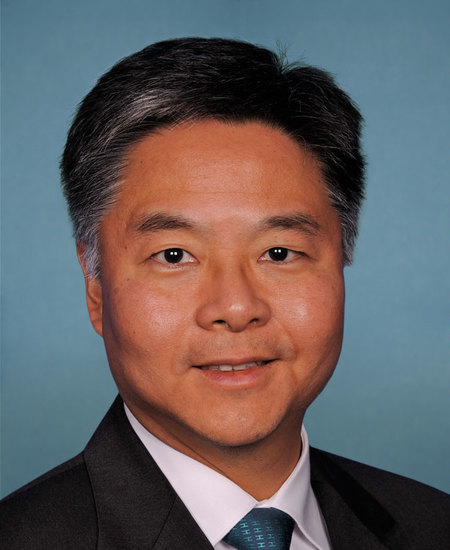
Rep. Ted Lieu
Sponsored bills
Insular Area Medicaid Parity Act This bill eliminates Medicaid funding limitations for U.S. territories beginning in FY2021.
Restricting First Use of Nuclear Weapons Act of 2021 This bill prohibits the use of federal funds to conduct a first-use nuclear strike unless Congress expressly authorizes such a strike pursuant to a declaration of war. A first-use nuclear strike is an attack using nuclear weapons against an enemy that did not first launch a nuclear strike against the United States, its territories, or its allies.
This resolution expresses the sense that it is the federal government's duty to develop and implement a Roadmap to Freedom immigration reform plan by (1) promoting full citizenship, (2) protecting and strengthening a fair process centered on family unity, (3) promoting and preserving diversity by encouraging immigration from underrepresented countries, and (4) establishing a just and humane system to uphold immigration laws.
This resolution calls for the federal government to establish a national biodiversity strategy, which must include a goal of conserving at least 30% of U.S. lands and waters to protect biodiversity and address climate change by 2030 and other goals necessary to reduce the threats to biodiversity.
Protections and Transparency in the Workplace Act This bill requires issuers of securities to disclose regularly information related to claims of discrimination because of race, color, religion, sex (including sexual orientation and gender identity), or national origin; discrimination because of age; discrimination on the basis of disability; discrimination because of genetic information; discrimination on the basis of status concerning service in a uniformed service; sexual harassment; and sexual assault or abuse. In investigating claims of discrimination or harassment, an issuer must hire an independent, third-party law firm agreed to by all parties involved. Issuers must implement discrimination and harassment training programs for employees, conduct an annual survey of employees to determine whether employees feel safe, and establish an anonymous whistleblower tip line.
Save Education Jobs Act This bill establishes through FY2030 the Education Jobs Fund, from which the Department of Education (ED) must award grants to state educational agencies and, through them, subgrants to local educational agencies (LEAs) to retain and create education jobs. ED must also provide grants to outlying areas and the Bureau of Indian Education. Specifically, LEAs must use subgrants for compensation and benefits to retain existing employees, rehire former employees, and hire new employees. Further, subgrants may be used for certain activities such as training and professional development, providing salary increases to cover extended days or school years to make up for lost instructional time due to COVID-19 (i.e., coronavirus disease 2019), and developing teacher leadership roles in high-need schools. The bill prohibits the use of subgrants for certain activities, such as funding voucher programs, tax-credit scholarships, or education savings accounts.
Safe from the Start Act of 2021 This bill directs the Department of State to direct U.S. foreign assistance to address humanitarian crises in a manner that aims to prevent and respond to gender-based violence at the onset of an emergency. The State Department shall focus on (1) preventing gender-based violence, (2) protecting survivors of humanitarian crises from the onset of the emergency, (3) promoting standards and activities to prevent and respond to gender-based violence, and (4) advancing and empowering survivors and at-risk individuals. Activities shall include improving access to post-sexual-assault medical and mental health services and ensuring such services are available to hard-to-reach populations. The State Department may provide support to local and international organizations to achieve its goals.
Reopen Small Businesses Safely Act This bill requires the Small Business Administration to issue rules or guidance to ensure that an economic injury disaster loan recipient may use loan amounts for covered worker protection expenditures related to the COVID-19 (i.e., coronavirus disease 2019) pandemic.
Global Health, Empowerment and Rights Act This bill establishes that a foreign nongovernmental organization shall not be disqualified from receiving certain U.S. international development assistance solely because the organization provides medical services using non-U.S. government funds if the medical services are legal in both the United States and the country in which they are being provided. Such foreign organizations shall not be subject to requirements relating to their use of non-U.S. funds for advocacy or lobbying activities, other than those that apply to U.S. nongovernmental organizations. Current U.S. policy prohibits various foreign assistance from going to a foreign nongovernmental organization unless it agrees to not perform or actively promote abortions.