

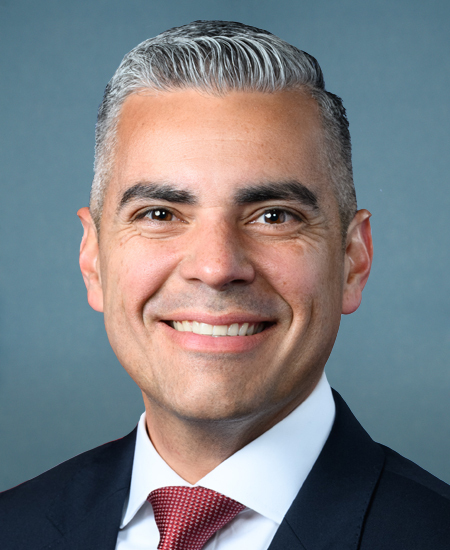
Photo of Juan Ciscomani
R United States House · District 6 · Arizona On the 2026 ballot

Rep. Juan Ciscomani

Compare
Total votes
1,860
all sessions
Attendance
96%
70 missed
Lower than 81% of chamber peers
With party
89%
of cast votes
Near the chamber average
Bipartisan score
6%
crosses aisle rarely
Near the chamber average
Sponsored
742
bills & resolutions
Near the chamber average
Committees
7
assignments
742 bills and resolutions

Sponsored bills

Total
742
Primary
63
Co-sponsor
679
This page
742
matching current filters
Co-sponsor HR 987
In committee · Oregon House · Co-sponsor
Prime Minister Golda Meir Commemorative Coin Act

Maddy summaryHR 987 authorizes the U.S. Mint to produce commemorative coins honoring Golda Meir, Israel's first female Prime Minister, and the 75th anniversary of U.S.-Israel relations. It specifies three coin types: $5 gold coins (max 50,000), $1 silver coins (max 400,000), and half-dollar clad coins (max 750,000), with detailed weight and composition requirements. All coins will include Golda Meir's image, her name, and commemorative inscriptions, and will be sold during 2026. A surcharge ($35 for $5 coins, $10 for $1 coins, $5 for half-dollars) will be paid to the American Friends of Kiryat Sanz Laniado Hospital Inc. to support its hospital operations.

In committee Feb 10, 2023 1 co-sponsor
Co-sponsor HR 889
In committee · Oregon House · Co-sponsor
Broadband Grant Tax Treatment Act

Maddy summaryHR 889, the Broadband Grant Tax Treatment Act, excludes certain federal broadband grants from recipients' taxable income. It specifically applies to grants received under programs like the Infrastructure Investment and Jobs Act's Broadband Equity, Access, and Deployment Program and state digital equity grants. The bill prevents double tax benefits by disallowing deductions or credits for expenses covered by these excluded grants and reduces the adjusted basis of related property. This policy change directly affects broadband providers, local governments, and tribal entities receiving qualifying grants from federal or state sources for broadband infrastructure deployment.

In committee Feb 9, 2023 1 co-sponsor
Co-sponsor HRES 109
In committee · Oregon House · Co-sponsor
Expressing the sense of the House of Representatives that Social Security should be preserved and protected for current beneficiaries, and for future generations to come.

Maddy summaryHRES 109 is a non-binding resolution introduced in the U.S. House of Representatives on February 8, 2023, expressing the House's sense that Social Security should be preserved and protected for current beneficiaries (over 66 million Americans) and future generations. It does not create new laws or alter existing Social Security policies but serves as a symbolic statement of support for the program. The resolution emphasizes Social Security's role in providing retirement, disability, and survivor benefits while referencing concerns about inflation's impact on beneficiaries. As a procedural resolution, it has no legal effect on Social Security funding or benefits.

In committee Feb 8, 2023 1 co-sponsor
Co-sponsor HR 596
In committee · Oregon House · Co-sponsor
Anti-Border Corruption Improvement Act

Anti-Border Corruption Improvement Act This bill revises the waiver authority of the U.S. Customs and Border Protection (CBP) for polygraph examinations of applicants for law enforcement positions in the CBP. Any individual who receives such waiver and holds a current background investigation may be subject to further background investigation. The CBP may administer a polygraph examination to an applicant for employment or an employee who is eligible for a waiver if information is discovered prior to the completion of a background investigation that makes necessary a final determination regarding suitability for employment or continued employment.

In committee Feb 8, 2023 1 co-sponsor
Co-sponsor HR 163
In committee · Oregon House · Co-sponsor
Security First Act

Security First Act This bill reauthorizes the Operation Stonegarden program from FY2024 through FY2027 and addresses other border security issues. (Operation Stonegarden provides grants to enhance the border security capabilities of state, local, and tribal governments.) From FY2024 through FY2027, the money from unreported monetary instruments seized from individuals crossing the U.S.-Mexico border and transferred into the Department of the Treasury general fund shall be made available without further appropriation to the Department of Homeland Security (DHS) to fund Operation Stonegarden. DHS must report to Congress on (1) DHS hiring practices from 2018 to 2021, and (2) whether certain Mexican drug cartels meet the criteria to be designated as foreign terrorist organizations. DHS must also periodically report to Congress about the technology needed to secure the U.S.-Mexico land border.

In committee Feb 8, 2023 1 co-sponsor
Co-sponsor HRES 100
In committee · Oregon House · Co-sponsor
Expressing support for the Iranian people's desire for a democratic, secular, and nonnuclear Republic of Iran, and condemning violations of human rights and state-sponsored terrorism by the Iranian Government.

This resolution condemns Iranian state-sponsored terrorist attacks against U.S. citizens and officials and Iranian dissidents. The resolution also expresses support for the people of Iran who are legitimately defending their rights for freedom against repression and condemns the killing of Iranian protesters by the Iranian regime.

In committee Feb 7, 2023 1 co-sponsor
Co-sponsor HCONRES 13
In committee · Oregon House · Co-sponsor
Supporting the Local Radio Freedom Act.

Maddy summaryHCONRES 13 is a concurrent resolution expressing Congress's support for maintaining the current policy that prohibits imposing new fees on local radio stations for playing music. It states that Congress should not impose any performance fee, tax, royalty, or charge on local radio stations for broadcasting sound recordings over the air, or on businesses like bars and restaurants that play music publicly. The resolution argues that such fees would harm local radio stations - critical sources for emergency information and community programming - and jeopardize the economic model that has supported both radio and the music industry for decades. This resolution does not create new law but formally opposes potential legislative changes to the existing fee structure.

In committee Feb 6, 2023 1 co-sponsor
Co-sponsor HR 838
In committee · Oregon House · Co-sponsor
Freight RAILCAR Act of 2023

Freight Rail Assistance and Investment to Launch Coronavirus-Era Activity and Recovery Act of 2023 or the Freight RAILCAR Act of 2023 This bill provides a new tax credit through 2025 for 10% of freight railcar fleet modernization expenses (i.e., railcar replacement and modernization expenses for meeting fuel efficiency and performance standards). The bill provides that no more than 2,000 freight railcars per taxpayer may be taken into account for purposes of determining the credit in a taxable year. The Department of the Treasury must report to Congress on the credit to provide information on the number of times the credit was claimed and the number of railcars scrapped or built as a result of the credit.

In committee Feb 6, 2023 1 co-sponsor
Co-sponsor HR 558
In committee · Oregon House · Co-sponsor
To amend the Defense Production Act of 1950 to prohibit certain foreign countries from purchasing or leasing property near sensitive sites, and for other purposes.

Maddy summaryHR 558 amends the Defense Production Act to prohibit China, Iran, North Korea, and Russia (and entities they control) from purchasing or leasing property within 10 miles of designated sensitive sites. These sites include U.S. military bases, ports, government facilities, and other locations where foreign access could threaten national security through intelligence collection or surveillance. The bill requires the Committee to notify Congress of any violations and applies to transactions occurring after its enactment. It directly affects foreign entities from the listed countries seeking real estate near critical U.S. infrastructure.

In committee Feb 3, 2023 1 co-sponsor
Co-sponsor HR 781
In committee · Oregon House · Co-sponsor
GIG Act

Maddy summaryHR 781, the GIG Act, clarifies the definition of an independent contractor under federal law. It adds specific factors the Secretary of Labor must consider when determining if a worker is an independent contractor, such as whether the worker has substantial control over their work, can earn profits or losses based on their initiative, and whether their services require specialized skills performed continuously. The bill explicitly states that the Secretary cannot consider unmet contractual terms or unrelated services when making this determination. This directly affects workers classified as independent contractors and the businesses that hire them, by establishing a clearer, more objective standard for classification. The change aims to reduce misclassification disputes under the Fair Labor Standards Act.

In committee Feb 2, 2023 1 co-sponsor
Showing 721 to 730 of 742 bills
Previous 1 72 73 74 75 Next