Empowering Medicare Seniors to Negotiate Drug Prices Act of 2021 This bill allows the Centers for Medicare & Medicaid Services to negotiate drug prices under the Medicare prescription drug benefit and to institute a price structure for the reimbursement of drugs covered under the benefit.
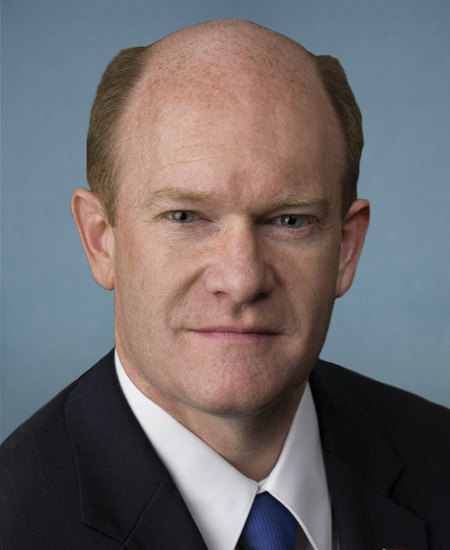
Sen. Christopher A. Coons
Sponsored bills
Taiwan Fellowship Act This bill directs the Department of State to establish a program to provide fellowships in Taiwan to qualifying U.S. government employees. Each program fellow shall work in (1) a Taiwanese government agency; or (2) a nongovernmental organization, such as the American Institute in Taiwan, whose interests are associated with the interests of the fellow's employing U.S. government agency. (In 1979, the United States established diplomatic relations with China and ended formal diplomatic ties with Taiwan. The American Institute in Taiwan is a private organization that has a contract with the State Department to represent U.S. interests in Taiwan and provide consular services.)
Storing CO2 And Lowering Emissions Act or the SCALE Act This bill establishes programs within the Department of Energy that provide financial support and incentives to develop infrastructure for carbon dioxide capture, transport, utilization, and storage.
Major Richard Star Act This bill allows a veteran with a combat-related disability and fewer than 20 years of creditable service to receive retirement pay, without reduction, concurrent with disability compensation.
Ensuring Lasting Smiles Act This bill requires private health insurance plans to cover diagnosis and treatment of congenital anomalies and birth defects, such as reconstructive services and items. Coverage must include services and items that functionally improve, repair, or restore any body part that is medically necessary for normal bodily functions or appearance, as determined by the treating physician. Coverage limits and cost-sharing requirements for such services and items may not be more restrictive than those applicable to all medical and surgical benefits under the plan.
Keeping Women and Girls Safe from the Start Act of 2021 This bill requires the Department of State to carry out activities under the Safe from the Start program to prevent, mitigate, and respond to gender-based violence in humanitarian emergencies around the world. (The Safe from the Start program addresses childhood exposure to violence.) These activities shall include (1) training and capacity building for humanitarian personnel; (2) deployment of, and support for, gender advisors and female humanitarian aid workers; (3) use of standards, guidelines, and best practices to address gender-based violence; (4) expanding and improving empowerment activities; and (5) establishing accountability mechanisms and monitoring and reporting tools to prevent and respond to incidents of sexual or other gender-based exploitation or abuse. The State Department must submit an annual report that includes an analysis of data and research regarding the key drivers of gender-based violence in humanitarian emergencies, as well as a detailed description of the programs, diplomatic efforts, and other activities taken to implement Safe from the Start.
Lori Jackson Domestic Violence Survivor Protection Act This bill makes changes to the federal statutory framework that prohibits the shipment, transport, receipt, or possession of firearms or ammunition by an individual who is subject to a qualifying domestic violence court order. Under current law, a qualifying domestic violence court order must meet certain criteria, including to (1) be issued after a hearing of which the individual had notice and an opportunity to participate; and (2) restrain the individual from harassing, stalking, or threatening an intimate partner (i.e., a current or former spouse, a co-parent of a child, or a current or former cohabitant) or the child of an intimate partner. This bill expands the scope of qualifying domestic violence court orders to include an order that is issued after an ex parte hearing (i.e., a hearing with only one party present); restrains the individual from harassing, stalking, or threatening a dating partner or former dating partner; or restrains the individual from intimidating a witness. Current law also prohibits an individual who is convicted of a misdemeanor crime of domestic violence from shipping, transporting, receiving, or possessing firearms or ammunition. These restrictions generally only apply to spouses, co-parents, and cohabitants, and to offenses that involve physical force or deadly weapons. This bill expands the scope of these restrictions to include dating partners and offenses that involve stalking.
American Innovation and Jobs Act This bill revises and expands the deductibility of research and experimental expenditures to allow immediate expensing of such expenditures. It also allows the amortization over a period of at least 60 months of certain other types of research and experimental expenditures not treated as expenses. The bill increases the maximum amount eligible for the tax credit for new and small businesses and increases to 20% the rate of the credit for business startups.
This resolution condemns the February 1, 2021, military coup in Burma (Myanmar) and calls on Burmese authorities to allow journalists, human rights organizations, United Nations monitors, and humanitarian actors full and safe access to every part of the country. The resolution also asks neighboring countries to provide immediate and direct cross-border assistance to address the humanitarian needs of refugees.
Assault Weapons Ban of 2021 This bill makes it a crime to knowingly import, sell, manufacture, transfer, or possess a semiautomatic assault weapon (SAW) or large capacity ammunition feeding device (LCAFD). The prohibition does not apply to a firearm that is (1) manually operated by bolt, pump, lever, or slide action; (2) permanently inoperable; (3) an antique; or (4) a rifle or shotgun specifically identified by make and model. The bill also exempts from the prohibition the following, with respect to a SAW or LCAFD: importation, sale, manufacture, transfer, or possession related to certain law enforcement efforts, or authorized tests or experiments; importation, sale, transfer, or possession related to securing nuclear materials; and possession by a retired law enforcement officer. The bill permits continued possession, sale, or transfer of a grandfathered SAW, which must be securely stored. A licensed gun dealer must conduct a background check prior to the sale or transfer of a grandfathered SAW between private parties. The bill permits continued possession of, but prohibits sale or transfer of, a grandfathered LCAFD. Newly manufactured LCAFDs must display serial number identification. Newly manufactured SAWs and LCAFDs must display the date of manufacture. The bill also allows a state or local government to use Edward Byrne Memorial Justice Assistance Grant Program funds to compensate individuals who surrender a SAW or LCAFD under a buy-back program.