Restoring the Armed Career Criminal Act This bill modifies the prior convictions that trigger a 15-year enhanced mandatory minimum prison term for a defendant who commits a firearms offense after three or more such prior convictions.
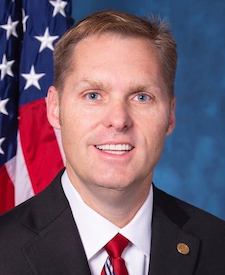
Rep. Michael Guest
Sponsored bills
Protect and Serve Act of 2021 This bill establishes a new criminal offense for knowingly assaulting a law enforcement officer and causing serious bodily injury (or attempting to do so) in circumstances that affect interstate commerce. It imposes criminal penalties—a prison term, a fine, or both—on a violator.
Protecting Our Kids from Harmful Research Act This bill prohibits the use of federal funds for research or publications concerning gender transitions in individuals under the age of 18.
Keeping Our COVID-19 Heroes Employed Act This bill exempts essential workers from COVID-19 vaccination requirements imposed by the federal government and contractors, public entities that received federal COVID-19 relief funds, and private entities that received any federal funds. An essential worker is an individual who was deemed to be essential or exempted from response measures during the COVID-19 pandemic by a state, tribe, or territory.
Employment Freedom for All Act This bill prohibits an employer from enforcing a noncompete agreement with an employee, or former employee, who has been fired for not receiving a COVID-19 vaccine. The Federal Trade Commission and state attorneys general are authorized to enforce this bill.
Extending Limits of U.S. Customs Waters Act This bill extends the customs waters territory of the United States. Under current law, customs waters means waters within four leagues of the coast of the United States. This bill revises the definition to include (1) the territorial sea of the United States to the limits permitted by international law in accordance with Presidential Proclamation 5928, dated December 27, 1988, that extended such limits to 12 nautical miles from the baselines of the United States; and (2) the contiguous zone of the United States to the limits permitted by international law in accordance with Presidential Proclamation 7219, dated September 2, 1999, that extended such limits to 24 nautical miles from the baselines of the United States.

Supplying America Needs Truckers Aged 18 Act or the SANTA 18 Act This bill exempts drivers who transport goods from a port of entry and another place within the same state from age restrictions and other requirements that apply to federal commercial driver's licenses.
Exposing China's Belt and Road Investment in America Act of 2021 This bill requires the Committee on Foreign Investment in the United States to review certain investments made by China in the United States. Specifically, the committee must review any investment by a foreign person that (1) involves the acquisition of real estate in the United States and the establishment of a U.S. business on such real estate, and (2) could result in direct or indirect control of that U.S. business by China. A party to any such investment must submit to the committee a declaration containing basic information regarding the transaction.
This bill prohibits the use of federal funds to require a member of the Armed Forces to receive a COVID-19 vaccination. The bill also prohibits adverse action (e.g., punishment) being taken against a member of the Armed Forces because the member refuses to receive a COVID-19 vaccination.
State, Local, Tribal, and Territorial Fiscal Recovery, Infrastructure, and Disaster Relief Flexibility Act This bill allows states, tribes, territories, and localities to use certain COVID-19 relief funds for new categories of spending, including for natural disasters and infrastructure projects. It also makes changes to expenditure deadlines and other aspects of this funding. Specifically, recipients may use funds for emergency relief from natural disasters and associated negative economic impacts of natural disasters. In addition, recipients may use a portion of their COVID-19 relief funds for designated infrastructure projects, such as nationally significant freight and highway projects. Furthermore, the bill allows recipients to expend COVID-19 relief funds on these types of infrastructure projects until September 30, 2026. Under current law, recipients must expend the funds by December 31, 2024. Other changes in the bill include (1) modifying eligibility and allocation requirements for funding set aside for counties and Indian tribes that are near public lands, (2) allowing Indian tribes an additional year to expend their COVID-19 relief funds, and (3) establishing a process for government entities to decline COVID-19 relief funds and requiring any declined funds to be used to reduce the federal deficit.