

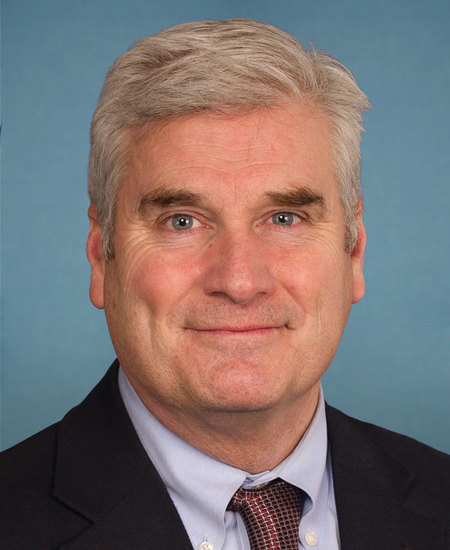
Photo of Tom Emmer
R United States House · District 6 · Minnesota On the 2026 ballot

Rep. Tom Emmer

Compare
Total votes
2,818
all sessions
Attendance
98%
49 missed
Near the chamber average
With party
96%
of cast votes
Higher than 91% of chamber peers
Bipartisan score
2%
crosses aisle rarely
Lower than 92% of chamber peers
Sponsored
512
bills & resolutions
Lower than 99% of chamber peers
Committees
2
assignments
512 bills and resolutions

Sponsored bills

Total
512
Primary
58
Co-sponsor
454
This page
512
matching current filters
Co-sponsor HR 2725
In committee · Oklahoma House · Co-sponsor
Affordable Housing Credit Improvement Act of 2025

Maddy summaryThe Affordable Housing Credit Improvement Act of 2025 would reform the Low-Income Housing Credit program, which provides tax credits to developers of affordable housing. It would increase state allocations based on population with annual cost-of-living adjustments, modify tenant eligibility rules to allow higher income limits for some residents, and add protections for domestic violence victims in housing. The bill would simplify rules for rural and Native American housing projects, clarify credit eligibility requirements, and require greater transparency in program administration. These changes would directly affect developers, property owners, and low-income tenants in housing projects that receive LIHC tax credits.

In committee Apr 8, 2025 1 co-sponsor
Primary HR 2365
In committee · Oklahoma House · Lead sponsor
Securities Clarity Act of 2025

Maddy summaryThe Securities Clarity Act of 2025 clarifies that certain digital assets, specifically "investment contract assets," are not considered securities under federal law. It defines these assets as fungible digital representations of value (like some cryptocurrencies) that are transferable without intermediaries on a blockchain, sold via investment contracts, and not otherwise classified as securities. This directly affects digital asset platforms, issuers, and investors by exempting these assets from regulations governing securities under the Securities Act of 1933, Investment Advisers Act of 1940, Investment Company Act of 1940, Securities Exchange Act of 1934, and Securities Investor Protection Act of 1970. The bill’s key mechanism is creating a specific exclusion within multiple financial laws to reduce regulatory overlap for this category of digital assets.

In committee Mar 26, 2025 0 co-sponsors
Primary HR 2183
In committee · Oklahoma House · Lead sponsor
CFPB Dual Mandate and Economic Analysis Act

Maddy summaryThis bill amends the Consumer Financial Protection Bureau's (CFPB) mission to prioritize "fair and transparent" markets while requiring the CFPB to assess how its rules affect consumer choice, credit access, and costs. It creates an Office of Economic Analysis to review all proposed rules, measure existing rules' effectiveness after 1-10 years, and publish findings in the Federal Register. The CFPB must now specify problem-solving goals and metrics for success in each rulemaking, including changes to consumer access and cost of financial products. These changes directly affect how the CFPB develops and evaluates regulations on consumer financial products.

In committee Mar 18, 2025 0 co-sponsors
Co-sponsor HCONRES 12
In committee · Oklahoma House · Co-sponsor
Supporting the Local Radio Freedom Act.

This concurrent resolution declares that Congress should not impose any new performance fee, tax, royalty, or other charge relating to the public performance of sound recordings on a local radio station for broadcasting sound recordings over the air, or on any business for such public performance of sound recordings.

In committee Feb 13, 2025 1 co-sponsor
Co-sponsor HR 1301
In committee · Oklahoma House · Co-sponsor
Death Tax Repeal Act

Maddy summaryHR 1301, the Death Tax Repeal Act, would eliminate the federal estate tax and generation-skipping transfer tax for estates of individuals dying on or after its enactment date. It directly affects individuals inheriting significant assets, as it removes taxes on estates exceeding $10 million (adjusted for inflation) and repeals taxes on large transfers between generations. The bill modifies the gift tax by establishing a $10 million lifetime exemption with annual inflation adjustments, replacing previous tax brackets. It applies to estates, gifts, and transfers occurring on or after the bill's effective date.

In committee Feb 13, 2025 1 co-sponsor
Co-sponsor HR 736
Passed · Oklahoma House · Co-sponsor
Protect Small Businesses from Excessive Paperwork Act of 2025

Maddy summaryThis bill extends the deadline for small businesses to file certain financial reports from a variable timeline tied to regulatory dates to a fixed date of January 1, 2026. It modifies Section 5336(b)(1)(B) of Title 31, U.S. Code, directly affecting small businesses already required to submit specific financial disclosures under existing law. The key change simplifies compliance by replacing flexible regulatory deadlines with a single, clear cutoff date. This adjustment provides additional time for affected businesses without altering the underlying reporting requirements.

Passed Feb 11, 2025 1 co-sponsor
Co-sponsor HR 987
In committee · Oklahoma House · Co-sponsor
Fair Access to Banking Act

Fair Access to Banking Act This bill places restrictions on certain banks, credit unions, and payment card networks if they refuse to do business with a person who complies with the law. Restrictions include prohibiting the use of electronic funds transfer systems and lending programs, termination of an institution's depository insurance, and specified civil penalties. Banks and other specified financial institutions are allowed to deny financial services to a person only if the denial is justified by a documented failure of that person to meet quantitative, impartial, risk-based standards established in advance by the institution. This justification may not be based upon reputational risks to the institution. The bill establishes the right for a person to bring a civil action for a violation of this bill.

In committee Feb 5, 2025 1 co-sponsor
Co-sponsor HCONRES 4
In committee · Oklahoma House · Co-sponsor
Expressing the sense of Congress that tax-exempt fraternal benefit societies have historically provided and continue to provide critical benefits to the people and communities of the United States.

Maddy summaryHCONRES 4 is a symbolic resolution expressing Congress's support for tax-exempt fraternal benefit societies (like mutual aid organizations). It recognizes these groups, which have over 7 million members nationwide, as historically and currently providing critical community benefits - including life/health insurance, charitable work, and volunteer services - valued at over $3.8 billion annually. The resolution affirms that their tax-exempt status under Section 501(c)(8) of the Internal Revenue Code remains beneficial and should continue to be promoted. This is a non-binding expression of congressional sentiment, not a policy change.

In committee Jan 28, 2025 1 co-sponsor
Co-sponsor HR 21
Passed · Oklahoma House · Co-sponsor
Born-Alive Abortion Survivors Protection Act

Maddy summaryHR 21, the Born-Alive Abortion Survivors Protection Act, requires medical staff at abortion facilities to provide the same immediate care and hospital admission to any infant born alive during an abortion as they would for any newborn. It mandates reporting failures to provide this care to law enforcement and imposes penalties of up to 5 years in prison for violations, with harsher penalties for intentional killing. The bill also allows women who undergo abortions to sue for civil damages, including triple the abortion cost, and provides for attorney fees. It defines "abortion" to exclude procedures performed after viability to preserve a live birth. This law directly affects healthcare providers at abortion facilities and creates new federal legal obligations for them.

Passed Jan 24, 2025 1 co-sponsor
Co-sponsor HR 703
In committee · Oklahoma House · Co-sponsor
Main Street Tax Certainty Act

Maddy summaryHR 703, the Main Street Tax Certainty Act, makes a key tax deduction permanent for small business owners. It removes the temporary sunset provision (subsection (i)) from Section 199A of the tax code, ensuring the qualified business income deduction remains available for eligible small businesses. This change directly affects pass-through business owners (like S-corps, partnerships, and sole proprietorships) who currently qualify for this deduction. The permanent change takes effect for tax years starting after December 31, 2025.

In committee Jan 23, 2025 1 co-sponsor
Showing 31 to 40 of 512 bills
Previous 1 3 4 5 52 Next