

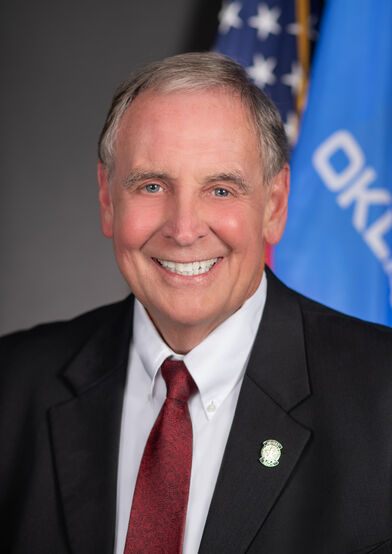
Photo of Jack Stewart
R Oklahoma Senate · District 18

Sen. Jack Stewart

Compare
Total votes
6,420
all sessions
Attendance
93%
340 missed
Lower than 78% of chamber peers
With party
92%
of cast votes
Near the chamber average
Bipartisan score
5%
crosses aisle rarely
Near the chamber average
Sponsored
86
bills & resolutions
Lower than 87% of chamber peers
Committees
5
assignments
86 bills and resolutions

Sponsored bills

Total
86
Primary
86
Co-sponsor
0
This page
86
matching current filters
Primary SB 1396
In committee · Oklahoma Senate · Lead sponsor
Sales tax; providing exemption for certain organizations providing support for first responders. Effective date.

Maddy summarySB 1396 amends Oklahoma's sales tax law to exempt certain organizations that support first responders from paying sales tax on goods and services they purchase. Specifically, it adds exemptions for organizations providing support to municipal law enforcement, fire departments, emergency medical services, municipal disaster mitigation services, and first responder canine training facilities. This means these eligible organizations will not pay state sales tax on qualifying purchases directly related to their support services. The bill updates the existing tax exemption list in Section 1356 of Oklahoma Statutes without changing other existing exemptions.

In committee Feb 3, 2026 0 co-sponsors
Primary SB 1014
Vetoed · Oklahoma Senate · Lead sponsor
Public Competitive Bidding Act of 1974; requiring local bid preference for certain public construction contracts. Effective date.

Maddy summarySB 1014 adds a 5% local bid preference for public construction contracts exceeding $100,000 (or $50,000 for subcontracts). It requires local governments to award contracts to the second-lowest qualified bidder who agrees to match the non-local bid price, provided they document economic benefits to the local area. This applies to counties, cities, and public trusts but excludes federal-funded projects. The bill does not change the requirement to award to the lowest responsible bidder overall, only adds this limited local preference option.

Vetoed May 29, 2025 0 co-sponsors
Primary SB 751
Signed into law · Oklahoma Senate · Lead sponsor
Architects; modifying certain construction value. Effective date.

Maddy summarySB 751 amends Oklahoma's architectural licensing law to update exemptions for certain building projects. It exempts small structures from requiring a licensed architect, including two-story buildings with: 50 or fewer occupants in assembly spaces (A-2/A-3), 64 or fewer hotel/motel units (R-1), 100,000 sq ft or less for business (B), 200,000 sq ft or less for retail (M), and most industrial/utility buildings (F, S, U). The bill also allows licensed interior designers to handle nonstructural interior work in projects requiring architects and clarifies that renovations remain exempt if the building's use doesn't change. These changes take effect November 1, 2025.

Signed into law May 14, 2025 0 co-sponsors
Primary SB 752
Signed into law · Oklahoma Senate · Lead sponsor
County purchasing; authorizing county purchasing agents to establish online bidding process with certain vendors. Effective date. Emergency.

Maddy summarySB 752 authorizes Oklahoma county purchasing agents to establish online bidding processes for procurement with vendors already approved under state contracts. It directly affects county governments and their purchasing agents by allowing electronic solicitations, bid submissions, and award notifications while requiring bidders to register, meet prequalification standards, and comply with existing bid notice rules. Key provisions mandate that online bids follow the same public meeting procedures as traditional bids and include specific requirements for bidder eligibility and submission timing. The bill became law on May 12, 2025, without gubernatorial action, effective July 1, 2025.

Signed into law May 12, 2025 0 co-sponsors
Primary SB 403
Signed into law · Oklahoma Senate · Lead sponsor
County purchasing; modifying duties of county purchasing agent related to bidders. Effective date.

Maddy summarySB 403 modifies the duties of county purchasing agents when dealing with bidders in county purchasing processes. The bill updates how county purchasing agents must handle interactions with bidders, ensuring compliance with current procurement standards. This change directly affects county governments and their purchasing departments by adjusting their operational responsibilities. The law takes effect without requiring the governor's signature and applies to ongoing and future county purchasing activities.

Signed into law May 7, 2025 0 co-sponsors
Primary SB 404
In committee · Oklahoma Senate · Lead sponsor
Counties; repealing the County Home Rule Charter Act. Effective date.

Maddy summarySB 404 repeals specific sections (8.1-8.5) of Oklahoma's County Home Rule Charter Act (19 O.S. 2021), which previously allowed counties to adopt home rule charters. This bill directly affects Oklahoma counties that could have used the repealed framework to establish local governing charters. The repeal becomes effective November 1, 2025, removing the statutory basis for county home rule charters without creating new provisions.

In committee Mar 24, 2025 0 co-sponsors
Primary SB 402
In committee · Oklahoma Senate · Lead sponsor
Commercial driver training; directing Service Oklahoma to promulgate certain rules. Emergency.

Maddy summarySB 402 directs Service Oklahoma to create specific rules governing commercial driver training programs. This bill directly affects commercial driving schools and training providers in Oklahoma that must comply with these new regulations. The key provision requires Service Oklahoma to establish clear standards for training curricula, instructor qualifications, and program oversight. As an emergency measure, the rules would take effect quickly upon passage to address current gaps in driver training oversight.

In committee Mar 17, 2025 0 co-sponsors
Primary SB 748
In committee · Oklahoma Senate · Lead sponsor
Larceny; establishing certain offense and providing penalty. Effective date.

Maddy summarySB 748 amends Oklahoma's larceny laws for theft from retail or wholesale businesses, establishing tiered penalties based on the value of stolen merchandise and prior convictions. It increases punishments for repeat offenses (e.g., third theft under $1,000 becomes a misdemeanor with up to 1 year in jail), classifies thefts of $1,000-$15,000 as felonies with prison terms up to 8 years, and requires restitution to victims. The bill also allows aggregating multiple thefts within 180 days for sentencing and imposes a $500 fine or 30 hours of community service for stealing shopping carts. This directly affects individuals who steal merchandise from stores, with penalties varying by value, frequency, and prior record.

In committee Mar 17, 2025 0 co-sponsors
Primary SB 928
In committee · Oklahoma Senate · Lead sponsor
Assault and battery; creating misdemeanor and felony offenses. Effective date.

Maddy summarySB 928 creates new misdemeanor and felony charges for assaulting or battering county employees while they are performing their duties. It defines "county employee" broadly to include workers for counties and contracted firms. Simple assault/battery becomes a misdemeanor (up to 1 year in jail or $1,000 fine), while aggravated attacks become felonies (up to 2 years in prison or $5,000 fine). The bill also requires counties to post clear signage stating that felony charges may apply for such attacks. This law directly affects county employees and aims to strengthen protections for them during work.

In committee Mar 12, 2025 0 co-sponsors
Primary SB 750
In committee · Oklahoma Senate · Lead sponsor
Law enforcement canines; creating the Canine Cooperative Grant Program. Effective date.

Maddy summarySB 750 creates the Canine Cooperative Grant Program to provide financial assistance to Oklahoma law enforcement agencies (sheriff's offices, municipal police, and fire departments) for purchasing, training, and covering medical expenses for service canines injured on duty. The program uses a revolving fund funded by state appropriations, private donations, and federal grants, with annual limits of $10,000 per agency type for canine-related costs. It requires the Department of Environmental Quality to administer the program and set rules for eligibility and fund usage, effective November 1, 2025.

In committee Mar 10, 2025 0 co-sponsors
Showing 11 to 20 of 86 bills
Previous 1 2 3 9 Next