

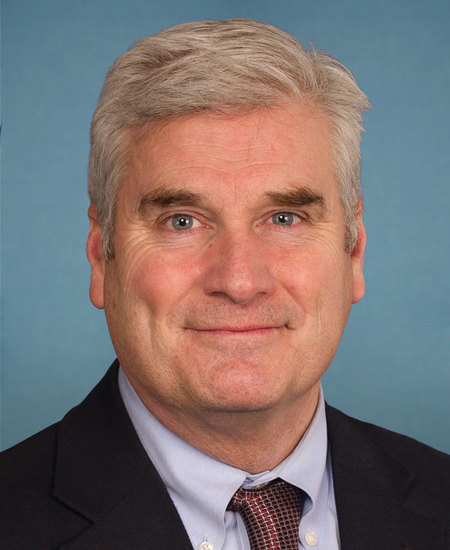
Photo of Tom Emmer
R United States House · District 6 · Minnesota On the 2026 ballot

Rep. Tom Emmer

Compare
Total votes
2,818
all sessions
Attendance
98%
49 missed
Near the chamber average
With party
96%
of cast votes
Higher than 91% of chamber peers
Bipartisan score
2%
crosses aisle rarely
Lower than 92% of chamber peers
Sponsored
512
bills & resolutions
Lower than 99% of chamber peers
Committees
2
assignments
512 bills and resolutions

Sponsored bills

Total
512
Primary
58
Co-sponsor
454
This page
512
matching current filters
Co-sponsor HR 4019
In committee · Ohio House · Co-sponsor
SEC Stabilization Act of 2023

SEC Stabilization Act of 2023 This bill expands the composition of the Securities and Exchange Commission from five commissioners to six, extends the term of the commissioners from five years to six, and creates an executive director position. If appointing two commissioners whose terms end on the same date, the President is prohibited from appointing individuals from the same political party.

In committee Jun 12, 2023 1 co-sponsor
Co-sponsor HR 835
Passed · Ohio House · Co-sponsor
Fair Investment Opportunities for Professional Experts Act

Maddy summaryThis bill amends the definition of "accredited investor" under securities law to expand who qualifies. It adds four new categories: individuals with net worth over $1 million (excluding primary residence value), those with high income ($200,000 individually or $300,000 jointly), licensed financial professionals, and individuals with verified investment expertise. The bill requires the SEC to update Regulation D to reflect these changes, with the $1 million net worth threshold adjusted for inflation every five years. This directly affects investors seeking to participate in certain private securities offerings by lowering the accreditation barriers for qualified professionals and high-net-worth individuals.

Passed Jun 6, 2023 1 co-sponsor
Primary HR 3572
In committee · Ohio House · Lead sponsor
Securities Clarity Act

Maddy summaryThe Securities Clarity Act (HR 3572) clarifies that digital assets sold through certain fundraising arrangements - like initial coin offerings (ICOs) - do not automatically become securities under federal law, if they aren’t securities by their own nature. It directly affects digital asset projects and investors participating in these arrangements by preventing the assets themselves from being classified as securities solely because they were sold via an investment contract. The bill amends key securities laws (including the Securities Act of 1933 and the Investment Company Act of 1940) to explicitly exclude "investment contract assets" from the definition of "security." This aims to reduce regulatory uncertainty in the digital asset sector, aligning U.S. policy more closely with international approaches.

In committee May 22, 2023 0 co-sponsors
Co-sponsor HR 3413
In committee · Ohio House · Co-sponsor
AM Radio for Every Vehicle Act of 2023

Maddy summaryThis bill requires that AM radio receivers be included as standard equipment in all new motor vehicles (such as cars and trucks) sold in the United States, with a rule to be issued by the Department of Transportation within one year. The rule must ensure AM radio is easily accessible on the dashboard and allows manufacturers to use digital AM radio technology instead of traditional AM. During the one-year period between the bill's enactment and the rule's effective date, manufacturers must clearly label vehicles without AM radio. The bill also directs a study to evaluate whether an alternative system could deliver emergency alerts as reliably as AM radio across the country, especially during crises.

In committee May 19, 2023 1 co-sponsor
Co-sponsor HR 3464
In committee · Ohio House · Co-sponsor
Affordable Homeownership Access Act

Affordable Homeownership Access Act This bill exempts from certain mortgage licensing and registration requirements a person (other than a depository institution) who engages in owner financing. Owner financers (1) originate a limited number of residential mortgage loans in a year, and (2) only originate residential mortgages with respect to property owned by the owner financer.

In committee May 18, 2023 1 co-sponsor
Co-sponsor HR 3418
In committee · Ohio House · Co-sponsor
Credit Access and Inclusion Act of 2023

Maddy summaryThis bill allows utility companies (like electricity, gas, and internet providers) and landlords to report payment history for essential services to credit bureaus, expanding credit reporting beyond traditional loans. It directly affects consumers who pay these bills regularly but may lack traditional credit history, potentially helping them build credit. Key provisions limit reporting to actual payment behavior (not usage data) and prevent utilities from reporting late payments if a consumer is on a valid payment plan. The bill also requires a government study to assess the impact of this reporting on consumers within two years.

In committee May 17, 2023 1 co-sponsor
Co-sponsor HRES 363
Passed · Ohio House · Co-sponsor
Resolution memorializing law enforcement officers killed in the line of duty

Maddy summaryHRES 363 is a resolution expressing support for recognizing National Police Week, an annual observance established by law to honor law enforcement officers who have died in the line of duty. The resolution acknowledges 556 officers killed in the line of duty during 2022 and calls for ensuring law enforcement officers have necessary equipment, training, and resources to protect both themselves and the public. It encourages the American public to observe National Police Week by honoring law enforcement personnel and recognizing their essential mission in serving communities across the United States. This resolution does not create new law but formally expresses congressional support for an existing observance.

Passed May 15, 2023 1 co-sponsor
Co-sponsor HR 3238
In committee · Ohio House · Co-sponsor
Affordable Housing Credit Improvement Act of 2023

Maddy summaryHR 3238, the Affordable Housing Credit Improvement Act of 2023, updates the Low-Income Housing Tax Credit (LIHTC) program to increase the availability of affordable housing across the United States. The bill makes several key changes including increasing state funding formulas, modifying tenant eligibility rules to better serve vulnerable populations (such as domestic violence victims and students), and expanding credit eligibility for projects in rural and Native American communities. Specific provisions raise the credit for properties serving extremely low-income households, clarify rules around tenant income increases, and require housing providers to protect victims of domestic violence. The bill also updates terminology from "low-income" to "affordable" throughout the tax code and enhances program transparency through data sharing requirements. These changes aim to make the LIHTC program more effective at creating and preserving affordable housing units for low-income households nationwide.

In committee May 11, 2023 1 co-sponsor
Co-sponsor HR 2808
In committee · Ohio House · Co-sponsor
Arnold Daniel Palmer Commemorative Coin Act

Maddy summaryHR 2808, the Arnold Daniel Palmer Commemorative Coin Act, authorizes the U.S. Mint to produce three commemorative coins in 2029 honoring golfer Arnold Palmer: $5 gold coins (50,000 max), $1 silver coins (400,000 max), and half-dollar clad coins (750,000 max). The bill requires coin designs to feature Palmer's image and includes surcharges ($35 for gold, $10 for silver, $5 for half-dollar) that fund the Arnold & Winnie Palmer Foundation. All surcharge revenue must support the Foundation's work in youth health, character development through golf, and nature wellness programs. The coins are legal tender but will only be issued in 2029, with all funds covering minting costs before surcharges are directed to the Foundation.

In committee Apr 24, 2023 1 co-sponsor
Co-sponsor HR 2743
In committee · Ohio House · Co-sponsor
Fair Access to Banking Act

Maddy summaryHR 2743 prohibits large financial institutions (over $100 billion in assets) from denying banking services to lawful businesses based on subjective political reasons, industry type, or reputational concerns. It requires these institutions to use objective, risk-based assessments for service decisions and provide written justifications for denials. The law applies to banks, credit unions, and payment networks, with civil penalties for violations including fines up to $10,000 per incident. It specifically ensures businesses operating legally under federal law receive fair access to financial services without discrimination. The bill mandates that denials be based on documented risk factors, not political bias or category-based exclusion.

In committee Apr 20, 2023 1 co-sponsor
Showing 101 to 110 of 512 bills
Previous 1 10 11 12 52 Next