

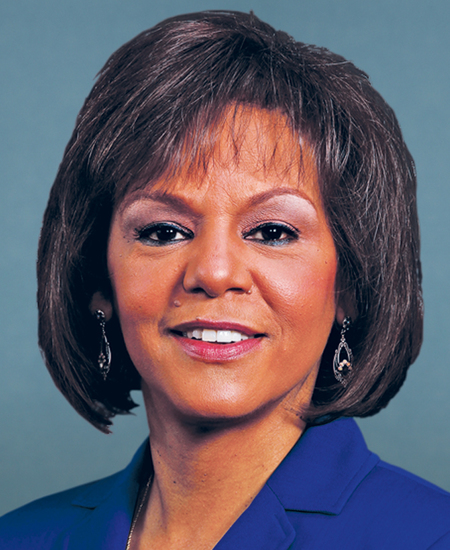
Photo of Robin L. Kelly
D United States House · District 2 · Illinois

Rep. Robin L. Kelly

Compare
Total votes
2,818
all sessions
Attendance
98%
67 missed
Near the chamber average
With party
98%
of cast votes
Higher than 84% of chamber peers
Bipartisan score
1%
crosses aisle rarely
Lower than 84% of chamber peers
Sponsored
1,321
bills & resolutions
Higher than 80% of chamber peers
Committees
4
assignments
1,321 bills and resolutions

Sponsored bills

Total
1,321
Primary
72
Co-sponsor
1,249
This page
1,321
matching current filters
Co-sponsor HR 7564
In committee · Ohio House · Co-sponsor
Jaime’s Law

Maddy summaryHR 7564, "Jaime’s Law," amends federal law to require background checks for ammunition transfers between unlicensed individuals. It mandates that unlicensed people cannot directly buy or receive ammunition; instead, they must go through a licensed dealer who conducts background checks and provides required notices. The bill specifically exempts transfers between family members, law enforcement, temporary safety-related transfers, and certain sporting activities. It does not create a national ammunition registry and leaves state laws intact.

In committee Feb 12, 2026 1 co-sponsor
Primary HR 7500
In committee · Ohio House · Lead sponsor
Responsible Firearms Marketing Act

Maddy summaryHR 7500, the Responsible Firearms Marketing Act, directs the Federal Trade Commission (FTC) to study whether firearm advertising or marketing practices are unfair or deceptive, particularly those targeting minors, implying illegal use, or promoting semiautomatic assault weapons. After a two-year study, the FTC must report to Congress and then create enforceable regulations within 18 months to ban such practices. The law specifically prohibits manufacturers, dealers, and importers from using ads that appeal to people under 18, suggest illegal activity, or market assault weapons. Violations would be enforced under existing FTC authority, treating them as unfair or deceptive acts under current law. This bill directly affects firearm industry marketing practices but does not regulate gun sales or ownership.

In committee Feb 11, 2026 0 co-sponsors
Primary HR 7499
In committee · Ohio House · Lead sponsor
Firearm Safety Act of 2025

Maddy summaryThe Firearm Safety Act of 2025 removes an existing exemption that prevents the Consumer Product Safety Commission from regulating firearms as consumer products. By amending the Consumer Product Safety Act, the bill allows the commission to apply its standard safety rules to guns, similar to how it regulates other household items. This change directly affects manufacturers and sellers of firearms by potentially subjecting them to federal safety standards and testing requirements. The legislation does not alter existing gun laws or create new bans, but rather changes the regulatory framework under which firearm safety is overseen.

In committee Feb 11, 2026 0 co-sponsors
Primary HR 6947
In committee · Ohio House · Lead sponsor
SAFE Exit Act of 2026

Maddy summaryThis bill requires new safety standards for vehicles with electronic door locks, mandating a manual release mechanism for occupants to open doors during emergencies. It directly affects vehicle manufacturers and new car models, requiring them to install an intuitive, power-independent manual release for each door and a way for emergency responders to access the vehicle if electrical power fails. The rulemaking process must be completed within two years of the bill's enactment, with full compliance required by the end of the fourth year. These changes aim to improve emergency egress during power outages or accidents, applying to all new vehicles equipped with electronic door latch systems.

In committee Feb 10, 2026 0 co-sponsors
Co-sponsor HR 7392
In committee · Ohio House · Co-sponsor
To impose a hiring freeze on United States Immigration and Customs Enforcement, and for other purposes.

Maddy summaryThis bill imposes a hiring freeze on U.S. Immigration and Customs Enforcement (ICE), prohibiting the use of federal funds to hire new employees or transfer existing federal workers to ICE. The freeze begins upon the bill's enactment and automatically ends when Congress passes a specific law overriding it. It directly affects ICE's staffing capabilities by halting new appointments and transfers using federal funding. The measure is procedural, focusing solely on restricting hiring authority without altering immigration enforcement policies.

In committee Feb 6, 2026 1 co-sponsor
Co-sponsor HRES 1040
In committee · Ohio House · Co-sponsor
Recognizing the significance of the Greensboro Four sit-in during Black History Month.

Maddy summaryHRES 1040 is a symbolic resolution recognizing the Greensboro Four sit-in during Black History Month. It commemorates the 66th anniversary of the February 1, 1960, sit-in at a Greensboro Woolworth's lunch counter, where four Black students challenged racial segregation. The resolution encourages states to include the Greensboro Four's history and contributions in school curricula. As a non-binding resolution, it has no legal effect but formally honors this pivotal civil rights moment.

In committee Feb 5, 2026 1 co-sponsor
Co-sponsor HR 7347
In committee · Ohio House · Co-sponsor
Stop Inhumane Conditions in ICE Detention Act of 2026

Maddy summaryHR 7347, the *Stop Inhumane Conditions in ICE Detention Act of 2026*, requires all facilities detaining noncitizens under U.S. immigration law - including contracted facilities - to implement real-time health reporting systems for medical, dental, and mental health conditions. It mandates anonymous, multilingual complaint systems for detainees with anti-retaliation protections, annual DHS audits of health conditions (including gender-specific care), and full-time health liaisons at each facility. The bill triggers contract reviews for facilities with three verified health complaints and requires quarterly public reports on conditions and complaints to Congress. These provisions directly affect ICE detention facilities, detainees, and DHS oversight processes, focusing on transparency and accountability in health care.

In committee Feb 5, 2026 1 co-sponsor
Co-sponsor HRES 1039
In committee · Ohio House · Co-sponsor
Supporting the goals and ideals of "National Black HIV/AIDS Awareness Day".

Maddy summaryHRES 1039 is a symbolic resolution supporting National Black HIV/AIDS Awareness Day observed annually on February 7. It highlights that Black Americans account for disproportionate HIV impacts (e.g., 39% of new diagnoses despite representing 12% of the U.S. population) and urges state/local health agencies to promote HIV testing, reduce stigma, and prioritize minority-led HIV services. The resolution encourages alignment with the National HIV/AIDS Strategy and emphasizes culturally competent care, but does not create new funding or enforceable requirements. It serves as a non-binding endorsement of existing efforts to address racial disparities in HIV prevention and treatment.

In committee Feb 4, 2026 1 co-sponsor
Co-sponsor HR 7385
In committee · Ohio House · Co-sponsor
PrEP Assistance Program Act

Maddy summaryHR 7385 establishes a federal grant program to expand access to HIV prevention through PrEP (pre-exposure prophylaxis) for uninsured individuals at high risk of HIV infection. The bill authorizes $400 million annually (2027-2031) to fund grants for eligible entities like clinics, community organizations, and tribal governments to cover PrEP-related costs - including medication, testing, counseling, and transportation - without requiring patient payment. Priority is given to programs serving rural areas, uninsured populations, or high-risk demographic groups, with grantees required to contribute 10% of program costs (except for certain health centers). The program also mandates a "PrEP Pass" card system to streamline access and requires annual reports tracking usage by race, gender, age, and location to measure impact on HIV prevention disparities.

In committee Feb 4, 2026 1 co-sponsor
Co-sponsor HR 7345
In committee · Ohio House · Co-sponsor
Studying Disastrous Impacts of Mass Deportation Act

Maddy summaryHR 7345 directs the Congressional Budget Office (CBO) to study the long-term economic effects of immigration policies implemented beginning January 20, 2025. The CBO must assess impacts across specific sectors (like healthcare, agriculture, STEM fields), public safety concerns, demographic shifts, small business effects, and tax revenue at federal, state, and local levels. Federal agencies - including Homeland Security, the Bureau of Labor Statistics, and the IRS - must provide requested data to support this study. The report must be completed within 180 days of the bill’s enactment or by the end of the current congressional session, whichever comes first. This is a procedural study bill, not a policy change.

In committee Feb 4, 2026 1 co-sponsor
Showing 101 to 110 of 1,321 bills
Previous 1 10 11 12 133 Next