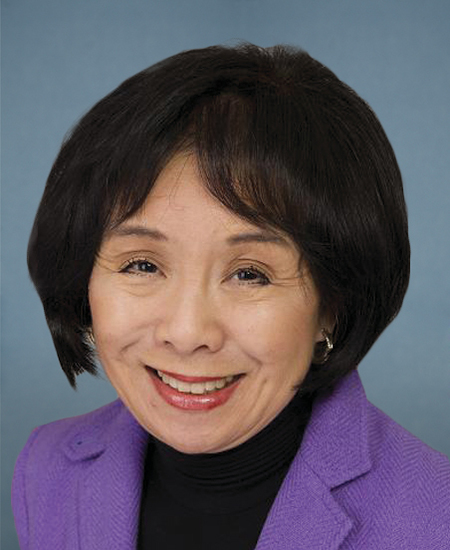
Photo of Doris O. Matsui
D United States House · District 7 · California On the 2026 ballot

Rep. Doris O. Matsui

Compare
Total votes
2,818
all sessions
Attendance
99%
41 missed
Higher than 97% of chamber peers
With party
98%
of cast votes
Near the chamber average
Bipartisan score
1%
crosses aisle rarely
Near the chamber average
Sponsored
1,327
bills & resolutions
Near the chamber average
Committees
3
assignments
1,327 bills and resolutions

Sponsored bills

Total
1,327
Primary
97
Co-sponsor
1,230
This page
1,327
matching current filters
Co-sponsor HR 1085
Passed · Ohio House · Co-sponsor
To award three congressional gold medals to the United States Capitol Police and those who protected the U.S. Capitol on January 6, 2021.

This bill directs the Speaker of the House and the President pro tempore of the Senate to arrange for the award of three Congressional Gold Medals to the U.S. Capitol Police (USCP) and other law enforcement agencies that protected the U.S. Capitol on January 6, 2021. Following the award of these medals, one medal shall be given to the USCP, one medal shall be given to the Metropolitan Police Department of the District of Columbia, and one medal shall be given to the Smithsonian Institution and displayed with a plaque listing all law enforcement agencies that participated in protecting the Capitol on January 6, 2021.

Passed Mar 17, 2021 1 co-sponsor
Co-sponsor HR 5
Passed · Ohio House · Co-sponsor
Equality Act

Equality Act This bill prohibits discrimination based on sex, sexual orientation, and gender identity in areas including public accommodations and facilities, education, federal funding, employment, housing, credit, and the jury system. Specifically, the bill defines and includes sex, sexual orientation, and gender identity among the prohibited categories of discrimination or segregation. The bill expands the definition of public accommodations to include places or establishments that provide (1) exhibitions, recreation, exercise, amusement, gatherings, or displays; (2) goods, services, or programs; and (3) transportation services. The bill allows the Department of Justice to intervene in equal protection actions in federal court on account of sexual orientation or gender identity. The bill prohibits an individual from being denied access to a shared facility, including a restroom, a locker room, and a dressing room, that is in accordance with the individual's gender identity.

Passed Mar 17, 2021 1 co-sponsor
Co-sponsor HR 1879
In committee Mar 16, 2021 1 co-sponsor
Co-sponsor HR 1790
In committee · Ohio House · Co-sponsor
Fair Indexing for Health Care Affordability Act

Fair Indexing for Health Care Affordability Act This bill revises the method for determining the annual per capita change in health insurance premiums for the purpose of determining the premium adjustment percentage that is used to establish the annual limits on cost sharing for health insurance plans.

In committee Mar 16, 2021 1 co-sponsor
Co-sponsor HR 1015
In committee · Ohio House · Co-sponsor
Water Recycling Investment and Improvement Act

Water Recycling Investment and Improvement Act This bill makes permanent, and otherwise revises, the Bureau of Reclamation's grant program for the funding of water recycling and reuse projects. Specifically, the bill removes priority under the program for projects in areas that, in the preceding four-year period, have been (1) identified as experiencing severe, extreme, or exceptional drought; or (2) designated as a disaster area by a state. Additionally, the bill increases through FY2025 the authorization of appropriations for the program and otherwise revises provisions related to program funding.

In committee Mar 15, 2021 1 co-sponsor
Co-sponsor HR 842
Passed · Ohio House · Co-sponsor
Protecting the Right to Organize Act of 2021

Protecting the Right to Organize Act of 20 21 This bill expands various labor protections related to employees' rights to organize and collectively bargain in the workplace. Among other things, it (1) revises the definitions of employee , supervisor , and employer to broaden the scope of individuals covered by the fair labor standards; (2) permits labor organizations to encourage participation of union members in strikes initiated by employees represented by a different labor organization (i.e., secondary strikes); and (3) prohibits employers from bringing claims against unions that conduct such secondary strikes. The bill also allows collective bargaining agreements to require all employees represented by the bargaining unit to contribute fees to the labor organization for the cost of such representation, notwithstanding a state law to the contrary; and expands unfair labor practices to include prohibitions against replacement of, or discrimination against, workers who participate in strikes. The bill makes it an unfair labor practice to require or coerce employees to attend employer meetings designed to discourage union membership and prohibits employers from entering into agreements with employees under which employees waive the right to pursue or a join collective or class-action litigation. The bill further prohibits employers from taking adverse actions against an employee, including employees with management responsibilities, in response to that employee participating in protected activities related to the enforcement of the prohibitions against unfair labor practices (i.e., whistleblower protections). Such protected activities include providing information about a potential violation to an enforcement agency, participating in an enforcement proceeding, initiating a proceeding concerning an alleged violation or assisting in such a proceeding, or refusing to participate in an activity the employee reasonably believes is a violation of labor laws. Finally, the bill addresses the procedures for union representation elections, provides employees with the ability to vote in such elections remotely by telephone or the internet, modifies the protections against unfair labor practices that result in serious economic harm, and establishes penalties and permits injunctive relief against entities that fail to comply with National Labor Relations Board orders.

Passed Mar 11, 2021 1 co-sponsor
Co-sponsor HR 1
Passed · Ohio House · Co-sponsor
For the People Act of 2021

For the People Act of 2021 This bill addresses voter access, election integrity and security, campaign finance, and ethics for the three branches of government. Specifically, the bill expands voter registration (e.g., automatic and same-day registration) and voting access (e.g., vote-by-mail and early voting). It also limits removing voters from voter rolls. The bill requires states to establish independent redistricting commissions to carry out congressional redistricting. Additionally, the bill sets forth provisions related to election security, including sharing intelligence information with state election officials, supporting states in securing their election systems, developing a national strategy to protect U.S. democratic institutions, establishing in the legislative branch the National Commission to Protect United States Democratic Institutions, and other provisions to improve the cybersecurity of election systems. Further, the bill addresses campaign finance, including by expanding the prohibition on campaign spending by foreign nationals, requiring additional disclosure of campaign-related fundraising and spending, requiring additional disclaimers regarding certain political advertising, and establishing an alternative campaign funding system for certain federal offices. The bill addresses ethics in all three branches of government, including by requiring a code of conduct for Supreme Court Justices, prohibiting Members of the House from serving on the board of a for-profit entity, and establishing additional conflict-of-interest and ethics provisions for federal employees and the White House. The bill requires the President, the Vice President, and certain candidates for those offices to disclose 10 years of tax returns.


Passed Mar 11, 2021 1 co-sponsor
Co-sponsor HR 1730
In committee · Ohio House · Co-sponsor
Speeding Therapy Access Today Act of 2021

Speeding Therapy Access Today Act of 2021 This bill requires and authorizes various actions to accelerate the development of therapies for rare diseases. The Food and Drug Administration (FDA) shall establish the Intercenter Institute on Rare Diseases and Conditions. The institute shall (1) coordinate engagement with relevant stakeholders, (2) build the FDA's expertise in the review of medical products to treat rare diseases, (3) coordinate regulatory science initiatives related to rare diseases, (4) establish and implement a program to make recommendations to address challenges associated with developing medical products to treat rare diseases in an individual or in very small populations, (5) convene a stakeholder meeting to consider potential amendments to labels for medical products to treat rare diseases, and (6) establish and carry out a program to facilitate voluntary communication between the sponsors of such medical products and third-party payers (e.g., insurance companies). The bill also authorizes the FDA to make grants to assist in developing practices related to the development and production of individualized therapies or therapies to treat very small populations. The bill also establishes an advisory committee to advise the FDA on issues related to the development of therapies to treat rare diseases.

In committee Mar 10, 2021 1 co-sponsor
Co-sponsor HR 1696
In committee · Ohio House · Co-sponsor
Air Carrier Access Amendments Act of 2021

Air Carrier Access Amendments Act of 2021 This bill expands provisions prohibiting discrimination against disabled individuals by an air carrier. Specifically, it enumerates certain actions that an air carrier must take or may not take with respect to a disabled individual. It also requires the Department of Transportation (DOT) to ensure that disabled individuals traveling in air transportation are able to file complaints with DOT in response to disability-related discrimination and receive assistance from DOT through a hotline or comparable electronic means. The bill authorizes an aggrieved individual and the Department of Justice to bring a civil action for discrimination. The Architectural and Transportation Barriers Compliance Board shall prescribe regulations setting forth minimum standards for aircraft with new or existing type certificates to ensure the accessibility of individuals with disabilities, including those who use wheelchairs. The standards shall address, among other things, boarding and deplaning equipment, seating accommodations, lavatories, visually accessible announcements, and proper stowage of assistive devices in the cargo hold to prevent damage.

In committee Mar 10, 2021 1 co-sponsor
Co-sponsor HR 1694
In committee · Ohio House · Co-sponsor
Stop Militarizing Law Enforcement Act

Stop Militarizing Law Enforcement Act This bill restricts the Department of Defense (DOD) from transferring certain surplus military property to federal, state, or local law enforcement agencies. Specifically, DOD may not transfer to such agencies specified property such as controlled firearms, ammunition, grenade launchers, explosives, certain vehicles or trucks, armored or weaponized drones, certain controlled aircraft, silencers, or long-range acoustic devices. DOD may waive this limitation and transfer certain vehicles or trucks if DOD determines that the transfer is necessary for disaster or rescue purposes or for another purpose where life and public safety are at risk. As a condition for a transfer of allowable property, DOD must require the federal or state agency that receives the property to return the property if the agency is investigated by the Department of Justice for civil liberties violations or is otherwise found to have engaged in widespread abuses of civil liberties. DOD must also periodically submit certain transfer-related information and certifications to Congress. Furthermore, as a condition for transfer, the recipient must receive the approval of its local governing body, provide specified notice to the local community, and submit specified information and certifications to DOD. A federal or state agency that receives controlled property under such a transfer may never take ownership of the property. The bill also eliminates the requirement for DOD to give preference to transfers of property that will be used in counter-drug, counterterrorism, disaster-related emergency preparedness, or border security activities.

In committee Mar 9, 2021 1 co-sponsor
Showing 1,241 to 1,250 of 1,327 bills