

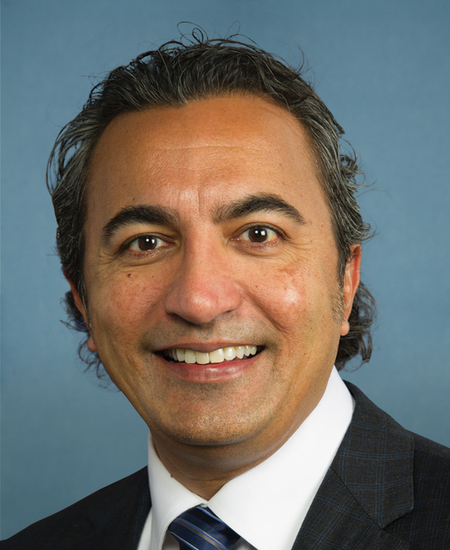
Photo of Ami Bera
D United States House · District 6 · California On the 2026 ballot

Rep. Ami Bera

Compare
Total votes
2,837
all sessions
Attendance
98%
52 missed
Near the chamber average
With party
98%
of cast votes
Near the chamber average
Bipartisan score
1%
crosses aisle rarely
Near the chamber average
Sponsored
987
bills & resolutions
Near the chamber average
Committees
6
assignments
987 bills and resolutions

Sponsored bills

Total
987
Primary
69
Co-sponsor
918
This page
987
matching current filters
Co-sponsor HR 5263
In committee · Ohio House · Co-sponsor
To require approval from the Secretary of Housing and Urban Development for any Federal manufactured home and safety standards, and for other purposes.

Maddy summaryThis bill gives the Secretary of Housing and Urban Development (HUD) primary authority to set federal safety and construction standards for manufactured homes. Federal agencies seeking to establish new standards must first submit proposals to HUD for approval and cannot implement them without that approval. HUD may reject proposed standards if they would significantly raise production costs, conflict with existing HUD standards, or for other reasons deemed appropriate. The bill directly affects manufactured home manufacturers (due to potential cost impacts) and federal agencies (requiring pre-approval for new standards).

In committee Sep 10, 2025 1 co-sponsor
Co-sponsor HR 5269
In committee · Ohio House · Co-sponsor
RESULTS Act

Maddy summaryThe RESULTS Act (HR 5269) changes how Medicare calculates payment rates for clinical diagnostic laboratory tests. It requires Medicare to collect data on private payor rates for widely available non-Advanced Diagnostic Laboratory Tests (non-ADLTs) from a qualifying independent claims data entity (a national nonprofit organization meeting specific criteria) rather than relying on data reported directly by laboratories. For tests where data is unavailable, the bill establishes default payment rates based on previous years' rates adjusted for inflation. The law also requires Medicare to publicly explain payment rates with supporting data, affecting Medicare beneficiaries, clinical laboratories, and private payors that provide services covered by Medicare.

In committee Sep 10, 2025 1 co-sponsor
Co-sponsor HR 5271
In committee · Ohio House · Co-sponsor
Pakistan Freedom and Accountability Act

Maddy summaryThis bill directs the U.S. President to identify Pakistani officials responsible for undermining democracy and human rights within 180 days of enactment, then impose Global Magnitsky sanctions on them. It targets senior government, military, or security officials found to have committed gross human rights violations or interfered with democratic processes, such as during Pakistan’s 2024 elections or through constitutional changes. Sanctions would include asset freezes and travel bans, with exceptions for humanitarian aid, UN obligations, and national security activities. The bill expires on September 30, 2030, and aims to pressure Pakistan to uphold democratic norms, human rights, and judicial independence.

In committee Sep 10, 2025 1 co-sponsor
Co-sponsor HR 5141
In committee · Ohio House · Co-sponsor
Stop the Rate Hikes Act

Maddy summaryHR 5141, the "Stop the Rate Hikes Act," limits electric utilities to requesting a single rate increase per year. This bill directly affects electric utilities by restricting how often they can seek higher rates from customers. The key provision amends the Public Utility Regulatory Policies Act of 1978 to require that each utility submit no more than one rate increase request annually. The policy change aims to reduce frequent rate adjustments for consumers, applying specifically to retail utility rates.

In committee Sep 4, 2025 1 co-sponsor
Co-sponsor HR 5106
In committee · Ohio House · Co-sponsor
Restore Trust in Congress Act

Maddy summaryThis bill prohibits Members of Congress, their spouses, and dependent children from owning or trading certain investments, including stocks, commodities, and derivatives (referred to as "covered investments"). It requires affected individuals to divest these investments within 90-180 days, with specific exemptions for Treasury bonds, diversified mutual funds, small business interests, and family trusts meeting strict conditions. Violations incur penalties of 10% of the investment's value plus disgorgement of profits, paid directly to the U.S. Treasury. The law applies to all covered individuals during federal service, with exceptions for investments acquired through inheritance or occupational trading (e.g., a spouse’s finance job).

In committee Sep 3, 2025 1 co-sponsor
Co-sponsor HR 2635
Passed · Ohio House · Co-sponsor
Uyghur Policy Act of 2025

Maddy summaryThis bill is a congressional resolution expressing U.S. policy priorities regarding Xinjiang. It urges China to open Xinjiang to international access, cease repression of Uyghurs and other minorities, release specific detained individuals (including Ekper Asat, Dr. Gulshan Abbas, and Kamile Wayit), and stop transnational repression against Uyghur families abroad. The bill directs the State Department to coordinate U.S. policy on Uyghur issues, prioritize support for Uyghur communities, establish reporting mechanisms for transnational repression, and develop strategies to pressure China on detention facilities. It also requires U.S. diplomatic posts in China to have Uyghur-language capabilities and directs U.S. advocacy at the United Nations to address human rights concerns.

Passed Sep 3, 2025 1 co-sponsor
Co-sponsor HR 5077
In committee · Ohio House · Co-sponsor
Strengthening Housing Supply Act of 2025

Maddy summaryHR 5077, the Strengthening Housing Supply Act of 2025, amends the Community Development Block Grant (CDBG) Program to allow local governments and community organizations to use CDBG funds for the **new construction of affordable housing**. This directly affects communities receiving CDBG funding by expanding eligible uses beyond rehabilitation to include building new homes meeting federal affordability standards. The key change adds "new construction of affordable housing" as a permitted activity under the CDBG program, referencing existing definitions from the Cranston-Gonzalez Act. The bill applies only to funds appropriated after its enactment, not to current or past allocations.

In committee Aug 29, 2025 1 co-sponsor
Co-sponsor HR 5045
In committee · Ohio House · Co-sponsor
HEALTH AI Act

Maddy summaryThis bill establishes a federal grant program to fund research on using generative AI in healthcare. The Secretary of Health and Human Services will award grants to eligible entities like universities, non-profits, and government agencies to study how AI can improve clinical documentation, reduce administrative burdens, speed up insurance claims, and enhance patient service. Grants prioritize projects focused on reducing clinician burnout, addressing health disparities, and expanding care for medically underserved populations. The law aims to support practical AI applications that make healthcare more efficient and accessible without mandating specific technologies or outcomes.

In committee Aug 26, 2025 1 co-sponsor
Co-sponsor HR 5022
In committee · Ohio House · Co-sponsor
No Advanced Chips for the CCP Act of 2025.

Maddy summaryThis bill would require U.S. companies to obtain both Commerce Department approval and a specific congressional joint resolution before exporting advanced AI semiconductors to China. The Commerce Secretary must first conduct an interagency review assessing national security risks, military applications, human rights concerns, and economic impacts. Congress would then need to pass a dedicated resolution approving each export, effectively giving lawmakers a veto over such transactions. The bill defines "advanced AI semiconductors" by technical thresholds (e.g., 2,400+ processing performance) and applies to all exports targeting China, including Hong Kong and Macau.

In committee Aug 22, 2025 1 co-sponsor
Co-sponsor HR 4995
In committee · Ohio House · Co-sponsor
Enduring Welcome Act of 2025

Maddy summaryThis bill permanently establishes the Coordinator for Afghan Relocation Efforts (CARE) within the State Department, expanding their role to prioritize family reunification for U.S. military personnel and veterans with Afghan allies. It mandates the Coordinator to collect detailed data on Afghan applicants (including special immigrant visa seekers, refugees, and parolees), vetting timelines, and pending family reunification cases into a centralized database. The Coordinator must report this data to Congress every 90 days to ensure transparency and inform policy decisions. The law directly affects Afghan allies and their families seeking U.S. relocation, particularly those connected to U.S. military service.

In committee Aug 19, 2025 1 co-sponsor
Showing 161 to 170 of 987 bills
Previous 1 16 17 18 99 Next