

Maddy summaryThis bill authorizes the North Carolina Division of Motor Vehicles to create a special license plate called the 'America's Semiquincentennial' plate. The plate will feature the phrase 'America 250' and other designs to celebrate the 250th anniversary of the United States. Any registered vehicle owner in the state will be eligible to purchase this plate starting on July 1, 2026.
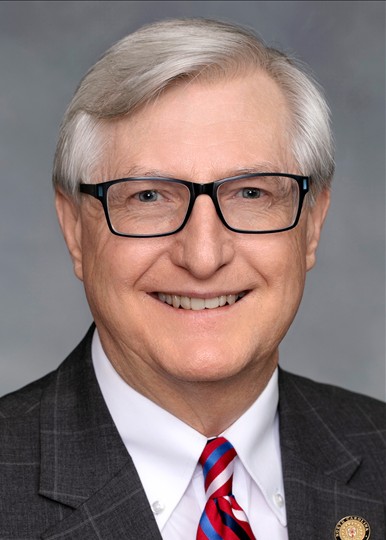
Sen. Ted Alexander
Sponsored bills
Maddy summaryThis North Carolina bill directs the Department of Health and Human Services to provide new luggage, such as suitcases or backpacks, to children entering or currently in the foster care system when they are removed from a household. The legislation appropriates specific funds for this purpose and allows the department to accept additional donations, while explicitly defining new luggage as unused containers and excluding disposable bags. To ensure accountability, the bill requires an annual report detailing how often disposable bags are still used and how the new luggage inventory is managed. These changes take effect on July 1, 2026, aiming to improve the personal belongings provided to children in state care.
Maddy summaryThis bill authorizes the North Carolina Department of Natural and Cultural Resources to create the First Broad River State Trail in Cleveland and Rutherford Counties. The trail would connect the river's headwaters in Golden Valley to its confluence with the Broad River, linking communities like Shelby and Zion while aiming to increase public access points. The legislation allows the state to use existing funds from various conservation sources to acquire land and develop the trail, rather than requiring new budget appropriations. Additionally, the bill allocates $25,000 in 2026-2027 for planning and public education efforts related to the project.
Maddy summaryThis bill authorizes the North Carolina Commissioner of Motor Vehicles to negotiate agreements allowing drivers from foreign nations to obtain licenses in the state. It specifically directs officials to evaluate whether Taiwan has comparable driver testing standards and, if so, to negotiate a memorandum of understanding for exchanging noncommercial driver licenses by January 1, 2027. The legislation also allocates $5,000 to fund a public awareness campaign about these new reciprocity options and requires a progress report to be submitted by October 1, 2027.
Maddy summarySB 50, "Freedom to Carry NC," allows most North Carolina residents aged 18 or older (who are U.S. citizens) to carry concealed handguns without a permit, while maintaining existing permit options for reciprocity. The bill prohibits concealed carry for individuals with certain felony convictions, domestic violence misdemeanors, active warrants, or specific mental health or substance use conditions. It also requires carrying valid ID and disclosing concealed weapons to law enforcement upon request. Additional provisions include increased penalties for assaults on first responders, new offenses for felons discharging firearms during crimes, and expanded benefits for law enforcement families. The bill does not change current restrictions on carrying firearms in sensitive locations like schools or government buildings.
Maddy summarySB 249 proposes redrawing the state's congressional district boundaries to reflect new census data, directly affecting voters in those districts for the 2025 elections. The bill would establish a new map for congressional representation in the 2025 election cycle based on updated population data. It is currently pending in the Senate after being filed and passing its first reading, though it was recently withdrawn from committee. This is a procedural redistricting bill focused on boundary changes, not substantive policy.
Maddy summarySB 55 creates a fast-track court process for property owners or their authorized representatives (like real estate brokers) to remove people occupying residential property without legal right, such as squatters. To qualify, the owner must prove the occupant has no lease, hasn't paid rent, and wasn't invited, while excluding tenants who stayed past their lease term. The process requires a hearing within 48 hours of filing, with removal ordered within 4 hours of the court decision. An appeal requires a $10,000 bond and allows a full trial in district court.
Maddy summarySB 416, the Personal Privacy Protection Act, prohibits North Carolina public agencies from collecting, disclosing, or releasing personal information about members, volunteers, or donors (financial or nonfinancial) to 501(c) nonprofit organizations. It directly affects individuals who support nonprofits, shielding their identities from public agency records. Key provisions ban agencies from requiring such information, publicly sharing it, or asking contractors/grantees for lists of nonprofit supporters. The bill designates this information as non-public under state law, with limited exemptions for court orders, required disclosures, or voluntary releases by the individual.
Maddy summaryThis bill requires North Carolina courts to treat judgments from Catawba Nation tribal courts as valid as out-of-state court orders. It clarifies that counties must have written agreements with the Catawba Nation to provide services on tribal trust lands, beyond basic public health or human services. The bill also authorizes Catawba tribal police to enforce laws within tribal boundaries under specific state statutes, aligning their authority with local law enforcement standards.
Maddy summarySB 124 aims to make North Carolina state government hiring more accessible by reducing unnecessary barriers. It requires the State Human Resources Commission to review job requirements starting October 2025, removing mandatory four-year degree requirements where practical experience (like military service or trade school) is sufficient. The bill also modernizes the application process by allowing resume uploads to auto-fill forms and simplifies job postings to limit additional qualifications to five, ensuring applicants clearly see basic requirements. These changes apply to all state agencies hiring staff, directly affecting job seekers and hiring managers across North Carolina's government workforce.